
Stöbern
genialokal zum Startbildschirm hinzufügen
Installieren Sie die genialokal App auf Ihrem Startbildschirm für einen schnellen Zugriff und eine komfortable Nutzung.
Installieren Sie die genialokal App auf Ihrem Startbildschirm für einen schnellen Zugriff und eine komfortable Nutzung.
Tippen Sie einfach auf Teilen:
 Und dann auf "Zum Home-Bildschirm [+]".
Bei genialokal.de kaufen Sie online bei Ihrer lokalen, inhabergeführten Buchhandlung!
Ihr gewünschter Artikel ist in 0 Buchhandlungen vorrätig - wählen Sie hier eine Buchhandlung in Ihrer Nähe aus:

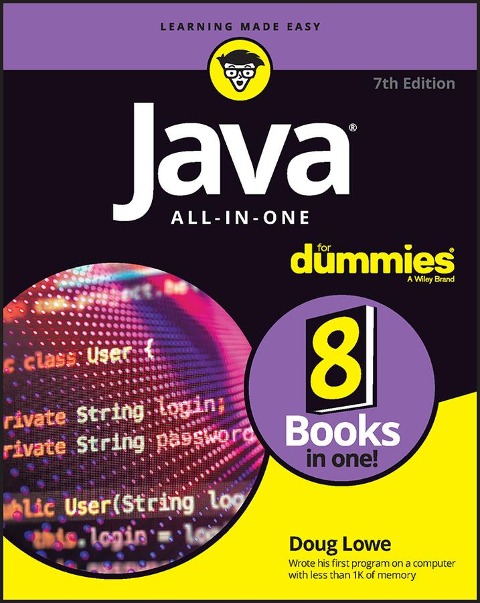

Get started writing Java® code-the easy way Java® code is the go-to language for developing Android apps and all sorts of other things. With Java All-in-One For Dummies, you can write your first lines of code in Java and work your way to advanced stuff like Internet of Things (IoT) programming, JavaFX, and Java for the web. Easy-to-follow instructions, fun practice, and a time-tested instructional approach will shorten your learning journey. With eight mini-books in one, consider this the only Java book you'll need as your take your knowledge to the next level, and the next, and the next. 8 Mini-books Inside... - Java Basics - Programming Basics - Object-Oriented Programming - Strings and Other Data Types - Data Structures - Algorithms - Programming Techniques - JavaFX
Doug Lowe is an accomplished technology writer of more than 30 books. He is a tech guru on all things computer programming. His expertise covers networking, Microsoft® Office, programming, and computer building. He is the author of the previous edition of Java All-in-One For Dummies.
Introduction 1 Book 1: Java Basics 5 Chapter 1: Welcome to Java 7 Chapter 2: Installing and Using Java Tools 17 Chapter 3: Working with TextPad 31 Book 2: Programming Basics 37 Chapter 1: Java Programming Basics 39 Chapter 2: Working with Variables and Data Types 59 Chapter 3: Working with Numbers and Expressions 97 Chapter 4: Making Choices 127 Chapter 5: Going Around in Circles (or, Using Loops) 149 Chapter 6: Pulling a Switcheroo 177 Chapter 7: Adding Some Methods to Your Madness 195 Chapter 8: Handling Exceptions 215 Book 3: Object-Oriented Programming 237 Chapter 1: Understanding Object-Oriented Programming 239 Chapter 2: Making Your Own Classes 253 Chapter 3: Working with Statics 273 Chapter 4: Using Subclasses and Inheritance 283 Chapter 5: Using Abstract Classes and Interfaces 305 Chapter 6: Using the Object and Class Classes 327 Chapter 7: Using Inner Classes and Anonymous Classes 355 Chapter 8: Working with Packages and the Java Module System 365 Book 4: Strings and Other Data Types 387 Chapter 1: Working with Strings 389 Chapter 2: Using Regular Expressions 411 Chapter 3: Working with Dates and Times 429 Chapter 4: Using the BigDecimal Class 451 Book 5: Data Structures 471 Chapter 1: Introducing Data Structures 473 Chapter 2: Using Arrays 503 Chapter 3: Using the ArrayList Class 535 Chapter 4: Using the LinkedList Class 549 Chapter 5: Creating Generic Collection Classes 561 Chapter 6: Using Maps and Trees 575 Book 6: Algorithms 595 Chapter 1: Introducing Algorithms 597 Chapter 2: Using Recursion 613 Chapter 3: Sorting 625 Chapter 4: Searching 637 Book 7: Programming Techniques 657 Chapter 1: Programming Threads 659 Chapter 2: Using Functional Programming and Lambda Expressions 689 Chapter 3: Consuming Web Services with HttpClient 705 Book 8: JavaFX 727 Chapter 1: Hello, JavaFX! 729 Chapter 2: Handling Events 751 Chapter 3: Setting the Stage and Scene Layout 769 Chapter 4: Using Layout Panes to Arrange Your Scenes 791 Chapter 5: Getting Input from the User 825 Chapter 6: Choosing from a List 841 Index 869