Und dann auf "Zum Home-Bildschirm [+]".

Stöbern
genialokal zum Startbildschirm hinzufügen
Installieren Sie die genialokal App auf Ihrem Startbildschirm für einen schnellen Zugriff und eine komfortable Nutzung.
Installieren Sie die genialokal App auf Ihrem Startbildschirm für einen schnellen Zugriff und eine komfortable Nutzung.
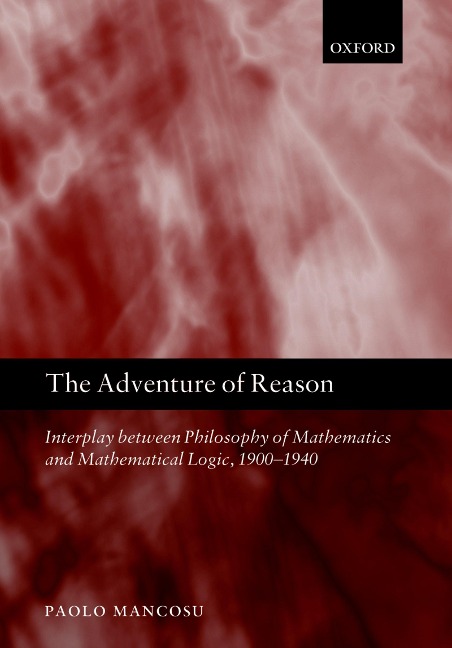
Paolo Mancosu presents a series of innovative studies in the history and the philosophy of logic and mathematics in the first half of the twentieth century. The Adventure of Reason is divided into five main sections: history of logic (from Russell to Tarski); foundational issues (Hilbert's program, constructivity, Wittgenstein, Gödel); mathematics and phenomenology (Weyl, Becker, Mahnke); nominalism (Quine, Tarski); semantics (Tarski, Carnap, Neurath). Mancosu exploits extensive untapped archival sources to make available a wealth of new material that deepens in significant ways our understanding of these fascinating areas of modern intellectual history. At the same time, the book is a contribution to recent philosophical debates, in particular on the prospects for a successful nominalist reconstruction of mathematics, the nature of finitist intuition, the viability of alternative definitions of logical consequence, and the extent to which phenomenology can hope to account for the exact sciences.
Paolo Mancosu is Professor of Philosophy at University of California Berkeley. His main interests are in logic, history and philosophy of mathematics, and history and philosophy of logic.
- Preface - Part 1: History of Logic - 1: The Development of Mathematical Logic from Russell to Tarski, 1900-1935 - Oart 2: Foundations of Mathematics - 2: Hilbert and Bernays on Metamathematics - 3: Between Russell and Hilbert: Behmann on the foundations of mathematics - 4: The Russellian influence on Hilbert and his school - 5: On the constructivity of proofs - 6: Wittgenstein's constructivization of Euler's proof of the infinitude of primes - 7: Between Vienna and Berlin: The immediate reception of Gödel's incompleteness theorems - 8: Essay Review of Gödel's Collected Works (volumes IV and V) - Part 3: Phenomenology and Mathematics - 9: Hermann Weyl: Predicativity and an intuitionistic excursion - 10: Mathematics and Phenomenology: the correspondence between O. Becker and H. Weyl - 11: Geometry, Physics and Phenomenology: Four letters of O. Becker to H. Weyl - 12: Das Abenteuer der Vernunft: O. Becker and D. Mahnke on the phenomenological foundation of the exact sciences - Part 4: Nominalism - 13: Harvard 1940-1941: Tarski, Carnap and Quine on a finitist language of mathematics for science - 14: Quine and Tarski on nominalism - Part 5: The emergence of semantics: truth and logical consequence - 15: Neurath and Kokoszynska on the semantic conception of truth - 16: Tarski on models and logical consequence - 17: Tarski on Categoricity and Completeness: an unpublished lecture from 1940 - 18: Archival Appendix. "On the completeness and categoricity of deductive theories" (1940), By Alfred Tarski. - Bibliography
Dieses eBook wird im PDF-Format geliefert und ist mit einem Adobe Kopierschutz (DRM) versehen. Sie können dieses eBook mit allen Geräten lesen, die das PDF-Format und den Adobe Kopierschutz (DRM) unterstützen.
Zum Beispiel mit den folgenden Geräten:
• tolino Reader
Laden Sie das eBook direkt über den Reader-Shop auf dem tolino herunter oder übertragen Sie das eBook auf Ihren tolino mit einer kostenlosen Software wie beispielsweise Adobe Digital Editions.
• Sony Reader & andere eBook Reader
Laden Sie das eBook direkt über den Reader-Shop herunter oder übertragen Sie das eBook mit der kostenlosen Software Sony READER FOR PC/Mac oder Adobe Digital Editions auf ein Standard-Lesegeräte mit epub- und Adobe DRM-Unterstützung.
• Tablets & Smartphones
Möchten Sie dieses eBook auf Ihrem Smartphone oder Tablet lesen, finden Sie hier unsere kostenlose Lese-App für iPhone/iPad und Android Smartphone/Tablets.
• PC & Mac
Lesen Sie das eBook direkt nach dem Herunterladen mit einer kostenlosen Lesesoftware, beispielsweise Adobe Digital Editions, Sony READER FOR PC/Mac oder direkt über Ihre eBook-Bibliothek in Ihrem Konto unter „Meine eBooks“ - „online lesen“.
Schalten Sie das eBook mit Ihrer persönlichen Adobe ID auf bis zu sechs Geräten gleichzeitig frei.
Bitte beachten Sie, dass die Kindle-Geräte das Format nicht unterstützen und dieses eBook somit nicht auf Kindle-Geräten lesbar ist.