
Stöbern
genialokal zum Startbildschirm hinzufügen
Installieren Sie die genialokal App auf Ihrem Startbildschirm für einen schnellen Zugriff und eine komfortable Nutzung.
Installieren Sie die genialokal App auf Ihrem Startbildschirm für einen schnellen Zugriff und eine komfortable Nutzung.
Tippen Sie einfach auf Teilen:
 Und dann auf "Zum Home-Bildschirm [+]".
Bei genialokal.de kaufen Sie online bei Ihrer lokalen, inhabergeführten Buchhandlung!
Ihr gewünschter Artikel ist in 0 Buchhandlungen vorrätig - wählen Sie hier eine Buchhandlung in Ihrer Nähe aus:

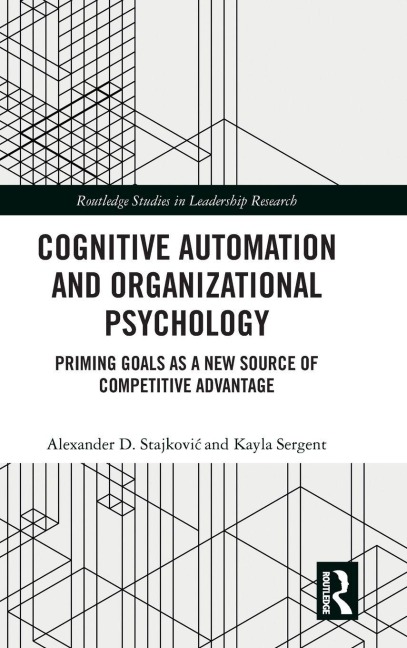
Stajkovi- and Sergent refute the common assumption that technological automation is the only way forward. Instead, they directly tackle the issue of employee cognitive overload by proposing cognitive automation as an alternative solution.
Alex Stajkovi- is the M. Keith Weikel Distinguished Chair in Leadership and Professor of Organizational Behavior at the University of Wisconsin-Madison. Alex earned both his Masters and Ph.D. in Organizational Behavior from the University of Nebraska-Lincoln. Alex's research has been featured in the New York Times, Elle Magazine, and BizEd, as well as premier journals in Organizational Behavior and Psychology, such as Academy of Management Journal, Journal of Applied Psychology, Organizational Behavior and Human Decision Processes, Personnel Psychology, and Psychological Bulletin. He has taught Organizational Behavior in the Executive and Evening MBA programs, as well as in the doctoral program, at the Wisconsin School of Business for 20 years. Alex has given over 100 presentations, invited talks, and has consulted globally. For more information see his website: www.stajkovic.biz Kayla Sergent is Assistant Professor of Management at Edgewood College. Kayla earned her Ph.D. in Organizational Behavior from the University of Wisconsin-Madison. Kayla's research has been published in Journal of Business and Psychology, Applied Psychology: An International Review, Personality and Individual Differences, and Journal of Occupational and Organizational Psychology. She teaches Organizational Behavior in the Evening MBA and undergraduate programs at Edgewood College. Kayla has consulted on transformational leadership, creativity, and organizational culture. For more information see her website: www.sergent.biz
Introduction Part I: The Problem and Proposed Solution Chapter 1: Skyrocketing Cognitive Load Versus the Snail's Pace of Attentional Adaptation Part II: Theory Foundations Chapter 2: Self-Regulation Guided by Conscious Goals Chapter 3: Subconscious Processing and Cognitive Automation Chapter 4: Four Conceptual Models of Goal Priming Part III: The Latest Empirical Research Chapter 5: Organizational Behavior Research on Priming Goals Guided by the Auto-Motive Model: Evidence from 15 Studies Chapter 6: Organizational Behavior Research on Priming Goals Guided by the Goal Contagion Model Chapter 7: Organizational Behavior Research on Priming Self-Efficacy as a Means-to-a-Goal Chapter 8: Organizational Behavior Research on Priming Goals by History of Reinforcement Chapter 9: Limitations, Methods, and Future Research Chapter 10: Application: Is Priming Ready for Prime Time The Past is Prologue Author Biographies Index