Und dann auf "Zum Home-Bildschirm [+]".

Stöbern
genialokal zum Startbildschirm hinzufügen
Installieren Sie die genialokal App auf Ihrem Startbildschirm für einen schnellen Zugriff und eine komfortable Nutzung.
Installieren Sie die genialokal App auf Ihrem Startbildschirm für einen schnellen Zugriff und eine komfortable Nutzung.
Ihr gewünschter Artikel ist in 0 Buchhandlungen vorrätig - wählen Sie hier eine Buchhandlung in Ihrer Nähe aus:

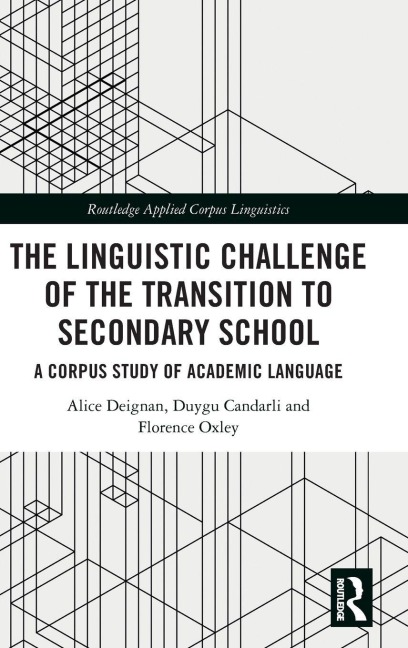
This book provides a unique analysis and description of the linguistic challenges faced by school students as they move from primary to secondary school, a major transition, which some students struggle with emotionally and academically.
Alice Deignan is Professor of Applied Linguistics in the School of Education, University of Leeds. She is the author of 'Metaphor and Corpus Linguistics' (2005, John Benjamins), and 'Figurative Language, Genre and Register' (2013, CUP, with Elena Semino and Jeannette Littlemore). Duygu Candarli is currently Lecturer in Language Education at the University of Dundee. She specialises in academic discourse, corpus linguistics, second language writing, and writing assessment. She has published research articles on these areas in international peer-reviewed journals. Florence Oxley is a Research Assistant in the School of Education, University of Leeds and a PhD candidate in Linguistics, University of York. She is interested in corpus linguistics, literacy, and first language acquisition, and has published on infant phonological development.
List of figures Acknowledgements 1 Schools, the transition, students, and teachers Alice Deignan, ORCiD: 0000-0002-9156-9168 Introduction The transition and the context of this research Issues at transition Social, psychological, and emotional issues Academic issues Language and the transition The voices of children in our project schools Aims of this book 2 Academic language and the school transition Alice Deignan, ORCiD: 0000-0002-9156-9168 Perspectives on the language of school Bernstein's language codes and the language of school The Systemic-Functional Linguistics Approach BICS and CALP CALS Academic language and function Academic language and social prestige Function: academic language to facilitate and express academic thought Register and genre Features of academic language Overview Disciplinary language The vocabulary of school Polysemy and homonymy Tiers Grammar and discourse Specific issues at transition Conclusion 3 Corpus data and methods Duygu Candarli, ORCiD: 0000-0001-9965-7835 Introduction Constructing our corpus Characteristics of our partner schools Corpus design and representativeness The written corpus Representativeness and data gathering Composition of the written corpus Sub-registers The spoken corpus Corpus analytical methods used Quantitative data analysis procedures Multi-dimensional Analysis Mixed and qualitative data analysis Conclusion 4 Written school language registers and the transition Duygu Candarli, ORCiD: 0000-0001-9965-7835 Introduction The corpus Analytical Steps Statistical analysis Multi-dimensional analysis of school language registers Dimension 1: Involved versus informational discourse Dimension 2: Narrative versus non-narrative discourse Dimension3: Explicit versus situation-dependent discourse Dimension 4: Overt expression of persuasion Dimension 5: Impersonal versus non-impersonal style Discussion Conclusion 5 The language of English at the transition Alice Deignan, ORCiD: 0000-0002-9156-9168 Florence Oxley, ORCiD: 0000-0002-6518-1717 Introduction The KS2 and KS3 curricula Assessment Reading in Years 5-8 Reading for pleasure Making inferences Understanding genre, purpose, and audience; criticality Writing in Years 5-8 Understanding genre, purpose, and audience Language and metalanguage in Years 5-8 Vocabulary Grammar teaching Corpus studies of the language of English in Years 5-8 Method The corpora used Frequent word analysis Keyword analysis Results Word frequency: aboutness Keywords Conclusion 6 The language of science at the transition Alice Deignan, ORCiD: 0000-0002-9156-9168 Florence Oxley, ORCiD: 0000-0002-6518-1717 Introduction The KS2 and KS3 curricula Language and learning science at school Scientific thinking and the language of science School science, language, and socio-economic status Features of the language of school science Discourse Grammar Vocabulary Polysemy Method The corpora Focus and tools Results Frequent words Aboutness Keywords Polysemy Conclusion 7 The language of mathematics at the transition Duygu Candarli, ORCiD: 0000-0001-9965-7835 Florence Oxley, ORCiD: 0000-0002-6518-1717 Introduction The KS2 and KS3 curricula Learning mathematics and language Mathematics, anxiety, and the transition Talking about mathematics Features of the language of mathematics Discourse Grammar Vocabulary Method The corpora Key feature analysis Keyword analysis Concordance and collocational analysis Findings Key feature analysis Results of keyword analysis Discourse functions of keywords Patterns of meaning of keywords Part-of-speech categories Concrete and abstract keywords Polysemy Collocation Conclusion 8 Conclusion Alice Deignan, ORCiD: 0000-0002-9156-9168 Duygu Candarli, ORCiD: 0000-0001-9965-7835 Florence Oxley, ORCiD: 0000-0002-6518-1717 Key issues and findings The move from generalist to specialist teachers Register features Polysemy Other language issues Context Awareness of the linguistic challenges of transition Academic language and home learning environment Understanding the purpose of academic language Research on learning school language Future research Index