Und dann auf "Zum Home-Bildschirm [+]".

Stöbern
genialokal zum Startbildschirm hinzufügen
Installieren Sie die genialokal App auf Ihrem Startbildschirm für einen schnellen Zugriff und eine komfortable Nutzung.
Installieren Sie die genialokal App auf Ihrem Startbildschirm für einen schnellen Zugriff und eine komfortable Nutzung.
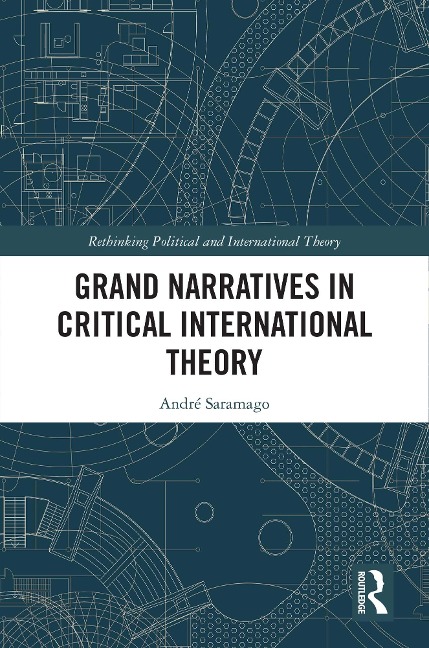
Critical international theory has the task of providing orientation to human beings in better understanding their conditions of existence, how those conditions came to assume their contemporary characteristics, and what immanent potential they might hold for emancipatory transformation. The argument in this book is that this task of orientation is indissociable from a reliance on grand narratives that capture the main features of the long-term process of human development. And yet, many of these grand narratives also tend to reproduce Eurocentric worldviews that undermine critical international theory's reliability as a means of orientation. In this book, André Saramago provides an innovative answer to the problem of orientation with which critical international theory is confronted. Through an indepth engagement with the work of Jürgen Habermas, Karl Marx, and Norbert Elias, he recovers a historical-sociological approach to grand narratives that avoids a reproduction of their Eurocentric shortcomings. In the process, he improves critical international theory's role as a means of orientation by making it better theoretically equipped to capture the interweaving of the historical development of the human capacity for self-determination in the four key dimensions of human existence: people's relations with themselves as individuals; social relations at both the intra- and inter-societal levels; and people's relations with non-human nature. This book will appeal to all students and researchers interested in interdisciplinary and critical approaches to the study of world politics, long-term processes of social change, and human-nature relations, working within or across the fields of International Relations, Sociology, Political Theory, and related areas of inquiry.
André Saramago is Assistant Professor of International Relations at the Faculty of Economics of the University of Coimbra and Researcher at the Centre for Social Studies of the University of Coimbra. His research focuses on the intersection of critical international theory, historical sociology, and environmental politics. He is the editor of Non-Human Nature in World Politics: Theory and Practice (with Joana Castro Pereira, 2020), and his research has been published in journals such as Historical Social Research, European Journal of International Relations, and International Relations.
Introduction 1. The problem of orientation in critical international theory Orientation, grand narratives, and critical international theory The Eurocentric critique of world politics The possibility of a historical-sociological approach to grand narratives 2. A philosophical-transcendental grand narrative A theory of moral and social evolution Universal communication community The cosmopolitan constitutionalization of world politics Orientation in history 3. The materialist-emergentist conception of history Humans in nature Objective ethics A general theory of human development Orientation and emancipation 4. Class struggles and utopian limitations The critique of capitalism The interweaving of multiple forms of class struggle Utopianism and social monopolies 5. Towards a reconstruction of historical-sociological grand narratives Process sociology and critical theory Symbol emancipation and the triad of controls On the concept of civilisation Civilising processes as grand narrative 6. Critical orientation in world politics From the triad to the tetrad of controls Class struggles in inter-societal relations Socialisation and planned interdependence Concluding remarks Bibliography
Dieses eBook wird im PDF-Format geliefert und ist mit einem Adobe Kopierschutz (DRM) versehen. Sie können dieses eBook mit allen Geräten lesen, die das PDF-Format und den Adobe Kopierschutz (DRM) unterstützen.
Zum Beispiel mit den folgenden Geräten:
• tolino Reader
Laden Sie das eBook direkt über den Reader-Shop auf dem tolino herunter oder übertragen Sie das eBook auf Ihren tolino mit einer kostenlosen Software wie beispielsweise Adobe Digital Editions.
• Sony Reader & andere eBook Reader
Laden Sie das eBook direkt über den Reader-Shop herunter oder übertragen Sie das eBook mit der kostenlosen Software Sony READER FOR PC/Mac oder Adobe Digital Editions auf ein Standard-Lesegeräte mit epub- und Adobe DRM-Unterstützung.
• Tablets & Smartphones
Möchten Sie dieses eBook auf Ihrem Smartphone oder Tablet lesen, finden Sie hier unsere kostenlose Lese-App für iPhone/iPad und Android Smartphone/Tablets.
• PC & Mac
Lesen Sie das eBook direkt nach dem Herunterladen mit einer kostenlosen Lesesoftware, beispielsweise Adobe Digital Editions, Sony READER FOR PC/Mac oder direkt über Ihre eBook-Bibliothek in Ihrem Konto unter „Meine eBooks“ - „online lesen“.
Schalten Sie das eBook mit Ihrer persönlichen Adobe ID auf bis zu sechs Geräten gleichzeitig frei.
Bitte beachten Sie, dass die Kindle-Geräte das Format nicht unterstützen und dieses eBook somit nicht auf Kindle-Geräten lesbar ist.