Und dann auf "Zum Home-Bildschirm [+]".

Stöbern
genialokal zum Startbildschirm hinzufügen
Installieren Sie die genialokal App auf Ihrem Startbildschirm für einen schnellen Zugriff und eine komfortable Nutzung.
Installieren Sie die genialokal App auf Ihrem Startbildschirm für einen schnellen Zugriff und eine komfortable Nutzung.
Ihr gewünschter Artikel ist in 0 Buchhandlungen vorrätig - wählen Sie hier eine Buchhandlung in Ihrer Nähe aus:

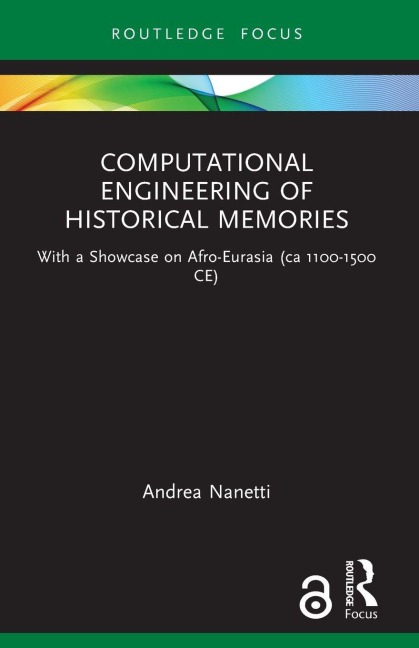

Nanetti outlines a methodology for deploying artificial intelligence and machine learning to enhance historical research.
Dr. Andrea Nanetti is an award-winning and internationally recognised expert in Digital Humanities. He has carried out trailblazing research in Europe, the United States, China, Africa, and South-East Asia for over 30 years. Since 2013, he has been a Professor at Nanyang Technological University, Singapore. Using the history of Venice as contextualised within late medieval Afro-Eurasian trade systems, he achieved international standing within a broad research spectrum that spans from critical editions of primary historical sources to computational applications and web-based media. As a result, several world's top-level institutions, including Harvard University, Princeton University, Shanghai Jiao Tong University, Brown University, Johns Hopkins University, and Ca' Foscari University of Venice, invited him to be a visiting fellow.
List of Figures List of Abbreviations Foreword Preface Acknowledgements 1 Computational Engineering of Historical Memories 1.1 Vision, Mission, and Motivation from a Human Sciences Perspective 1.2 Reloading the Treasure of Human Experiences into the Digital Time Machine 1.3 The Online System Engineering Historical Memory (EHM): Methods and Tools 2 Historians and Computers 2.1 Computers in the Historian's Craft. Opportunities and Limits 2.2 Reflections on the Training of Machine Learning Algorithms for the Next Generation of Historians 2.3 Towards a Computational Approach to History. The Principle of Computational Equivalence and the Phenomenon of Computational Irreducibility in Historical Sciences 3 History, Films, and Online Video Streaming 3.1 Communicating History with Films 3.1.1 Documentary Films 3.1.2 Docudramas 3.1.3 Feature Films 3.1.4 Historical Dramas 3.1.5 Compilation Films 3.1.6 User-Generated Content 3.2 Animated Picture as a Privileged Medium to Screen Historical Narratives in Films 3.2.1 Using Animation to Adapt Historical Narratives in Films 3.2.2 Significant Examples of History- Driven Animations 3.3 Validating Historical Narratives in Films 3.3.1 Acquiring Knowledge from History- Based Films. Opportunities and Challenges for the Audience 3.3.1.1 Netflix, Amazon Prime Video, and Disney+ 3.3.1.2 MUBI and Curiosity Stream 3.3.1.3 YouTube and TikTok 3.3.1.4 Vimeo 3.3.1.5 History Channel 3.3.1.6 TED 3.3.2 The EHM Approach to Computational Validation of Historical Information in Films 4 Languages and Cultures at the Computational Turn 4.1 Gazing at the World as Seen from the Others 4.2 A New Tower of Babel? 4.3 Computational Approaches as Tools to Overcome Linguistic Obstacles and Cultural Barriers in the Historian's Craft 5 EHM Showcase on Afro-Eurasia (ca 1100-1500 CE) 5.1 EHM Computational Engineering of Afro-Eurasian Communication Networks with a Focus on Waterways 5.2 Venetian State-Run Galley Convoys as a Testbed to Design ABMs and Run Simulations 5.3 Framing EHM in the Silk Road Discourse 5.4 Epilogue without Conclusion Index