Und dann auf "Zum Home-Bildschirm [+]".

Stöbern
genialokal zum Startbildschirm hinzufügen
Installieren Sie die genialokal App auf Ihrem Startbildschirm für einen schnellen Zugriff und eine komfortable Nutzung.
Installieren Sie die genialokal App auf Ihrem Startbildschirm für einen schnellen Zugriff und eine komfortable Nutzung.


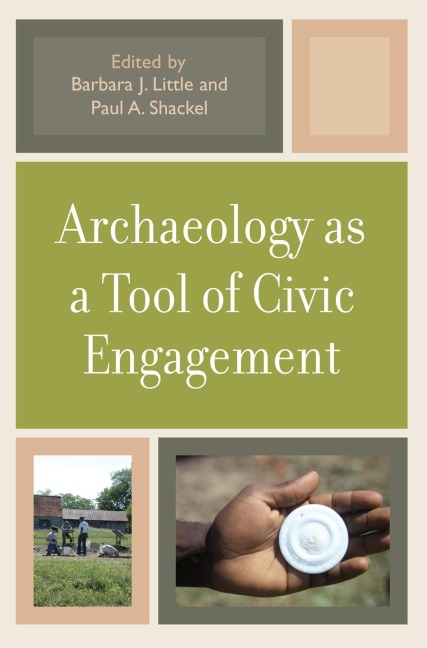
Archaeology as a Tool of Civic Engagement is an indispensable resource for archaeologists and the communities in which they work. The authors are intensely committed to developing effective models for participating in the civic renewal movement - through active engagement in community life, in development offor interpretive and educational programming, and for in participation in debates and decisions about preservation and community planning. Using case studies from different regions within the United States, Guatemala, Vietnam, Canada, and Eastern Europe, Little and Shackel challenge archaeologists to create an ethical public archaeology that is concerned not just with the management of cultural resources, but with social justice and civic responsibility. Their new book will be a valuable guide for archaeologists, community planners, historians, and museum professionals.
Barbara J. Little is an archaeologist with the National Park Service. She has edited four volumes, including Public Benefits of Archaeology (2002), and she is the co-author (with Donald L. Hardesty) of Assessing Site Significance: A Guide for Archaeologists and Historians (2000). Paul A. Shackel is professor of Anthropology at the University of Maryland and is director of the Center for Heritage Resource Studies. He has edited six volumes and written four books and edited six volumes, including Memory in Black and White: Race, Commemoration, and the Post-Bellum Landscape (2003).
0 Introduction: Archaeology and Civic Engagement
Chapter 1 History, Justice, and Reconciliation
Chapter 2 Civic Engagement at Werowocomoco: Reasserting Native Narratives from a Powhatan Place of Power
Chapter 3 Beyond Strategy and Good Intentions: Archaeology, Race and White Privilege
Chapter 4 Politics, Inequality, and Engaged Archaeology: Community Archaeology along the Color Line
Chapter 5 Remaking Connections: Archaeology and Community after the Loma Prieta Earthquake
Chapter 6 Voices from the Past: Changing the Culture of Historic House Museums with Archaeology
Chapter 7 Archaeology- the "Missing Link" to Civic Engagement? An Introspective Look at the Tools of Reinvention and Reengagement in Lancaster, Pennsylvania
Chapter 8 Civil Religion and Civically Engaged Archaeology: Researching Benjamin Franklin and the Pragmatic Spirit
Chapter 9 Reconnecting the Present with its Past: The Doukhobor Pit House Public Archaeology Project
Chapter 10 Heritage in Hampden: A Participatory Research Design for Public Archaeology in a Working-Class Neighborhood, Baltimore, Maryland
Chapter 11 Civic Engagement and Social Justice: Race on hte Illinois Frontier
Chapter 12 Learning through Visitors: Exhibits as a Tool for Encouraging Civic Engagement through Archaeology
Dieses eBook wird im PDF-Format geliefert und ist mit einem Adobe Kopierschutz (DRM) versehen. Sie können dieses eBook mit allen Geräten lesen, die das PDF-Format und den Adobe Kopierschutz (DRM) unterstützen.
Zum Beispiel mit den folgenden Geräten:
• tolino Reader
Laden Sie das eBook direkt über den Reader-Shop auf dem tolino herunter oder übertragen Sie das eBook auf Ihren tolino mit einer kostenlosen Software wie beispielsweise Adobe Digital Editions.
• Sony Reader & andere eBook Reader
Laden Sie das eBook direkt über den Reader-Shop herunter oder übertragen Sie das eBook mit der kostenlosen Software Sony READER FOR PC/Mac oder Adobe Digital Editions auf ein Standard-Lesegeräte mit epub- und Adobe DRM-Unterstützung.
• Tablets & Smartphones
Möchten Sie dieses eBook auf Ihrem Smartphone oder Tablet lesen, finden Sie hier unsere kostenlose Lese-App für iPhone/iPad und Android Smartphone/Tablets.
• PC & Mac
Lesen Sie das eBook direkt nach dem Herunterladen mit einer kostenlosen Lesesoftware, beispielsweise Adobe Digital Editions, Sony READER FOR PC/Mac oder direkt über Ihre eBook-Bibliothek in Ihrem Konto unter „Meine eBooks“ - „online lesen“.
Schalten Sie das eBook mit Ihrer persönlichen Adobe ID auf bis zu sechs Geräten gleichzeitig frei.
Bitte beachten Sie, dass die Kindle-Geräte das Format nicht unterstützen und dieses eBook somit nicht auf Kindle-Geräten lesbar ist.