Und dann auf "Zum Home-Bildschirm [+]".

Stöbern
genialokal zum Startbildschirm hinzufügen
Installieren Sie die genialokal App auf Ihrem Startbildschirm für einen schnellen Zugriff und eine komfortable Nutzung.
Installieren Sie die genialokal App auf Ihrem Startbildschirm für einen schnellen Zugriff und eine komfortable Nutzung.
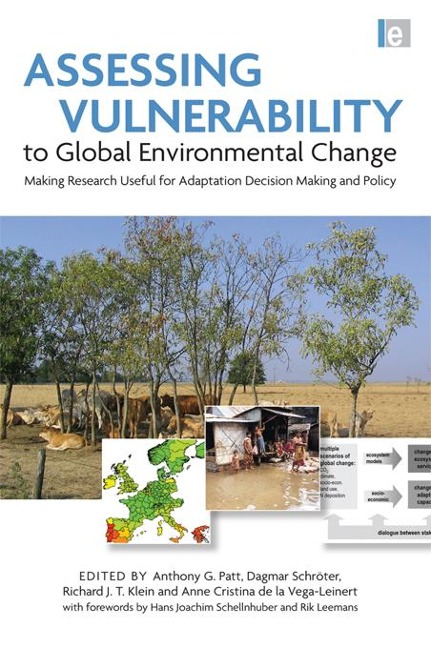
Assessing the vulnerability of human populations to global environmental change, particularly climate change, is now the main imperative of research and international action. However, much of the research into vulnerability is not designed to feed directly into decision making and policy, creating a gap between the knowledge created by researchers and what is required by decision makers. This book seeks to rectify this problem and bridge the gap. It discusses vulnerability as the central theme and brings together many different applications from disaster studies, climate change impact studies and several other fields and provides the most comprehensive synthesis of definitions, theories, formalization and applications to date, illustrated with examples from different disciplines, regions and periods, and from local through to regional, national and international levels. Case study topics cover sea level rise, vulnerability to changes in ecosystem services, assessing the vulnerability of human health and 'double exposure' to climate change and trade liberalization amongst other issues. Research outcomes stress that science-policy dialogues must be transparent to be effective and concentrate on a mutual understanding of the concepts used. A key research finding is that the most useful information for decision makers is that which shows the separate causes and drivers of vulnerability, rather than presenting vulnerability in an aggregated form. The book concludes with a unifying framework for analysing integrated methodologies of vulnerability assessment and guiding how research and policy can be linked to reduce vulnerability.
Anthony Patt leads the Decisions and Governance Research Group in the Program on Risk and Vulnerability at the International Institute for Applied Systems Analysis, in Austria. He has published extensively on climate vulnerability and climate adaptation in Africa. Dagmar Schratter is currently scientific coordinator of a European Era-Net project on climate change adaptation. She has published extensively on global change vulnerability, ecosystem processes and ecosystem services. Richard Klein coordinates climate policy research at the Stockholm Environment Institute. His research interests include methodological aspects of vulnerability assessment, societal adaptation to climate change, and integration of climate and development policy. Anne Cristina de la Vega-Leinert is currently a researcher and lecturer in applied geography at Greifswald University, Germany. She investigates emergent synergies between biodiversity, development, food and human rights issues in the context of global change.
Forewords by Hans Joachim Schellnhuber and Rik Leemans List of Acronyms and Abbreviations 1 Vulnerability Research and Assessment to Support Adaptation and Mitigation: Common Themes from the Diversity of Approaches Anthony G.Patt, Dagmar Schr ter, A.Cristina de la Vega-Leiner and Richard J.T. Klein 2 The House is Both Empty and Sad: Social Vulnerability, Environmental Disturbance, Economic Change and the Irish Potato Famine Evan D.G. Fraser 3 Vulnerability Assessments in the Developed World:The UK and Norway Ian Holman and Lars Otto N'ss 4 Vulnerability Assessments in the Developing World: Mozambique and South Africa Siri Eriksen, Coleen Vogel, Gina Ziervogel, Franziska Steinbruch and Florence Nazare 5 Global Assessment of Coastal Vulnerability to Sea-Level Rise: Experience from DINAS-COAST Richard J.T. Klein and Jochen Hinkel 6 Our Vulnerability to Changes in Ecosystem Services Dagmar Schr ter 7 Assessing Vulnerability of Human Health Hans-Martin F'ssel and Kristie L. Ebi 8 Mapping Double Exposure to Climate Change and Trade Liberalization as an Awareness-Raising Tool Robin Leichenko and Karen O'Brien 1566.qxd 8/11/08 8:54 AM Page v 9 An Agent-Based Framework for Assessing Vulnerability Futures Lilibeth Acosta-Michlik and Mark Rounsevell 10 Assessing Financial and Economic Vulnerability to Natural Hazards: Bridging the Gap between Scientific Assessment and the Implementation of Disaster Risk Management with the CatSim Model Stefan Hochrainer and Reinhard Mechler 11 Evaluation of a Stakeholder Dialogue on European Vulnerability to Global Change A. Cristina de la Vega-Leinert and Dagmar Schr ter 12 Defining Dangerous Climate Change:The Beijing Exercise Martin Welp, Antonella Battaglini and Carlo C. Jaeger 13 A Framework for Analysing Methodologies of Vulnerability Assessments Jochen Hinkel Index
Dieses eBook wird im PDF-Format geliefert und ist mit einem Adobe Kopierschutz (DRM) versehen. Sie können dieses eBook mit allen Geräten lesen, die das PDF-Format und den Adobe Kopierschutz (DRM) unterstützen.
Zum Beispiel mit den folgenden Geräten:
• tolino Reader
Laden Sie das eBook direkt über den Reader-Shop auf dem tolino herunter oder übertragen Sie das eBook auf Ihren tolino mit einer kostenlosen Software wie beispielsweise Adobe Digital Editions.
• Sony Reader & andere eBook Reader
Laden Sie das eBook direkt über den Reader-Shop herunter oder übertragen Sie das eBook mit der kostenlosen Software Sony READER FOR PC/Mac oder Adobe Digital Editions auf ein Standard-Lesegeräte mit epub- und Adobe DRM-Unterstützung.
• Tablets & Smartphones
Möchten Sie dieses eBook auf Ihrem Smartphone oder Tablet lesen, finden Sie hier unsere kostenlose Lese-App für iPhone/iPad und Android Smartphone/Tablets.
• PC & Mac
Lesen Sie das eBook direkt nach dem Herunterladen mit einer kostenlosen Lesesoftware, beispielsweise Adobe Digital Editions, Sony READER FOR PC/Mac oder direkt über Ihre eBook-Bibliothek in Ihrem Konto unter „Meine eBooks“ - „online lesen“.
Schalten Sie das eBook mit Ihrer persönlichen Adobe ID auf bis zu sechs Geräten gleichzeitig frei.
Bitte beachten Sie, dass die Kindle-Geräte das Format nicht unterstützen und dieses eBook somit nicht auf Kindle-Geräten lesbar ist.