
Stöbern
genialokal zum Startbildschirm hinzufügen
Installieren Sie die genialokal App auf Ihrem Startbildschirm für einen schnellen Zugriff und eine komfortable Nutzung.
Installieren Sie die genialokal App auf Ihrem Startbildschirm für einen schnellen Zugriff und eine komfortable Nutzung.
Tippen Sie einfach auf Teilen:
 Und dann auf "Zum Home-Bildschirm [+]".
Bei genialokal.de kaufen Sie online bei Ihrer lokalen, inhabergeführten Buchhandlung!
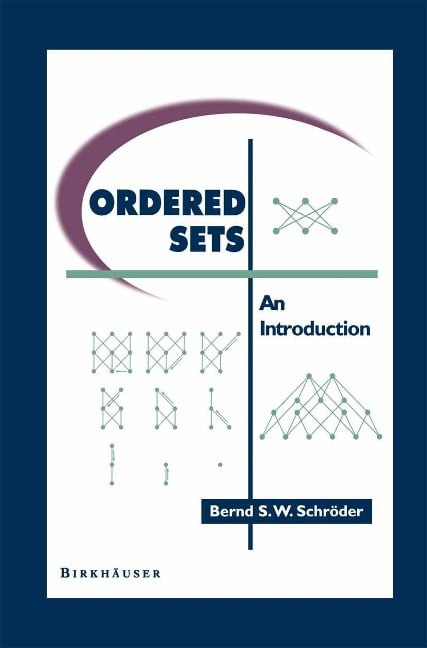
An introduction to the basic tools of the theory of (partially) ordered sets such as visualization via diagrams, subsets, and homomorphisms. Using a thematic approach, the author presents open or recently solved problems to motivate the development of constructions and investigations for new classes of ordered sets. The text can be used as a focused follow-up or companion to a first proof (set theory and relations) or graph theory course. Rich in exercises, the book will be a valuable text for undergraduate/graduate students and an excellent resource for interested researchers.
1 The Basics.- 1.1 Definition and Examples.- 1.2 The Diagram.- 1.3 Order-Preserving Mappings/Isomorphism.- 1.4 Fixed Points.- 1.5 Ordered Subsets/The Reconstruction Problem.- Exercises.- Remarks and Open Problems.- 2 Chains, Antichains and Fences.- 2.1 Chains and Zorn's Lemma.- 2.2 Well-ordered Sets.- 2.3 A Remark on Duality.- 2.4 The Rank of an Element.- 2.5 Antichains and Dilworth's Chain Decomposition Theorem.- 2.6 Dedekind Numbers.- 2.7 Fences and Crowns.- 2.8 Connectivity.- Exercises.- Remarks and Open Problems.- 3 Upper and Lower Bounds.- 3.1 Extremal Elements.- 3.2 Covers.- 3.3 Lowest Upper and Greatest Lower Bounds.- 3.4 Chain-Completeness and the Abian-Brown Theorem.- Exercises.- Remarks and Open Problems.- 4 Retractions.- 4.1 Definition and Examples.- 4.2 Fixed Point Theorems.- 4.3 Dismantlability.- 4.4 The Fixed Point Property for Ordered Sets of Width 2 or Height 1.- 4.5 Li and Milner's Structure Theorem.- 4.6 Isotone Relations.- Exercises.- Remarks and Open Problems.- 5 Lattices.- 5.1 Definition and Examples.- 5.2 Fixed Point Results/The Tarski-Davis Theorem.- 5.3 Embeddings/The Dedekind-MacNeille Completion.- 5.4 Irreducible Points in Lattices.- 5.5 Finite Ordered Sets vs. Distributive Lattices.- 5.6 More on Distributive Lattices.- Exercises.- Remarks and Open Problems.- 6 Truncated Lattices.- 6.1 Definition and Examples.- 6.2 Recognizability and More.- 6.3 The Fixed Clique Property.- 6.4 Triangulations of Sn.- 6.5 Cutsets.- 6.6 Truncated Noncomplemented Lattices.- Exercises.- Remarks and Open Problems.- 7 The Dimension of Ordered Sets.- 7.1 (Linear) Extensions of Orders.- 7.2 Balancing Pairs.- 7.3 Defining the Dimension.- 7.4 Bounds on the Dimension.- 7.5 Ordered Sets of Dimension 2.- Exercises.- Remarks and Open Problems.- 8 Interval Orders.- 8.1Definition and Examples.- 8.2 The Fixed Point Property for Interval Orders.- 8.3 Dedekind's Problem for Interval Orders and Reconstruction.- 8.4 Interval Dimension.- Exercises.- Remarks and Open Problems.- 9 Lexicographic Sums.- 9.1 Definition and Examples.- 9.2 The Canonical Decomposition.- 9.3 Comparability Invariance.- 9.4 Lexicographic Sums and Reconstruction.- 9.5 An Almost Lexicographic Construction.- Exercises.- Remarks and Open Problems.- 10 Sets PQ = Hom(Q, P) and Products.- 10.1 Sets PQ = Hom(Q, P).- 10.2 Finite Products.- 10.3 Infinite Products.- 10.4 Hashimoto's Theorem and Automorphisms of Products.- 10.5 Arithmetic of Ordered Sets.- Exercises.- Remarks and Open Problems.- 11 Enumeration.- 11.1 Graded Ordered Sets.- 11.2 The Number of Graded Ordered Sets.- 11.3 The Asymptotic Number of Graded Ordered Sets.- 11.4 The Number of Nonisomorphic Ordered Sets.- 11.5 The Number of Automorphisms.- Exercises.- Remarks and Open Problems.- 12 Algorithmic Aspects.- 12.1 Algorithms.- 12.2 Polynomial Efficiency.- 12.3 NP problems.- 12.4 NP-completeness.- 12.5 So It's NP-complete.- 12.6 A Polynomial Algorithm for the Fixed Point Property in Graded Ordered Sets of Bounded Width.- Exercises.- Remarks and Open Problems.- A A Primer on Algebraic Topology.- A.l Chain Complexes.- A.2 The Lefschetz Number.- A.3 (Integer) Homology.- A.4 A Homological Reduction Theorem.- Remarks and Open Problems.- B Order vs. Analysis.- B.2 Fixed Point Theorems.- B.3 An Application.- Remarks and Open Problems.- References.