Und dann auf "Zum Home-Bildschirm [+]".

Stöbern
genialokal zum Startbildschirm hinzufügen
Installieren Sie die genialokal App auf Ihrem Startbildschirm für einen schnellen Zugriff und eine komfortable Nutzung.
Installieren Sie die genialokal App auf Ihrem Startbildschirm für einen schnellen Zugriff und eine komfortable Nutzung.
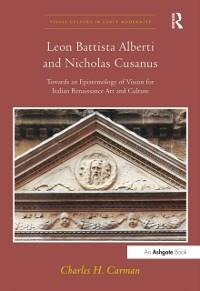
Providing a fresh evaluation of Alberti's text On Painting (1435), along with comparisons to various works of Nicholas Cusanus - particularly his Vision of God (1450) - this study reveals a shared epistemology of vision. And, the author argues, it is one that reflects a more deeply Christian Neoplatonic ideal than is typically accorded Alberti. Whether regarding his purpose in teaching the use of a geometric single point perspective system, or more broadly in rendering forms naturalistically, the emphasis leans toward the ideal of Renaissance art as highly rational. There remains the impression that the principle aim of the painter is to create objective, even illusionistic images. A close reading of Alberti's text, however, including some adjustments in translation, points rather towards an emphasis on discerning the spiritual in the material. Alberti's use of the tropes Minerva and Narcissus, for example, indicates the opposing characteristics of wisdom and sense certainty that function dialectically to foster the traditional importance of seeing with the eye of the intellect rather than merely with physical eyes. In this sense these figures also set the context for his, and, as the author explains, Brunelleschi's earlier invention of this perspective system that posits not so much an objective seeing as an opposition of finite and infinite seeing, which, moreover, approximates Cusanus's famous notion of a coincidence of opposites. Together with Alberti's and Cusanus's ideals of vision, extensive analysis of art works discloses a ubiquitous commitment to stimulating an intellectual perception of divine, essential, and unseen realities that enliven the visible material world.
Charles H. Carman is Associate Professor of Art History at the University of Buffalo, USA.
List of Illustrations, Preface: Perspectiva ut Poesis, Acknowledgements, 1. Alberti and Cusanus: An Overview, 2. On Painting: Setting the Stage and "Tutta la Storia", 3. The Eye of the Mind: Where it Goes, What it Sees, 4. Divine and Human Vision: Perspective and the Coincidence of Opposites, 5. Disclosing Metaphors 1: Ways into Perspective, 6. Disclosing Metaphors 2: The Window, The Flower, and The Map, Conclusion, Bibliography, Index
Dieses eBook wird im PDF-Format geliefert und ist mit einem Adobe Kopierschutz (DRM) versehen. Sie können dieses eBook mit allen Geräten lesen, die das PDF-Format und den Adobe Kopierschutz (DRM) unterstützen.
Zum Beispiel mit den folgenden Geräten:
• tolino Reader
Laden Sie das eBook direkt über den Reader-Shop auf dem tolino herunter oder übertragen Sie das eBook auf Ihren tolino mit einer kostenlosen Software wie beispielsweise Adobe Digital Editions.
• Sony Reader & andere eBook Reader
Laden Sie das eBook direkt über den Reader-Shop herunter oder übertragen Sie das eBook mit der kostenlosen Software Sony READER FOR PC/Mac oder Adobe Digital Editions auf ein Standard-Lesegeräte mit epub- und Adobe DRM-Unterstützung.
• Tablets & Smartphones
Möchten Sie dieses eBook auf Ihrem Smartphone oder Tablet lesen, finden Sie hier unsere kostenlose Lese-App für iPhone/iPad und Android Smartphone/Tablets.
• PC & Mac
Lesen Sie das eBook direkt nach dem Herunterladen mit einer kostenlosen Lesesoftware, beispielsweise Adobe Digital Editions, Sony READER FOR PC/Mac oder direkt über Ihre eBook-Bibliothek in Ihrem Konto unter „Meine eBooks“ - „online lesen“.
Schalten Sie das eBook mit Ihrer persönlichen Adobe ID auf bis zu sechs Geräten gleichzeitig frei.
Bitte beachten Sie, dass die Kindle-Geräte das Format nicht unterstützen und dieses eBook somit nicht auf Kindle-Geräten lesbar ist.