Und dann auf "Zum Home-Bildschirm [+]".

Stöbern
genialokal zum Startbildschirm hinzufügen
Installieren Sie die genialokal App auf Ihrem Startbildschirm für einen schnellen Zugriff und eine komfortable Nutzung.
Installieren Sie die genialokal App auf Ihrem Startbildschirm für einen schnellen Zugriff und eine komfortable Nutzung.
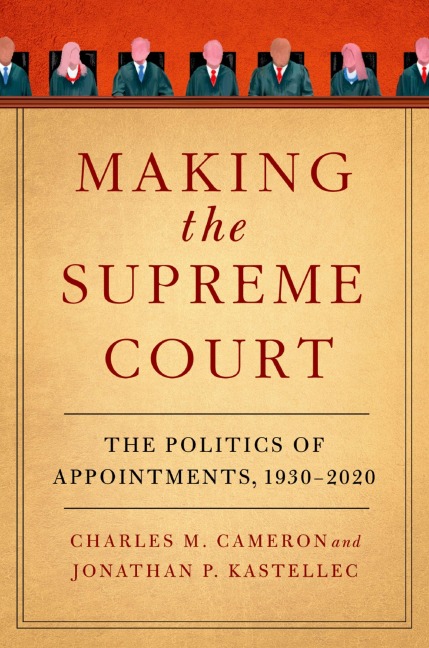
Appointments to the United States Supreme Court are now central events in American political life. Every vacancy unleashes a bitter struggle between Republicans and Democrats over nominees; and once the seat is filled, new justices typically vote in predictable ways. However, this has not always been the case. As late as the middle of the twentieth century, presidents invested little time and effort in finding and vetting nominees, often selecting personal cronies, who senators briskly confirmed. Media coverage was desultory, public opinion was largely non-existent, and the justices often voted independently and erratically. In Making the Supreme Court, Charles M. Cameron and Jonathan P. Kastellec examine 90 years of American political history to show how the growth of federal judicial power from the 1930s onward inspired a multitude of groups struggling to shape judicial policy. Over time, some groups moved beyond lobbying the Court to changing who sits on it. Other groups formed expressly to influence appointments. These activists and organized groups penetrated the national party system so that after about 1980, presidential candidates increasingly pledged to select and confirm nominees who conformed to specific policy and ideological litmus tests. Once in office, these presidents re-shaped the executive selection system to deliver on their promises. Moreover, the selection process for justices turned into media events, often fueled by controversy. As Cameron and Kastellec argue, the result is a new politics aimed squarely at selecting and placing judicial ideologues on the Court. They make the case that this new model gradually transformed how the Court itself operates, turning it into an ideologically driven and polarized branch. Based on rich data and qualitative evidence, Making the Supreme Court provides a sharp lens on the social and political transformations that created a new American politics.
Charles M. Cameron is Professor of Politics and Public Affairs at Princeton University. He specializes in the analysis of political institutions, particularly courts and law, the American presidency, and legislatures. The author of numerous articles in leading journals of political science, he is also the author of Veto Bargaining: Presidents and the Politics of Negative Power, which won the American Political Science Association's Richard F. Fenno Jr. Prize and the William H. Riker Award. He was inducted in the American Academy of Arts and Sciences in 2014. Jonathan P. Kastellec is Professor of Politics at Princeton University. His research and teaching interests are in American political institutions, with a particular focus on judicial politics and the politics of Supreme Court nominations and confirmations. His research has been published in the American Political Science Review; American Journal of Political Science; Journal of Politics; Journal of Law, Economics & Organization; Journal of Empirical Legal Studies; and Political Research Quarterly.
I. What Happened
Then and Now
The Party Demands: Party Agendas for the Supreme Court
Selecting How to Select: Presidents and Organizational Design
The Candidates for the Court and the Nominees
Interest Groups
The Media, co-authored with Leeann Bass and Julian Dean
Public Opinion
Decision in the Senate
II. Why it Happened
The Logic of Presidential Selection, co-authored with Lauren Mattioli
What the Public Wanted
Voting in the Shadow of Accountability: Senators' Confirmation Decisions
III. How It Matters, and What the Future Holds
New Politics, New Justices, New Policies: The Courts That Politics Made
The Future: The Courts that Politics May Make
What Future Do We Want? Evaluating Judicial Independence
Conclusion
Dieses eBook wird im PDF-Format geliefert und ist mit einem Adobe Kopierschutz (DRM) versehen. Sie können dieses eBook mit allen Geräten lesen, die das PDF-Format und den Adobe Kopierschutz (DRM) unterstützen.
Zum Beispiel mit den folgenden Geräten:
• tolino Reader
Laden Sie das eBook direkt über den Reader-Shop auf dem tolino herunter oder übertragen Sie das eBook auf Ihren tolino mit einer kostenlosen Software wie beispielsweise Adobe Digital Editions.
• Sony Reader & andere eBook Reader
Laden Sie das eBook direkt über den Reader-Shop herunter oder übertragen Sie das eBook mit der kostenlosen Software Sony READER FOR PC/Mac oder Adobe Digital Editions auf ein Standard-Lesegeräte mit epub- und Adobe DRM-Unterstützung.
• Tablets & Smartphones
Möchten Sie dieses eBook auf Ihrem Smartphone oder Tablet lesen, finden Sie hier unsere kostenlose Lese-App für iPhone/iPad und Android Smartphone/Tablets.
• PC & Mac
Lesen Sie das eBook direkt nach dem Herunterladen mit einer kostenlosen Lesesoftware, beispielsweise Adobe Digital Editions, Sony READER FOR PC/Mac oder direkt über Ihre eBook-Bibliothek in Ihrem Konto unter „Meine eBooks“ - „online lesen“.
Schalten Sie das eBook mit Ihrer persönlichen Adobe ID auf bis zu sechs Geräten gleichzeitig frei.
Bitte beachten Sie, dass die Kindle-Geräte das Format nicht unterstützen und dieses eBook somit nicht auf Kindle-Geräten lesbar ist.