Und dann auf "Zum Home-Bildschirm [+]".

Stöbern
genialokal zum Startbildschirm hinzufügen
Installieren Sie die genialokal App auf Ihrem Startbildschirm für einen schnellen Zugriff und eine komfortable Nutzung.
Installieren Sie die genialokal App auf Ihrem Startbildschirm für einen schnellen Zugriff und eine komfortable Nutzung.
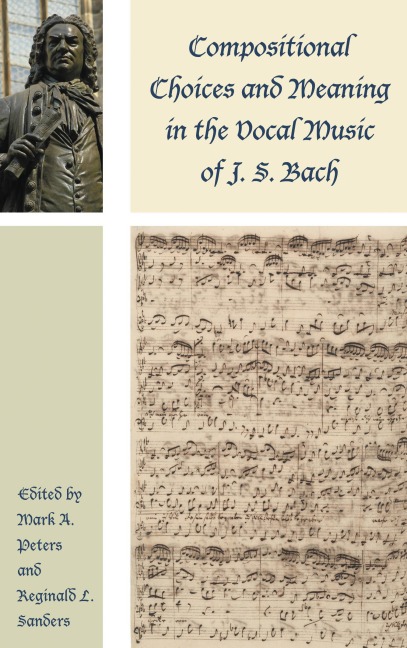
Compositional Choices and Meaning in the Vocal Music of J. S. Bach collects seventeen essays by leading Bach scholars. The authors each address in some way such questions of meaning in J. S. Bach's vocal compositions-including his Passions, Masses, Magnificat, and cantatas-with particular attention to how such meaning arises out of the intentionality of Bach's own compositional choices or (in Part IV in particular) how meaning is discovered, and created, through the reception of Bach's vocal works. And the authors do not consider such compositional choices in a vacuum, but rather discuss Bach's artistic intentions within the framework of broader cultural trends-social, historical, theological, musical, etc. Such questions of compositional choice and meaning frame the four primary approaches to Bach's vocal music taken by the authors in this volume, as seen across the book's four parts: Part I: How might the study of historical theology inform our understanding of Bach's compositional choices in his music for the church (cantatas, Passions, masses)? Part II: How can we apply traditional analytical tools to understand better how Bach's compositions were created and how they might have been heard by his contemporaries? Part III: What we can understand anew through the study of Bach's self-borrowing (i.e., parody), which always changed the earlier meaning of a composition through changes in textual content, compositional characteristics, the work's context within a larger composition, and often the performance context (from court to church, for example)? Part IV: What can the study of reception teach us about a work's meaning(s) in Bach's time, during the time of his immediate successors, and at various points since then (including our present)?The chapters in this volume thus reflect the breadth of current Bach research in its attention not only to source study and analysis, but also to meanings and contexts for understanding Bach's compositions.
Mark A. Peters is professor of music at Trinity Christian College.
Reginald L. Sanders is professor of music at Kenyon College.
Series Editor Foreword
Robin A. Leaver
Preface
Mark A. Peters and Reginald L. Sanders
Paragram for Professor Dr. Don O. Franklin
Ruth Tatlow
Part I: Bach's Vocal Music in Theological Context
1. In Honor of God and the City: Strategies of Theological and Symbolic Communication in Bach's Cantata Gott ist mein König (BWV 71)
Markus Rathey
2. Two "Johannine" Cantatas: Darzu ist erschienen der Sohn Gottes (BWV 40) and Sehet, welch eine Liebe (BWV 64)
Eric Chafe
3. Death to Life, Sorrow to Joy: Martin Luther's Theology of the Cross and J. S. Bach's Eastertide Cantata Ihr werdet weinen und heulen (BWV 103)
Mark A. Peters
4. Toward an Understanding of J. S. Bach's Use of Red Ink in the Autograph Score of the Matthew Passion
Mary Greer
5. The Theological in Bach Research (2007)
Martin Petzoldt
Part II: Analytical Perspectives
6. Formal and Motivic Design in the Opening Chorus of J. S. Bach's Magnificat
Reginald L. Sanders
7. The Tonally Open Ritornello in J. S. Bach's Church Cantatas
Kayoung Lee
8. The Christian Believer and the Sleep of Jesus: "Mache dich, mein Herze, rein" from J. S. Bach's Matthew Passion
Wye J. Allanbrook
Part III: Bach's Self-Modeling: Parody as Compositional Impetus
9. Parody and Text Quality in the Vocal Works of J. S. Bach
Hans-Joachim Schulze
10. J. S. Bach's Parodies of Vocal Music: Conservation or Intensification?
Robin A. Leaver
11. J. S. Bach's Dresden Trip and His Earliest Serenatas for Köthen
Gregory Butler
12. Bach's Second Thoughts on the Christmas Oratorio: The Compositional Revisions to "Bereite dich, Zion," BWV 248/4
Steven Saunders
13. The Passions as a Source of Inspiration? A Hypothesis on the Origin and Musical Aim of Well-Tempered Clavier II
Yo Tomita
Part IV: The Reception of Bach's Vocal Works
14. The Leipzig Audiences of J. S. Bach's Matthew Passion to 1750
Tanya Kevorkian
15. The Vocal Music of the Bach Family in Carl Philipp Emanuel Bach: The Complete Works
Jason B. Grant
16. The Need for a New Music: J. S. Bach in Contemporary Context (1946)
William H. Scheide
17. Bach at the Boundaries of Music History: Preliminary Thoughts on the B-minor Mass and the Late Style Paradigm
Robert L. Marshall
About the Authors
Dieses eBook wird im PDF-Format geliefert und ist mit einem Adobe Kopierschutz (DRM) versehen. Sie können dieses eBook mit allen Geräten lesen, die das PDF-Format und den Adobe Kopierschutz (DRM) unterstützen.
Zum Beispiel mit den folgenden Geräten:
• tolino Reader
Laden Sie das eBook direkt über den Reader-Shop auf dem tolino herunter oder übertragen Sie das eBook auf Ihren tolino mit einer kostenlosen Software wie beispielsweise Adobe Digital Editions.
• Sony Reader & andere eBook Reader
Laden Sie das eBook direkt über den Reader-Shop herunter oder übertragen Sie das eBook mit der kostenlosen Software Sony READER FOR PC/Mac oder Adobe Digital Editions auf ein Standard-Lesegeräte mit epub- und Adobe DRM-Unterstützung.
• Tablets & Smartphones
Möchten Sie dieses eBook auf Ihrem Smartphone oder Tablet lesen, finden Sie hier unsere kostenlose Lese-App für iPhone/iPad und Android Smartphone/Tablets.
• PC & Mac
Lesen Sie das eBook direkt nach dem Herunterladen mit einer kostenlosen Lesesoftware, beispielsweise Adobe Digital Editions, Sony READER FOR PC/Mac oder direkt über Ihre eBook-Bibliothek in Ihrem Konto unter „Meine eBooks“ - „online lesen“.
Schalten Sie das eBook mit Ihrer persönlichen Adobe ID auf bis zu sechs Geräten gleichzeitig frei.
Bitte beachten Sie, dass die Kindle-Geräte das Format nicht unterstützen und dieses eBook somit nicht auf Kindle-Geräten lesbar ist.