Und dann auf "Zum Home-Bildschirm [+]".

Stöbern
genialokal zum Startbildschirm hinzufügen
Installieren Sie die genialokal App auf Ihrem Startbildschirm für einen schnellen Zugriff und eine komfortable Nutzung.
Installieren Sie die genialokal App auf Ihrem Startbildschirm für einen schnellen Zugriff und eine komfortable Nutzung.
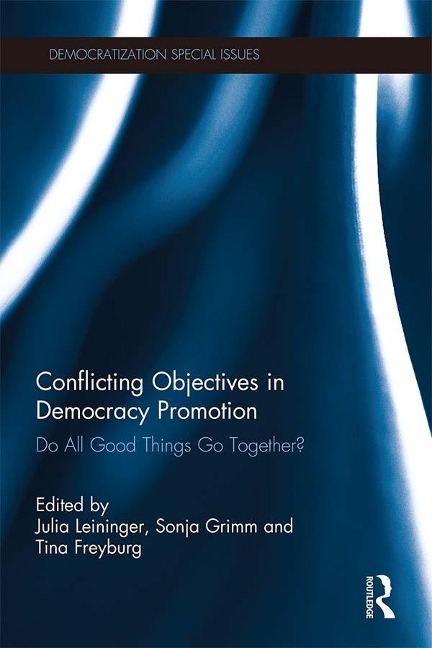
The agenda of external actors often includes a number of objectives that do not necessarily and automatically go together. Fostering security and stability in semi-authoritarian regimes collides with policies aimed at the support of processes of democratization prone to conflict and destabilization. Meanwhile, the promotion of national self-determination and political empowerment might lead to forms of democracy, partially incompatible with liberal understandings. These conflicting objectives are often problematized as challenges to the effectiveness of international democracy promotion. This book presents systematic research about their emergence and effects. The contributing authors investigate (post-) conflict societies, developing countries, and authoritarian regimes in Southeast Europe, Latin America, Africa, and Asia. They identify the socio-economic and political conditions in the recipient country, the interaction between international and local actors, and the capacity of international and local actors as relevant for explaining the emergence of conflicting objectives. And they empirically show that faced with conflicting objectives donors either use a 'wait and see'-approach (i.e. not to act to overcome such conflicts), they prioritize security, state-building and development over democracy, or they compromise democracy promotion with other goals. However, convincing strategies for dealing with such conflicts still need to be devised. This book was published as a special issue of Democratization.
Julia Leininger is Senior Researcher at the German Development Institute / Deutsches Institut für Entwicklungspolitik (DIE) in Bonn. She has previously published a handbook on international organizations ('Handbuch international Organisationen' with Dr Katja Freistein) and developed an approach to study international democracy promotion. Sonja Grimm is Senior Researcher and Lecturer on International and Comparative Politics at the University of Konstanz. She specializes in studies of transition to democracy in postconflict societies and has previously edited (with Prof. Dr Wolfgang Merkel) War and Democratization: Legality, Legitimacy, and Effectiveness, a Democratization special issue (2008, Vol. 15, No. 3). Tina Freyburg is post-doctoral researcher at ETH Zurich, Switzerland and Leverhulme Trust Visiting Fellow at the University of Warwick, United Kingdom. Her current research projects explore new avenues in the study of the international dimension of democratization, in particular the democratizing potential of transgovernmental networks. For more information refer to [http://www.tina-freyburg.eu].
Foreword 1. Not all good things go together: conflicting objectives in democracy promotion 2. Democracy promotion, empowerment, and self-determination: conflicting objectives in US and German policies towards Bolivia 3. Financing poverty alleviation vs. promoting democracy? Multi-Donor Budget Support in Zambia 4. Coerced transitions in Timor-Leste and Kosovo: managing competing objectives of institution-building and local empowerment 5. Power-sharing and democracy promotion in post-civil war peace-building 6. Two at one blow? The EU and its quest for security and democracy by political conditionality in the Western Balkans 7. Inconsistent interventionism in Palestine: objectives, narratives, and domestic policy-making 8. Peace-building and democracy promotion in Afghanistan: the Afghanistan Peace and Reintegration Programme and reconciliation with the Taliban 9. The two sides of functional cooperation with authoritarian regimes: a multi-level perspective on the conflict of objectives between political stability and democratic change
Dieses eBook wird im PDF-Format geliefert und ist mit einem Adobe Kopierschutz (DRM) versehen. Sie können dieses eBook mit allen Geräten lesen, die das PDF-Format und den Adobe Kopierschutz (DRM) unterstützen.
Zum Beispiel mit den folgenden Geräten:
• tolino Reader
Laden Sie das eBook direkt über den Reader-Shop auf dem tolino herunter oder übertragen Sie das eBook auf Ihren tolino mit einer kostenlosen Software wie beispielsweise Adobe Digital Editions.
• Sony Reader & andere eBook Reader
Laden Sie das eBook direkt über den Reader-Shop herunter oder übertragen Sie das eBook mit der kostenlosen Software Sony READER FOR PC/Mac oder Adobe Digital Editions auf ein Standard-Lesegeräte mit epub- und Adobe DRM-Unterstützung.
• Tablets & Smartphones
Möchten Sie dieses eBook auf Ihrem Smartphone oder Tablet lesen, finden Sie hier unsere kostenlose Lese-App für iPhone/iPad und Android Smartphone/Tablets.
• PC & Mac
Lesen Sie das eBook direkt nach dem Herunterladen mit einer kostenlosen Lesesoftware, beispielsweise Adobe Digital Editions, Sony READER FOR PC/Mac oder direkt über Ihre eBook-Bibliothek in Ihrem Konto unter „Meine eBooks“ - „online lesen“.
Schalten Sie das eBook mit Ihrer persönlichen Adobe ID auf bis zu sechs Geräten gleichzeitig frei.
Bitte beachten Sie, dass die Kindle-Geräte das Format nicht unterstützen und dieses eBook somit nicht auf Kindle-Geräten lesbar ist.