Und dann auf "Zum Home-Bildschirm [+]".

Stöbern
genialokal zum Startbildschirm hinzufügen
Installieren Sie die genialokal App auf Ihrem Startbildschirm für einen schnellen Zugriff und eine komfortable Nutzung.
Installieren Sie die genialokal App auf Ihrem Startbildschirm für einen schnellen Zugriff und eine komfortable Nutzung.
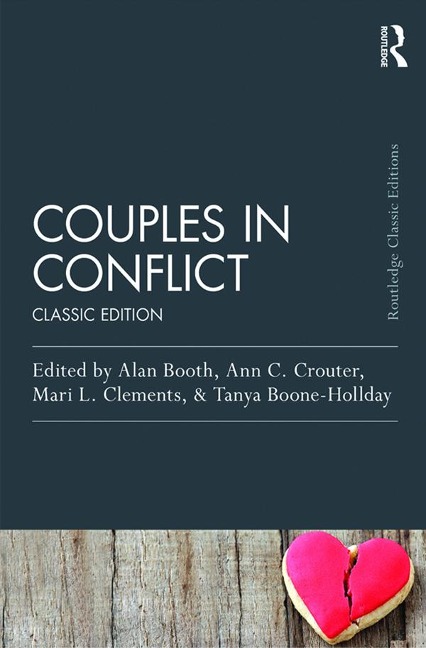
This classic volume provides a solid foundation for thinking about creative ways in which our society can work to prevent or minimize destructive couple conflict and enhance couples' abilities to constructively handle their differences. A common thread throughout is that constructive conflict and negotiation are beneficial for relationships. The new introduction provides an overview of how this classic text is still relevant today. Divided into four parts, this book: *addresses the societal and bio-evolutionary underpinnings of couple conflict; *presents the interpersonal roots of couple conflict and the consequences for individuals and couples; *discusses what effects couple conflict have on children and how individual differences in children moderate these effects; *outlines policies and programs that address couple conflict; and * concludes with an essay that pulls these four themes together and points to new directions for research and program efforts. This book serves as a supplement in graduate or advanced undergraduate courses on interpersonal relationships, couples and/or family and conflict, divorce, couples and/or family therapy taught in human development and family studies, clinical or counseling psychology, social work, sociology, and communications and it is also a helpful compendium for researchers and clinicians/counselors interested in couple conflict.
Alan Booth is Distinguished Emeritus Professor of Sociology, Human Development, and Demography at The Pennsylvania State University. Ann (Nan) C. Crouter is the Raymond and Erin Stuart Schultz Dean of the College of Health and Human Development and Professor of Human Development at Penn State University. Mari L. Clements is Dean of the School of Psychology and a Professor of Psychology at Fuller Theological Seminary. Tanya Boone-Holladay is Chair & Associate Professor of Psychology at California State University, Bakersfield.
Preface. Introduction to the Classic Edition. Part I: What Are the Societal and Bioevolutionary Underpinnings of Couple Conflict? M. Wilson, M. Daly, The Evolutionary Psychology of Couple Conflict in Registered Versus de Facto Marital Unions J. Belsky, Marital Violence in Evolutionary Perspective. F.K. Goldscheider, Men's Changing Family Relationships. R.L. Repetti, Searching for the Roots of Marital Conflict in Uxoricides and Uxorious Husbands. Part II: What Are the Interpersonal Roots of Couple Conflict? What Are the Consequences for Individuals and Couples? T. Bradbury, R. Rogge, E. Lawrence, Reconsidering the Role of Conflict in Marriage. S.R.H. Beach, Expanding the Study of Dyadic Conflict: The Potential Role of Self-Evaluation Maintenance Processes. M.P. Johnson, Conflict and Control: Images of Symmetry and Asymmetry in Domestic Violence. J.V. Cordova, Broadening the Scope of Couples Research: Pragmatics and Prevention. Part III: What Effect Does Couple Conflict Have on Children? How Do Individual Differences in Children Moderate These Effects? E.M. Cummings, M.C. Goeke-Morey, L.M. Papp, Couple Conflict, Children, and Families: It's Not Just You and Me, Babe. C.M. Buchanan, R. Waizenhofer, The Impact of Interparental Conflict on Adolescent Children: Considerations of Family Systems and Family Structure. R.D. Conger, Understanding Child and Adolescent Response to Caregiver Conflict: Some Observations on Context, Process, and Method. J.H. Grych, Increasing Precision in the Study of Interparental Conflict and Child Adjustment. Part IV: What Policies and Programs Influence Couple Conflict? What Works? What Doesn't Work? Where Do We Go From Here? M.R. Sanders, Helping Families Change: From Clinical Interventions to Population-Based Strategies. R.J. Gelles, The Challenge of Changing Couples. T. Ooms, Policy Responses to Couple Conflict and Domestic Violence: A Framework for Discussion. R.E. Emery, Behavioral Family Intervention: Less "Behavior" and More "Family." C. Knoester, T.L. Afifi, Reviewing Couples in Conflict.
Dieses eBook wird im PDF-Format geliefert und ist mit einem Adobe Kopierschutz (DRM) versehen. Sie können dieses eBook mit allen Geräten lesen, die das PDF-Format und den Adobe Kopierschutz (DRM) unterstützen.
Zum Beispiel mit den folgenden Geräten:
• tolino Reader
Laden Sie das eBook direkt über den Reader-Shop auf dem tolino herunter oder übertragen Sie das eBook auf Ihren tolino mit einer kostenlosen Software wie beispielsweise Adobe Digital Editions.
• Sony Reader & andere eBook Reader
Laden Sie das eBook direkt über den Reader-Shop herunter oder übertragen Sie das eBook mit der kostenlosen Software Sony READER FOR PC/Mac oder Adobe Digital Editions auf ein Standard-Lesegeräte mit epub- und Adobe DRM-Unterstützung.
• Tablets & Smartphones
Möchten Sie dieses eBook auf Ihrem Smartphone oder Tablet lesen, finden Sie hier unsere kostenlose Lese-App für iPhone/iPad und Android Smartphone/Tablets.
• PC & Mac
Lesen Sie das eBook direkt nach dem Herunterladen mit einer kostenlosen Lesesoftware, beispielsweise Adobe Digital Editions, Sony READER FOR PC/Mac oder direkt über Ihre eBook-Bibliothek in Ihrem Konto unter „Meine eBooks“ - „online lesen“.
Schalten Sie das eBook mit Ihrer persönlichen Adobe ID auf bis zu sechs Geräten gleichzeitig frei.
Bitte beachten Sie, dass die Kindle-Geräte das Format nicht unterstützen und dieses eBook somit nicht auf Kindle-Geräten lesbar ist.