
Stöbern
genialokal zum Startbildschirm hinzufügen
Installieren Sie die genialokal App auf Ihrem Startbildschirm für einen schnellen Zugriff und eine komfortable Nutzung.
Installieren Sie die genialokal App auf Ihrem Startbildschirm für einen schnellen Zugriff und eine komfortable Nutzung.
Tippen Sie einfach auf Teilen:
 Und dann auf "Zum Home-Bildschirm [+]".
Bei genialokal.de kaufen Sie online bei Ihrer lokalen, inhabergeführten Buchhandlung!
Ihr gewünschter Artikel ist in 0 Buchhandlungen vorrätig - wählen Sie hier eine Buchhandlung in Ihrer Nähe aus:

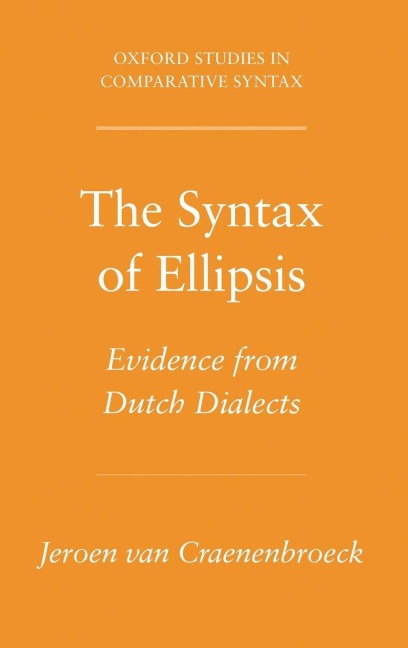
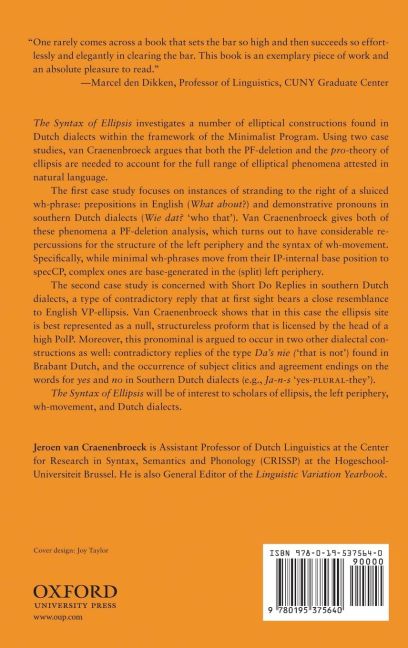
The Syntax of Ellipsis investigates a number of elliptical constructions found in Dutch dialects within the framework of the Minimalist Program. Using two case studies, Van Craenenbroeck argues that both the PF-deletion and the pro-theory of ellipsis are needed to account for the full range of elliptical phenomena attested in natural language.
The first case study focuses on instances of stranding to the right of a sluiced wh-phrase: prepositions in English (What about?) and demonstrative pronouns in southern Dutch dialects (Wie dat? 'who that'). Van Craenenbroeck gives both of these phenomena a PF-deletion analysis, which turns out to have considerable repercussions for the structure of the left periphery and the syntax of wh-movement. Specifically, while minimal wh-phrases move from their IP-internal base position to specCP, complex ones are base-generated in the (split) left periphery.
The second case study is concerned with Short Do Replies in southern Dutch dialects, a type of contradictory reply that at first sight bears a close resemblance to English VP-ellipsis. Van Craenenbroeck shows that in this case the ellipsis site is best represented as a null, structureless proform that is licensed by the head of a high PolP. Moreover, this pronominal is argued to occur in two other dialectal constructions as well: contradictory replies of the type Da's nie 'that is not' found in Brabant Dutch, and the occurrence of subject clitics and agreement endings on the words for yes and no in Southern Dutch dialects (e.g. Ja-n-s 'yes-PLURAL-they').
The Syntax of Ellipsis will be of interest to scholars of the left periphery, wh-movement, and Dutch dialects.
Jeroen van Craenenbroeck is Assistant Professor of Dutch Linguistics, Center for Research in Syntax, Semantics, and Phonology, Hogeschool-Universiteit, Brussels.
- 1.: Introduction
- Part 1
- First Case Study: Stranding under Sluicing as PF-Deletion
- 2.: Introduction: Stranding under Sluicing
- 3.: The Data
- 4.: Theoretical Background: Splitting up CP
- 5.: The Analysis
- 6.: When Swiping Met Spading: The Case of Frisian
- 7.: Previous Analyses
- 8.: Expanding the Data Set
- 9.: Conclusion and Theoretical Implications
- Part 2
- Second Case Study: Short Do Replies as TP-Proforms
- 10.: Short Do Replies: Introduction
- 11.: The Data
- 12.: Theoretical Background
- 13.: The Analysis
- 14.: Spelling out the Proform: Da's Nie and Da's Wel
- 15.: Conjugated 'Yes' and 'No' in SDR-Dialects
- 16.: Conclusion and Theoretical Implications
-
- General Conclusions
- Notes
- References