Und dann auf "Zum Home-Bildschirm [+]".

Stöbern
genialokal zum Startbildschirm hinzufügen
Installieren Sie die genialokal App auf Ihrem Startbildschirm für einen schnellen Zugriff und eine komfortable Nutzung.
Installieren Sie die genialokal App auf Ihrem Startbildschirm für einen schnellen Zugriff und eine komfortable Nutzung.
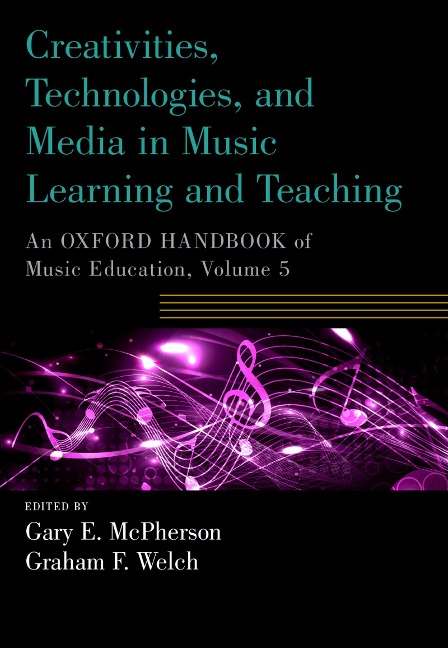
Creativities, Media, and Technology in Music Learning and Teaching is one of five paperback books derived from the foundational two-volume Oxford Handbook of Music Education. Designed for music teachers, students, and scholars of music education, as well as educational administrators and policy makers, this fifth book in the set comprises three complementary sections: musical creativity as practice; music teaching and learning through technology; and the interplay of media, music, and education. The first section reviews notions of musical creativity, examining practice-based perspectives to support and develop understanding of the diverse types of creativity found within music education practice across the globe. In the second section, authors explore the essential role of technology in musical discourse and in various forms of musical learning, even as technology continually evolves and the needs and possibilities continue to rapidly change. The third section provokes readers to assess their own thinking about the transformative changes occurring within the discipline as a result of advances in media, and the increasing infiltration of media into all aspects of life, the classroom, and music making. Contributors Andrew R. Brown, Pamela Burnard, Bernadette Colley, Ian Cross, Rokus de Groot, Steven C. Dillon, Randi Margrethe Eidsaa, David G. Hebert, Evangelos Himonides, Neryl Jeanneret, Ailbhe Kenny, Andrew King, Eleni Lapidaki, Felicity Laurence, Samuel Leong, Bo Wah Leung, Alagi Mbye, Gary E. McPherson, Ross Purves, Tal-Chen Rabinowitch, S. Alex Ruthmann, Eva Sæther, Jonathan Savage, Reza Shayesteh, Petros Stagkos, Matthew D. Thibeault, Evan S. Tobias, Carole Waugh, Graham F. Welch
Gary E. McPherson studied music education at the Sydney Conservatorium of Music, before completing a master of music education at Indiana University, a doctorate of philosophy at the University of Sydney, and a Licentiate and Fellowship in trumpet performance through Trinity College, London. He is the Ormond Professor and Director of the Melbourne Conservatorium of Music at the University of Melbourne, and has served as National President of the Australian Society for Music Education and President of the International Society for Music Education. His research interests are broad and his approach interdisciplinary. His most important research examines the acquisition and development of musical competence, and motivation to engage and participate in music from novice to expert levels. With a particular interest in the acquisition of visual, aural and creative performance skills he has attempted to understand more precisely how music students become sufficiently motivated and self-regulated to achieve at the highest level.
Graham F. Welch holds the University College London (UCL) Institute of Education Established Chair of Music Education. He is elected Chair of the internationally based Society for Education, Music and Psychology Research (SEMPRE), a former President of the International Society for Music Education (ISME), and past co-chair of the Research Commission of ISME. Current Visiting Professorships include the Universities of Queensland (Australia), Guildhall School of Music and Drama, and Liverpool (UK). He is an ex-member of the UK Arts and Humanities Research Council's (AHRC) Review College for music and has been a specialist consultant for Government departments and agencies in the UK, Italy, Sweden, USA, Ukraine, UAE, South Africa and Argentina. Publications number over three hundred and fifty and embrace musical development and music education, teacher education, the psychology of music, singing and voice science, and music in special education and disability. Publications are in English, Spanish, Portuguese, Italian, Swedish, Greek, Japanese and Chinese.
Part 1 Musical Creativity as PracticePart Editor: Pamela Burnard Chapter 1. Commentary: Musical Creativity as Practice Pamela BurnardChapter 2. Empathy and Creativity in Group Musical Practices: Towards a Concept of Empathic Creativity Ian Cross, Felicity Laurence, and Tal-Chen RabinowitchChapter 3. Intercultural Tensions and Creativity in Music Eva Saether with Alagi Mbye and Reza ShayestehChapter 4. Communal Creativity as Socio-musical Practice Eleni Lapidaki, Rokus de Groot, and Petros StagkosChapter 5. Assessing Creativity in Music: International Perspectives and PracticesSamuel Leong, Pamela Burnard, Neryl Jeanneret, Bo Wah Leung, and Carole WaughChapter 6. Creativity in Partnership Practices Bernadette D. Colley, Randi Margrethe Eidsaa, Ailbhe Kenny, and Bo Wah Leung
Part 2 Music Learning and Teaching through Technology Part Editor: Evangelos HimonidesChapter 7. Commentary: Music learning and Teaching through Technology Evangelos HimonidesChapter 8. The Misunderstanding of Music-Technology-Education: A Meta Perspective Evangelos HimonidesChapter 9. Technology and the Educator Ross PurvesChapter 10. The Student Prince: Music-Making with Technology Andrew KingChapter 11. Driving forward Technology's Imprint on Music Education Jonathan Savage
Part 3 Media, Music, and Education Part Editor: Matthew D. ThibeaultChapter 12. Commentary: Media, Music, and Education Matthew D. ThibeaultChapter 13. Music Education in the Postperformance World Matthew D. Thibeault Chapter 14. Let's Play! Learning Music through Video Games and Virtual Worlds Evan S. TobiasChapter 15. Collaborative Digital Media Performance with Generative Music Systems Andrew R. Brown and Steven C. Dillon
Chapter 16. Music Learning and New Media in Virtual and Online Environments S. Alex Ruthmann and David G. Hebert
Dieses eBook wird im PDF-Format geliefert und ist mit einem Adobe Kopierschutz (DRM) versehen. Sie können dieses eBook mit allen Geräten lesen, die das PDF-Format und den Adobe Kopierschutz (DRM) unterstützen.
Zum Beispiel mit den folgenden Geräten:
• tolino Reader
Laden Sie das eBook direkt über den Reader-Shop auf dem tolino herunter oder übertragen Sie das eBook auf Ihren tolino mit einer kostenlosen Software wie beispielsweise Adobe Digital Editions.
• Sony Reader & andere eBook Reader
Laden Sie das eBook direkt über den Reader-Shop herunter oder übertragen Sie das eBook mit der kostenlosen Software Sony READER FOR PC/Mac oder Adobe Digital Editions auf ein Standard-Lesegeräte mit epub- und Adobe DRM-Unterstützung.
• Tablets & Smartphones
Möchten Sie dieses eBook auf Ihrem Smartphone oder Tablet lesen, finden Sie hier unsere kostenlose Lese-App für iPhone/iPad und Android Smartphone/Tablets.
• PC & Mac
Lesen Sie das eBook direkt nach dem Herunterladen mit einer kostenlosen Lesesoftware, beispielsweise Adobe Digital Editions, Sony READER FOR PC/Mac oder direkt über Ihre eBook-Bibliothek in Ihrem Konto unter „Meine eBooks“ - „online lesen“.
Schalten Sie das eBook mit Ihrer persönlichen Adobe ID auf bis zu sechs Geräten gleichzeitig frei.
Bitte beachten Sie, dass die Kindle-Geräte das Format nicht unterstützen und dieses eBook somit nicht auf Kindle-Geräten lesbar ist.