
Stöbern
genialokal zum Startbildschirm hinzufügen
Installieren Sie die genialokal App auf Ihrem Startbildschirm für einen schnellen Zugriff und eine komfortable Nutzung.
Installieren Sie die genialokal App auf Ihrem Startbildschirm für einen schnellen Zugriff und eine komfortable Nutzung.
Tippen Sie einfach auf Teilen:
 Und dann auf "Zum Home-Bildschirm [+]".
Bei genialokal.de kaufen Sie online bei Ihrer lokalen, inhabergeführten Buchhandlung!
Ihr gewünschter Artikel ist in 0 Buchhandlungen vorrätig - wählen Sie hier eine Buchhandlung in Ihrer Nähe aus:

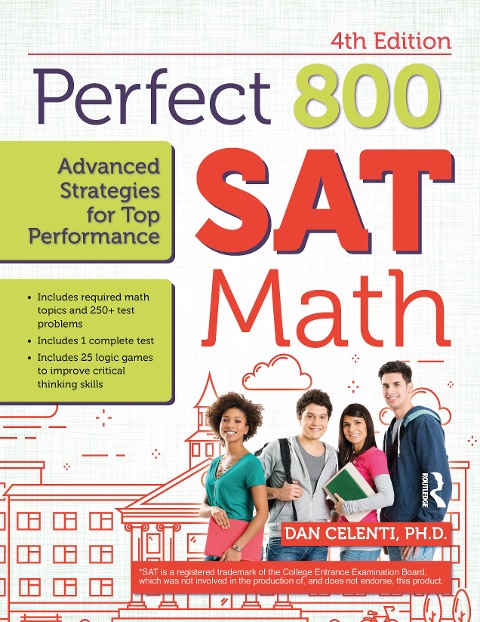
Perfect 800: SAT Math gives advanced students the tools needed to master the SAT math test.
Dan Celenti holds a Ph.D. in Applied Physics and has worked as a scientist, engineer, and educator (college professor and tutor). His wealth of experience-from conducting research in plasma physics and developing software for simulation of integrated circuits, to developing architectures for voice and data communication networks and doing research in artificial intelligence and machine learning-has enabled him to take a pragmatic and holistic approach to the study of math. Dan lives with his wife and their 21-year-old son in Holmdel, NJ. In his spare time-when he doesn't "do math" (an activity he prefers to refer to as "playing mind games")-he likes to play tennis, go skiing, play guitar, read, watch independent movies, spend time in Manhattan, hang out with his friends, and travel the world: a world in which he truly believes that "math is everything!"
Acknowledgements Foreword to the Fourth Edition Introduction: Why Another SAT Book This Book's Approach PART I: GENERAL TEST-TAKING ADVICE AND STRATEGIES Chapter 1: What Is Math and Why Do I Need to Study It? Why You Should Never Say "I Hate Math!" Chapter 2: Test Preparation Strategies and Advice How Too Much "Strategy" Can Be Hazardous to Your Performance An Approach to Test Preparation Do Calculators Really Help? Too Much Memorization? Ubiquitous Algebra Fast Math Reading Comprehension PSAT Versus SAT SAT Versus ACT Final Tips for Better Learning PART II: SPECIFIC MATH TOPICS, TIPS FOR PROBLEM SOLVING, AND SAMPLE PROBLEMS Chapter 3: Arithmetic Concepts 3.1: Integer 3.2: Odd/Even Numbers 3.3: Consecutive Integers 3.4: Number Line 3.5: Reciprocal (of a Number) 3.6: Factors (of a Number) 3.7: Common Factors 3.8: Greatest Common Factor (GCF) 3.9: Common Multiples (of Two or More Numbers) 3.10: Least Common Multiple (LCM) 3.11: Greatest Common Divisor (GCD) 3.12: Prime Numbers 3.13: Ratio 3.14: Percent 3.15: Proportion 3.16: Directly Proportional Quantities 3.17: Inversely Proportional Quantities 3.18: Sequence 3.19: Arithmetic Sequence 3.20: Geometric Sequence 3.21: Set 3.22: Union 3.23: Intersection 3.24: Venn Diagram 3.25: Factorials 3.26: The Fundamental Counting Principle 3.27: Permutation 3.28: Combination 3.29: Distinguishable Permutations 3.30: Absolute Value Chapter 4: Algebra 4.1: Monomial 4.2: Coefficient 4.3: Polynomial 4.4: Term 4.5: Like Terms 4.6: Exponents 4.7: Function 4.8: Quadratic Function 4.9: Domain 4.10: Range 4.11: Interpreting and Solving Equations/Inequalities 4.12: Cartesian Coordinate System 4.13: Straight Line 4.14: Slope 4.15: Distance 4.16: Midpoint 4.17: Graphical Representation of Inequalities 4.18: Complex Numbers Chapter 5: Geometry 5.1: Angles 5.2: Vertex 5.3: Acute Angles 5.4: Obtuse Angles 5.5: Vertical Angles 5.6: Supplementary Angles 5.7: Complementary Angles 5.8: Straight Angles 5.9: Right Angles 5.10: Exterior Angles 5.11: Polygon 5.12: Diagonal 5.13: Triangle 5.14: Acute Triangle 5.15: Obtuse Triangle 5.16: Right Triangle 5.17: Equilateral Triangle 5.18: Isosceles Triangle 5.19: Hypotenuse 5.20: Congruent Triangles 5.21: Similar Triangles 5.22: Altitude 5.23: Quadrilaterals 5.24: Parallelograms 5.25: Rectangles 5.26: Squares 5.27: Perimeter 5.28: Regular Polygon 5.29: Circle 5.30: Diameter 5.31: Radius 5.32: Arc 5.33: Tangent Line 5.34: Tangent to a Circle 5.35: Circumference 5.36: Central Angle 5.37: Area of a Sector and Arc Length 5.38: Solid Geometry Chapter 6: Trigonometry 6.1: Right Triangle 6.2: Unit Circle 6.3: Degrees to Radians Conversion 6.4: Trigonometric Functions 6.5: Miscellaneous Identities 6.6: Pythagorean Identities Chapter 7: Miscellaneous Topics 7.1: Average/Arithmetic Mean 7.2: Median 7.3: Mode 7.4: Weighted Average 7.5: Probability 7.6: Probability and Compound Events 7.7: Elements of Statistics Chapter 8: Problems by Degree of Difficulty and Type 163 8.1: Easy Problems; Multiple Choice 8.2: Easy Problems; Open-Ended 8.3: Medium Problems; Multiple Choice 8.4: Medium Problems; Open-Ended 8.5: Hard Problems; Multiple Choice 8.6: Hard Problems; Open-Ended Chapter 9: Solutions to Problems in Chapter 8 Chapter 10: Additional Problems Chapter 11: Solutions to Problems in Chapter 10 Chapter 12: Mind Games Chapter 13: Solutions to Mind Games Chapter 14: Test Yourself Conclusion Appendix A Appendix B: Solutions to On Your Own Problems References About the Author Common Core State Standards Alignment