
Stöbern
genialokal zum Startbildschirm hinzufügen
Installieren Sie die genialokal App auf Ihrem Startbildschirm für einen schnellen Zugriff und eine komfortable Nutzung.
Installieren Sie die genialokal App auf Ihrem Startbildschirm für einen schnellen Zugriff und eine komfortable Nutzung.
Tippen Sie einfach auf Teilen:
 Und dann auf "Zum Home-Bildschirm [+]".
Bei genialokal.de kaufen Sie online bei Ihrer lokalen, inhabergeführten Buchhandlung!

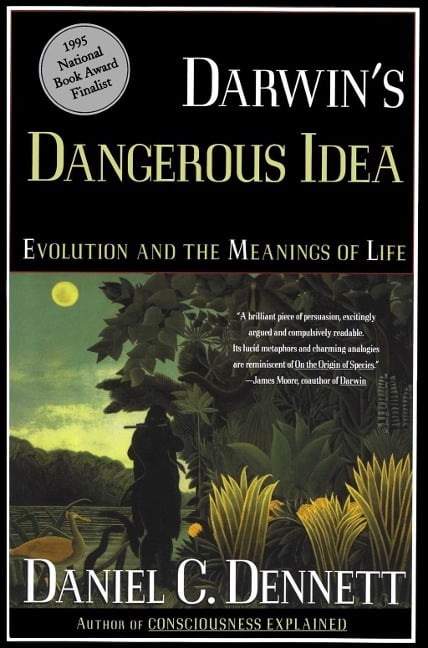

In a book that is both groundbreaking and accessible, Daniel C. Dennett, whom Chet Raymo of The Boston Globe calls "one of the most provocative thinkers on the planet," focuses his unerringly logical mind on the theory of natural selection, showing how Darwin's great idea transforms and illuminates our traditional view of humanity's place in the universe. Dennett vividly describes the theory itself and then extends Darwin's vision with impeccable arguments to their often surprising conclusions, challenging the views of some of the most famous scientists of our day.
Daniel Dennett is the author of Brainstorms, Elbow Room, and Consciousness Explained. He is currently the Distinguished Arts and Sciences Professor and Director of the Center for Cognitive Studies at Tufts University. He lives in North Andover, Massachusetts, with his wife and has two children.
Contents Preface Part I: Starting in the Middle CHAPTER ONE Tell Me Why 1. Is Nothing Sacred? 2. What, Where, When, Why -- and How? 3. Locke's "Proof" of the Primacy of Mind 4. Hume's Close Encounter CHAPTER TWO An Idea Is Born 1. What Is So Special About Species? 2. Natural Selection -- an Awful Stretcher 3. Did Darwin Explain the Origin of Species? 4. Natural Selection as an Algorithmic Process 5. Processes as Algorithms CHAPTER THREE Universal Acid 1. Early Reactions 2. Darwin's Assault on the Cosmic Pyramid 3. The Principle of the Accumulation of Design 4. The Tools for R and D: Skyhooks or Cranes? 5. Who's Afraid of Reductionism? CHAPTER FOUR The Tree of Life 1. How Should We Visualize the Tree of Life? 2. Color-coding a Species on the Tree 3. Retrospective Coronations: Mitochondrial Eve and Invisible Beginnings 4. Patterns, Oversimplification, and Explanation CHAPTER FIVE The Possible and the Actual 1. Grades of Possibility? 2. The Library of Mendel 3. The Complex Relation Between Genome and Organism 4. Possibility Naturalized CHAPTER SIX Threads of Actuality in Design Space 1. Drifting and Lifting Through Design Space 2. Forced Moves in the Game of Design 3. The Unity of Design Space Part II: Darwinian Thinking in Biology CHAPTER SEVEN Priming Darwin' s Pump 1. Back Beyond Darwin's Frontier 2. Molecular Evolution 3. The Laws of the Game of Life 4. Eternal Recurrence -- Life Without Foundations? CHAPTER EIGHT Biology Is Engineering 1. The Sciences of the Artificial 2. Darwin Is Dead -- Long Live Darwin! 3. Function and Specification 4. Original Sin and the Birth of Meaning 5. The Computer That Learned to Play Checkers 6. Artifact Hermeneutics, or Reverse Engineering 7. Stuart Kauffman as Meta-Engineer CHAPTER NINE Searching for Quality 1. The Power of Adaptationist Thinking 2. The Leibnizian Paradigm 3. Playing with Constraints CHAPTER TEN Bully for Brontosaurus 1. The Boy Who Cried Wolf? 2. The Spandrel's Thumb 3. Punctuated Equilibrium: A Hopeful Monster 4. Tinker to Evers to Chance: The Burgess Shale Double-Play Mystery CHAPTER ELEVEN Controversies Contained 1. A Clutch of Harmless Heresies 2. Three Losers: Teilhard, Lamarck, and Directed Mutation 3. Cui Bono? Part III: Mind, Meaning, Mathematics, and Morality CHAPTER TWELVE The Cranes of Culture 1. The Monkey's Uncle Meets the Meme 2. Invasion of the Body-Snatchers 3. Could There Be a Science of Memetics? 4. The Philosophical Importance of Memes CHAPTER THIRTEEN Losing Out Minds to Darwin 1. The Role of Language in Intelligence 2. Chomsky Contra Darwin: Four Episodes 3. Nice Tries CHAPTER FOURTEEN The Evolution of Meanings 1. The Quest for Real Meaning 2. Two Black Boxes 3. Blocking the Exits 4. Safe Passage to the Future CHAPTER FIFTEEN The Emperor's New Mind, and Other Fables 1. The Sword in the Stone 2. The Library of Toshiba 3. The Phantom Quantum-Gravity Computer: Lessons from Lapland CHAPTER SIXTEEN On the Origin of Morality 1. E Pluribus Unum? 2. Friedrich Nietzsche's Just So Stories 3. Some Varieties of Greedy Ethical Reductionism 4. Sociobiology: Good and Bad, Good and Evil CHAPTER SEVENTEEN Redesigning Morality 1. Can Ethics Be Naturalized? 2. Judging the Competition 3. The Moral First Aid Manual CHAPTER EIGHTEEN The Future of an Idea 1. In Praise of Biodiversity 2. Universal Acid: Handle with Care Appendix Bibliography Index