Und dann auf "Zum Home-Bildschirm [+]".

Stöbern
genialokal zum Startbildschirm hinzufügen
Installieren Sie die genialokal App auf Ihrem Startbildschirm für einen schnellen Zugriff und eine komfortable Nutzung.
Installieren Sie die genialokal App auf Ihrem Startbildschirm für einen schnellen Zugriff und eine komfortable Nutzung.
Ihr gewünschter Artikel ist in 0 Buchhandlungen vorrätig - wählen Sie hier eine Buchhandlung in Ihrer Nähe aus:

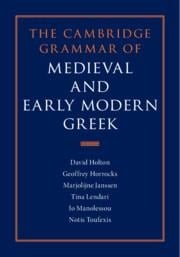
The Greek language has a written history of more than 3,000 years. While the classical, Hellenistic and modern periods of the language are well researched, the intermediate stages are much less well known, but of great interest to those curious to know how a language changes over time. The geographical area where Greek has been spoken stretches from the Aegean Islands to the Black Sea and from Southern Italy and Sicily to the Middle East, largely corresponding to former territories of the Byzantine Empire and its successor states. This Grammar draws on a comprehensive corpus of literary and non-literary texts written in various forms of the vernacular to document the processes of change between the eleventh and eighteenth centuries, processes which can be seen as broadly comparable to the emergence of the Romance languages from Medieval Latin. Regional and dialectal variation in phonology and morphology are treated in detail.
David Holton is Emeritus Professor of Modern Greek at the University of Cambridge and a Fellow of Selwyn College. He directed the 'Grammar of Medieval and Early Modern Greek' research project and has published many articles on Greek language and literature of various periods. His publications include: The Tale of Alexander: The rhymed version (1973, 2nd edition 2002), Erotokritos (1991), Studies on Erotokritos and other Modern Greek Texts (2001), (as editor) Literature and Society in Renaissance Crete (Cambridge, 1991), and (as a co-author) two grammars of Modern Greek.
Volume 1: General Introduction; Acknowledgements; Bibliography; Correspondence table of graphemes and phonemes; Abbreviations; Part I. Phonology; 1. Introduction; 2. Vowels; 3. Consonants; 4. Stress. Volume 2: Correspondence table of graphemes and phonemes; Abbreviations; Part II. Nominal Morphology: 1. Introduction; 2. The Noun; 3. The Adjective; 4. Adverbs; 5. Articles, Pronouns and determiners; 6. Numerals. Volume 3: Correspondence table of graphemes and phonemes; Abbreviations; Part III. Verb Morphology: 1. Introduction; 2. Stem Formation; 3. Augment; 4. Conjugation; 5. Morphosyntax. Volume 4: Correspondence table of graphemes and phonemes; Abbreviations; Part IV. Syntax: Introduction; 1. Main clauses; 2. Complement clauses; 3. Adverbial clauses; 4. Verbs and verb phrases; 5. Nouns and noun phrases; 6. Prepositions and prepositional phrases; 7. Coordination and apposition; 8. Constituent order.