Und dann auf "Zum Home-Bildschirm [+]".

Stöbern
genialokal zum Startbildschirm hinzufügen
Installieren Sie die genialokal App auf Ihrem Startbildschirm für einen schnellen Zugriff und eine komfortable Nutzung.
Installieren Sie die genialokal App auf Ihrem Startbildschirm für einen schnellen Zugriff und eine komfortable Nutzung.
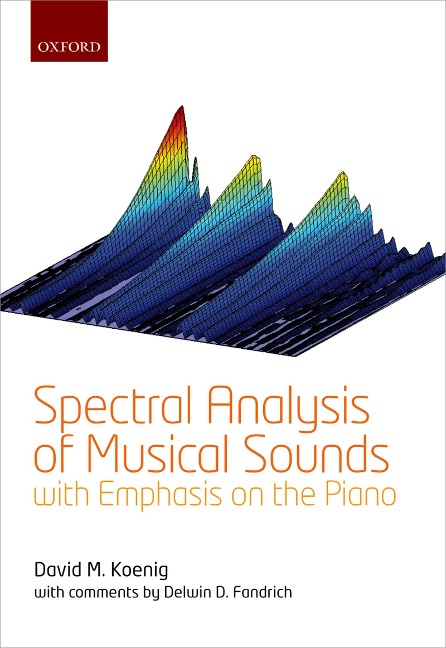
This book addresses the analysis of musical sounds from the viewpoint of someone at the intersection between physicists, engineers, piano technicians, and musicians.
The study is structured into three parts. The reader is introduced to a variety of waves and a variety of ways of presenting, visualizing, and analyzing them in the first part. A tutorial on the tools used throughout the book accompanies this introduction. The mathematics behind the tools is left to the appendices. Part Two provides a graphical survey of the classical areas of acoustics that pertain to musical instruments: vibrating strings, bars, membranes, and plates. Part Three is devoted almost exclusively to the piano. Several two- and three-dimensional graphical tools are introduced to study various characteristics of pianos: individual notes and interactions among them, the missing fundamental, inharmonicity, tuning visualization, the different distribution of harmonic power for the various zones of the piano keyboard, and potential uses for quality control. These techniques are also briefly applied to other musical instruments studied in earlier parts of the book.
For physicists and engineers there are appendices to cover the mathematics lurking beneath the numerous graphs and a brief introduction to Matlab® which was used to generate these graphs. A website accompanying the book (https://sites.google.com/site/analysisofsoundsandvibrations/) contains:- Matlab® scripts- mp3 files of sounds- references to YouTube videos - and up-to-date results of recent studies
David M. Koenig was born in Columbus, Ohio and lived in the nearby town of Grove City until age 17. He attended Bates College and the University of Chicago where he graduated with a B.S. in Chemistry. After obtaining a M.S. in Chemical Engineering at the University of Connecticut he received a Ph.D. in chemical engineering from The Ohio State University. He worked at Corning, Inc. for 27 years in the area of process control and analysis and wrote a book on that subject in 1991. After retirement he wrote a book on process control and then got interested in applying the analysis tools to the piano which led to this book.
Delwin D. Fandrich is Piano Research, Design and Manufacturing Consultant at Fandrich Piano Company.
- Part 1: Some Basic Sound Waves and Some Simple Tools - 1: An Introduction to Some Elementary Waves - 2: The Basic Tools of Spectral Analysis - 3: Analysis of Several Common Musical Instruments - 4: Harmonics in Musical Sounds - Part 2: A Visual Analysis of Vibrating Objects (Strings, Membranes, Bars, Plates) - 5: The Vibrating String - 6: The Vibrating Bar - 7: The Vibrating Membrane - 8: The Vibrating Plate - Part 3: The Piano - 9: An Introduction to Pianos - 10: Some Individual Piano Notes and Interactions Between Them - 11: The Missing Fundamental - 12: Octave Stretching, Inharmonicity and Railsback Curves - 13: Beating, Unisons and Tuning - 14: Two Dimensional Graphical Metrics - 15: Three Dimensional Graphical Metrics - 16: An Investigation into Hammer Knock and Key Striking - 17: Evaluation of a Wapin Bridge Conversion - 18: Similarities between Pianos and Repeatability of Data Gathering Methods - 19: Two Metrics Applied to Other Instruments - 20: Use of the Metrics in Production and Development - 21: Comments by Delwin Fandrich - Appendix 1. Mathematical Basis for Part One - Appendix 2. Mathematical Basis for Part Two - Appendix 3. Mathematical Basis for Part Three - Appendix 4. Experimental Setup - Appendix 5. A Brief Exposure to Matlab
Dieses eBook wird im PDF-Format geliefert und ist mit einem Adobe Kopierschutz (DRM) versehen. Sie können dieses eBook mit allen Geräten lesen, die das PDF-Format und den Adobe Kopierschutz (DRM) unterstützen.
Zum Beispiel mit den folgenden Geräten:
• tolino Reader
Laden Sie das eBook direkt über den Reader-Shop auf dem tolino herunter oder übertragen Sie das eBook auf Ihren tolino mit einer kostenlosen Software wie beispielsweise Adobe Digital Editions.
• Sony Reader & andere eBook Reader
Laden Sie das eBook direkt über den Reader-Shop herunter oder übertragen Sie das eBook mit der kostenlosen Software Sony READER FOR PC/Mac oder Adobe Digital Editions auf ein Standard-Lesegeräte mit epub- und Adobe DRM-Unterstützung.
• Tablets & Smartphones
Möchten Sie dieses eBook auf Ihrem Smartphone oder Tablet lesen, finden Sie hier unsere kostenlose Lese-App für iPhone/iPad und Android Smartphone/Tablets.
• PC & Mac
Lesen Sie das eBook direkt nach dem Herunterladen mit einer kostenlosen Lesesoftware, beispielsweise Adobe Digital Editions, Sony READER FOR PC/Mac oder direkt über Ihre eBook-Bibliothek in Ihrem Konto unter „Meine eBooks“ - „online lesen“.
Schalten Sie das eBook mit Ihrer persönlichen Adobe ID auf bis zu sechs Geräten gleichzeitig frei.
Bitte beachten Sie, dass die Kindle-Geräte das Format nicht unterstützen und dieses eBook somit nicht auf Kindle-Geräten lesbar ist.