Stöbern
genialokal zum Startbildschirm hinzufügen
Installieren Sie die genialokal App auf Ihrem Startbildschirm für einen schnellen Zugriff und eine komfortable Nutzung.
Installieren Sie die genialokal App auf Ihrem Startbildschirm für einen schnellen Zugriff und eine komfortable Nutzung.
Tippen Sie einfach auf Teilen:
 Und dann auf "Zum Home-Bildschirm [+]".

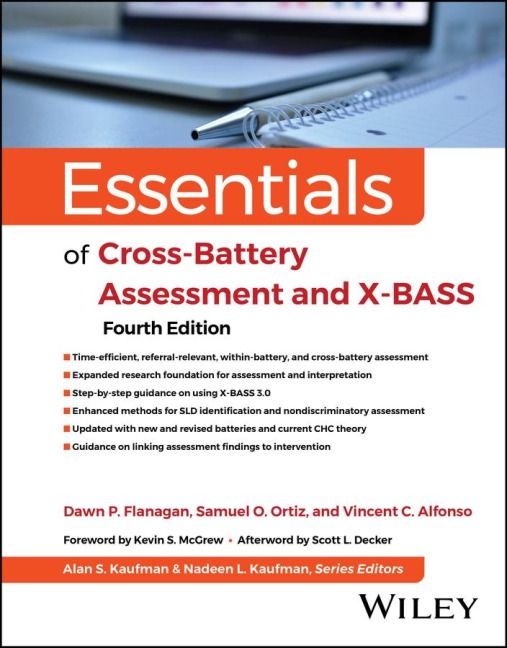

The most empirically grounded and practice-transforming edition of Cross-Battery Assessment to date The Fourth Edition of Essentials of Cross-Battery Assessment and X-BASS delivers a comprehensive scientific update to the XBA framework and its application to SLD identification and nondiscriminatory assessment. This edition incorporates a large-scale meta-analytic database used to program X-BASS 3.0-spanning hundreds of correlation matrices, thousands of subtest-level coefficients, and data from more than 200,000 examinees-to provide unprecedented precision in composite estimation, score-cohesion evaluation, and cross-battery interpretive accuracy. Combined with updated CHC classifications and a rigorous re-evaluation of over 1,000 subtests across major cognitive, achievement, language, and neuropsychological batteries, this edition offers the most transparent and defensible cross-battery interpretive system to date. Building on advances in cognitive theory and psychometric analyses, this edition integrates the expanded capabilities of X-BASS 3.0, including updated composite logic, refined score-cohesion rules, and enhanced decision support for evaluating cultural and linguistic influences, domain-specific cognitive strengths and weaknesses, and unexpected underachievement. New case studies illustrate how XBA and X-BASS work together to support accurate, process-focused SLD identification across reading, writing, and math, with step-by-step demonstrations of planning batteries, integrating data, and making defensible interpretations. New to the Fourth Edition - Fully updated CHC classifications for all tests and subtests in X-BASS - Revised interpretive frameworks that strengthen diagnostic precision in SLD identification - Expanded X-BASS 3.0 workflows guiding cross-battery assessment, interpretation of cultural and linguistic influences, and estimates of decision accuracy - New case studies demonstrating real-world application of XBA and X-BASS - Comprehensive technical appendices documenting the psychometric foundations of XBA, including cross-source comparisons and validation evidence - A fully articulated SLD workflow guiding practitioners from PSW interpretation through ecological validity, exclusionary factors, and converging data sources - Practitioner-friendly tables and rapid-reference tools supporting everyday decisions - Enhanced guidance for nondiscriminatory assessment and culturally responsive practices - Guidance on linking diagnostic findings to evidence-based interventions School psychologists, clinical psychologists, neuropsychologists, and graduate students in assessment courses will find this Fourth Edition an authoritative resource. By connecting theory directly to practice through X-BASS integration, the book supports accurate, defensible cognitive ability evaluations across diverse populations.
DAWN P. FLANAGAN is a faculty member in the Department of Psychology at St. John's University in Queens, New York, where she conducts research and training in psychoeducational assessment, cognitive theories, ability-achievement relations, and SLD identification. Her work focuses on advancing cross-battery and SLD identification methodology. She is a co-founder of Comprehensive Assessment for Intervention (CAIpsychs.com). SAMUEL O. ORTIZ is a faculty member in the Department of Psychology at St. John's University in Queens, New York, where he specializes in psychological assessment and nondiscriminatory evaluation. His research addresses culturally and linguistically responsive testing practices for diverse populations in school and clinical contexts. VINCENT C. ALFONSO is Dean of the College for Education and Engaged Learning at Montclair State University. He continues to publish and present on several topics, including specific learning disabilities, early childhood assessment, and psychometric matters in testing and evaluation.
List of Figures vii List of Tables ix Foreword xiii Series Preface xxvii Acknowledgments xxix One Overview of Cross-Battery Assessment and the Cross-Battery Assessment Software System (X-BASS) 1 Two How to Organize, Analyze, and Interpret Cross-Battery Data Using X-BASS 27 Three DD/C as the Core of SLD Identification: History, Definitions, and Contemporary Practice 65 Four How to Use the PSW and SLD Evidence Tabs in X-BASS 95 Five Diagnostic Cross-Battery Assessments for Reading, Writing, and Math Referrals 119 Six When Evaluations Disagree But the Data Do Not: How Interpretation Shaped a Child's Reading Support 181 Seven A Case of Conceptual/Reasoning Dyscalculia 201 Eight Cross-Battery Assessment and Evaluation of Culturally and Linguistically Diverse Populations 213 Nine The Cognitive Profiles of Students with Reading and Math Learning Difficulties and Corresponding Evidence-Based Interventions 247 Appendix A The Contemporary Cattell-Horn-Carroll Taxonomy: Broad and Narrow Ability Definitions and Task Examples 253 Appendix B Expert-Consensus Study for New Tests/Subtests Included in X-BASS 3.0 263 Appendix C The Evolution of Cognitive-Achievement Relations Research: Past, Present, and Future 271 Appendix D Intercorrelations and Reliability Coefficients Used to Calculate XBA Composites in X-BASS 291 Appendix E Convergent Validity of X-BASS CHC Composites: A Large-Scale Comparison with Norm-Referenced Composites 297 Appendix F Continuous Variables and Categorical Decisions About SLD 301 Appendix G Exclusionary Criteria in the Diagnosis of SLD 313 Appendix H Manifestations of Cognitive Weaknesses 319 Appendix I Batteries and Tests Included in X- BASS 3.0 333 Appendix J Phonological and Orthographic Reading Errors: A Diagnostic Guide and Related Interventions 341 Appendix K Phonological and Orthographic Spelling Errors: A Diagnostic Guide and Related Interventions 349 Appendix L Manifestations of Cognitive Strengths 357 Appendix M Calculation of the Facilitating Cognitive Composite in the Dual Discrepancy/Consistency Pattern of Strengths and Weaknesses Method 371 Appendix N Manifestations of at Least Average Ability to Think and Reason Across Grade Levels 375 Appendix O Calculation of Domain- Specific Cognitive Weakness and Unexpected Underachievement in the Dual Discrepancy/Consistency Pattern of Strengths and Weaknesses Method in X- BASS 377 Appendix P Addressing Measurement Error to Improve Specific Learning Disability Identification Accuracy and School Psychologists' Confidence 381 Appendix Q Real- World Manifestations of Academic Skill Weaknesses 395 Appendix R Sample Report From Intervention Library-IL for a 3rd-Grade Student with a Weakness in Retrieval Fluency 407 Appendix S Sample Report From Intervention Library-IL for a 7th-Grade Student with a Weakness in Working Memory Capacity 415 Appendix T Sample Report From Intervention Library-IL for a 10th-Grade Student with a Weakness in Reading Comprehension 423 Afterword 431 Index 433