Und dann auf "Zum Home-Bildschirm [+]".

Stöbern
genialokal zum Startbildschirm hinzufügen
Installieren Sie die genialokal App auf Ihrem Startbildschirm für einen schnellen Zugriff und eine komfortable Nutzung.
Installieren Sie die genialokal App auf Ihrem Startbildschirm für einen schnellen Zugriff und eine komfortable Nutzung.
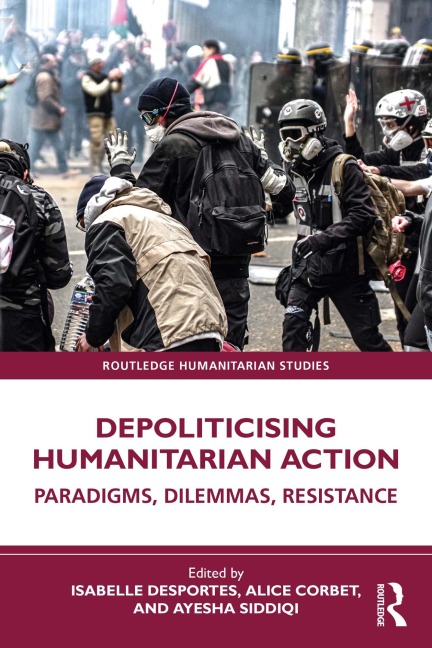
Is it ever possible to separate humanitarian action from politics? Drawing on the experience of both practitioners and researchers, this book is an essential guide to the thorny interplay between what are too often considered as separate worlds. The humanitarian sector aims to separate its work from politics, arguing that independence and neutrality are essential in order to gain entry into disaster and conflict settings. Yet, humanitarian claims of non-involvement in politics have also been dismissed as misleading, naive, or counter-productive. In practice, humanitarians find themselves working within political settings on a daily basis. This book investigates the theory behind depoliticisation, the political background and context behind humanitarian action, and the daily dilemmas faced by practitioners walking that fine line between principles and pragmatism. Finally, this book considers the importance of decolonising mainstream understandings of humanitarianism and politics, and of placing understandings from the Global South at the heart of the discussion. Balancing theoretical insights with empirical grounding, field examples, and recommendations for policy and practice, this book is perfect for researchers and students in humanitarian studies, political science, international relations, human rights, development studies, disaster studies, and peace and conflict studies, as well as humanitarian practitioners and policy makers.
Isabelle Desportes is a postdoctoral researcher at the Centre Marc Bloch, Humboldt Universität zu Berlin, Germany. Her research focuses on the (hidden) politics of disaster prevention and humanitarian response, including in authoritarian conflict settings. Alice Corbet is an anthropologist working for the French National Centre for Scientific Research. She does consulting work for non-governmental organisations and works on the issues of refugees and displaced persons, encampment, and humanitarian relations. Ayesha Siddiqi is an associate professor in the Department of Geography at the University of Cambridge, United Kingdom. Her research examines postcolonial geographies of disasters.
Chapter 1: Depoliticising humanitarian action: Understanding and countering the status quo in an age of crises SECTION I: Depoliticising paradigms Humanitarians without politics?: Practitioner intervention Chapter 2: Humanitarianism and neoliberal rationality as a depoliticising ideology Chapter 3: Resilience versus surveillance humanitarianism: How two conflicting paradigms depoliticise aid and affirm the top-down status quo Chapter 4: Austere rationalities: UK food banks, humanitarian practice and the depoliticisation of need Chapter 5: How media depoliticise disasters in Indigenous contexts SECTION II: Depoliticisation dilemmas Principles versus pragmatism: Humanitarian diplomacy dilemmas from Cox's Bazar to Kyiv: Practitioner intervention Chapter 6: Access over advocacy: The depoliticisation of Myanmar's 2012 Rohingya internally displaced persons' crisis Chapter 7: Depoliticisation is disaster risk creation: Insights on non-government organisations' disaster prevention and humanitarian response in the Philippines Chapter 8: Depoliticising humanitarian aid in Lebanon: National and Gulf actors between co-optation and independence from Western institutions SECTION III: Resisting Depoliticisation Bottom-up humanitarianism: Practitioner intervention Chapter 9: Resisting depoliticisation: Alternative humanitarian advocacy from the experiences of women and feminists in Colombia Chapter 10: Ruptures and contingencies in a bottom-up humanitarian assemblage: a history of peasants, territories and displacement in Colombia Chapter 11: Politics, principles and practice among medical-humanitarian volunteers in protest and revolutionary settings Chapter 12: Conclusion: Alternative visions for humanitarianism
Dieses eBook wird im PDF-Format geliefert und ist mit einem Adobe Kopierschutz (DRM) versehen. Sie können dieses eBook mit allen Geräten lesen, die das PDF-Format und den Adobe Kopierschutz (DRM) unterstützen.
Zum Beispiel mit den folgenden Geräten:
• tolino Reader
Laden Sie das eBook direkt über den Reader-Shop auf dem tolino herunter oder übertragen Sie das eBook auf Ihren tolino mit einer kostenlosen Software wie beispielsweise Adobe Digital Editions.
• Sony Reader & andere eBook Reader
Laden Sie das eBook direkt über den Reader-Shop herunter oder übertragen Sie das eBook mit der kostenlosen Software Sony READER FOR PC/Mac oder Adobe Digital Editions auf ein Standard-Lesegeräte mit epub- und Adobe DRM-Unterstützung.
• Tablets & Smartphones
Möchten Sie dieses eBook auf Ihrem Smartphone oder Tablet lesen, finden Sie hier unsere kostenlose Lese-App für iPhone/iPad und Android Smartphone/Tablets.
• PC & Mac
Lesen Sie das eBook direkt nach dem Herunterladen mit einer kostenlosen Lesesoftware, beispielsweise Adobe Digital Editions, Sony READER FOR PC/Mac oder direkt über Ihre eBook-Bibliothek in Ihrem Konto unter „Meine eBooks“ - „online lesen“.
Schalten Sie das eBook mit Ihrer persönlichen Adobe ID auf bis zu sechs Geräten gleichzeitig frei.
Bitte beachten Sie, dass die Kindle-Geräte das Format nicht unterstützen und dieses eBook somit nicht auf Kindle-Geräten lesbar ist.