
Stöbern
genialokal zum Startbildschirm hinzufügen
Installieren Sie die genialokal App auf Ihrem Startbildschirm für einen schnellen Zugriff und eine komfortable Nutzung.
Installieren Sie die genialokal App auf Ihrem Startbildschirm für einen schnellen Zugriff und eine komfortable Nutzung.
Tippen Sie einfach auf Teilen:
 Und dann auf "Zum Home-Bildschirm [+]".
Bei genialokal.de kaufen Sie online bei Ihrer lokalen, inhabergeführten Buchhandlung!
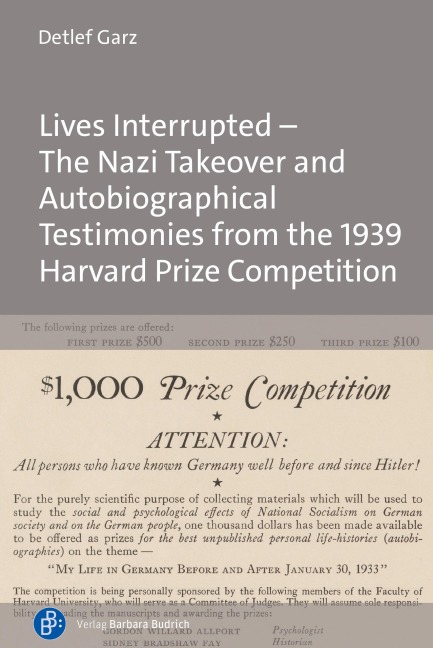
Im Jahr 1939 wurden im Rahmen eines außergewöhnlichen akademischen Wettbewerbs an der Harvard University Fragen zum Leben von Emigranten aus Nazideutschland vor und nach 1933 gestellt. Rund 200 autobiografische Manuskripte wurden von Emigranten aus Deutschland und Österreich gesammelt. Der Korpus ist bis heute weitgehend unerforscht. Detlef Garz wirft einen umfassenden Blick auf den Wettbewerb und konzentriert sich auf die Lebensgeschichten der Teilnehmer: detaillierte Erfahrungen aus dem Leben vor 1933, Leiden, Widerstand, Emigration zwischen 1933 und 1939 sowie Ankunft und Neuansiedlung in den Aufnahmeländern. Sein Buch legt damit den Grundstein sowohl für die Erforschung der autobiografischen Materialien und das Verständnis exemplarischer Lebensgeschichten als auch für das Konzept der (moralischen) Fehlwahrnehmung.
Prof. Dr. Detlef Garz is senior professor at Kiel University (CAU).
Prologue Introduction
I. How it Came About: Scientific Prize Competitions as a Data Basis 1. 'Old Fighters': Biographies of 'Hitler Germans' - the Research of Theodore Abel 1.1 About the Framing 1.2 The Research Procedure 2. 'My Life in Germany Before and After January 30, 1933' or 'To All who Know Germany Well Before and Since Hitler'. The Research of Gordon Allport, Sidney Fay and Edward Hartshorne 2.1 About the Framing 2.2 The Research Procedure 2.3 The Autobiographical Manuscripts and their Authors 2.4 The Motives of the Participants 2.5 Who did the Prizes Go To?
II. Selected Life Stories 1. Hilde Rosa Stern (1900-1961) - Duty and Justice: "There is only one morality, the fighting morality: for our friends and against our enemies" 1.1 Childhood 1.2 Stern Family 1.3 "Thrown from security into insecurity" 1.4 School, Education, Marriage, Divorce 1.5 1933: Exclusion 1.6 Resistance 1.7 Arrest, Concentration Camp Fuhlsbüttel, Pre-trial Imprisonment and Conviction for "aiding and abetting the preparation of a highly treasonable enterprise" 1.8 "That was my father" 1.9 The "day in court" and the Time in the Prison: The "combat morale" 1.10 The Exile: USA (1937-1946): "They were really hard years" 1.11 The 'Homecoming': GDR 2. Carl Paeschke (1895-1983) - On the Life of a More and More Disillusioned Social Democrat and his Resistance to National Socialism: 'We were weak, but our leading men did not know it' 2.1 Winning the First Prize 2.2 Who was Carl Paeschke? Definition through the Homeland 2.3 Childhood and Youth: Kriescht, Berlin, Vietz: 'Eine Welt stürzt ein' (A World Collapses) 2.4 "But that brings us to the outbreak of the World War 1914-1918" 2.5 A "public career" Begins 2.6 As an Editor to the Owl Mountains (Eulengebirge) 2.7 "The Swastika grows" 2.8 "A people in ecstasy" 2.9 'The assassination attempt' 2.10 The Trial 2.11 "That was my farewell to Germany" 2.12 After Emigration: Theoretical Work and Swiss Difficulties (1933 to 1938) 2.13 More Difficulties: Now also the 'Fight' with the Berlin Compensation Office, Marriage, Back to Art 3. Rudolfine Menzel (1891-1973) - "Looking backward is death and torpor, looking forward is happiness and the precondition of success" 3.1 Childhood and Youth in Vienna 3.2 Zionism: "We attached great importance to strictness" 3.3 Start and Completion of Studies, Marriage, War 3.4 The Time in Linz: the Sportive and Scientific Occupation with Dogs 3.5 Scientific Successes and Cooperation with the German Reichswehr 3.6 The Political Development in Austria, Contacts to Palestine 3.7 The Departure: "The die was cast. Everything came more quickly than we had believed or suspected" 3.8 Successes in Palestine and Israel: Security and Military Aspects 3.9 Successes in Palestine and Israel: The Domestication of the Canaan Dog 4. Alfred Fabian (1897-1950) - Paranmanjang - "The ups and downs of life" 4.1 Introduction 4.2 Some Biographical Background Information 4.3 "Torment at school, no understanding at home" 4.4 World War I, Captivity and Return to Germany 4.5 "The turmoil of the post-war period" 4.6 "The year 1927 then brought a turnaround" 4.7 The Nazis' Grip: Arrests, Camps, Release 4.8 His Epilogue: It Goes to Shanghai 4.9 Adding a Few Facts
III. Neither Solidarity nor Justice nor Love 1. Basic Features of a Morality of Recognition 2. Moral Misrecognition 2.1 Non-recognition - Refused solidarity, refused rights 2.2 Misrecognition as a process 3. "When Bad Things Happen to Good People" - About an Extreme Case of Misrecognition
The End: And what Happened Next? Publications Resulting from the Harvard University Scientific Prize Competition - a Selection References Index