Und dann auf "Zum Home-Bildschirm [+]".

Stöbern
genialokal zum Startbildschirm hinzufügen
Installieren Sie die genialokal App auf Ihrem Startbildschirm für einen schnellen Zugriff und eine komfortable Nutzung.
Installieren Sie die genialokal App auf Ihrem Startbildschirm für einen schnellen Zugriff und eine komfortable Nutzung.
Ihr gewünschter Artikel ist in 0 Buchhandlungen vorrätig - wählen Sie hier eine Buchhandlung in Ihrer Nähe aus:

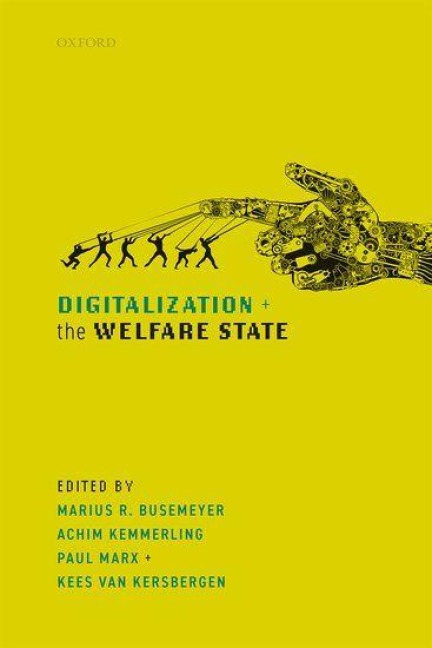
This volume explores how digitalization--in different forms--affects the welfare state. Digitalization is likely to have a lasting impact on work, welfare, and the distribution of income. It will radically transform not only social risks in health, education and the labour market, but also the means by which these risks are addressed. The volume studies how digitalization affects policies as well as the underlying power relationship between actors, i.e. the politics of the welfare state.
The volume brings together internationally renowned welfare-state scholars to identify - the socio-economic challenges that result from rapid technological change; - the ensuing political conflicts and struggles in the domain of welfare state reform broadly defined; - how these changes challenge and shape existing labour market and welfare state arrangements.
Overall, the volume explains the potential and real political and policy responses to these challenges, grasps the contours of future developments, and reflects on whether the current wave of technological change might promote the emergence of a new paradigm of welfare state policy-making.
The rapid and accelerating pace of technological change has potentially radical ramifications for the welfare state that demand an engagement with possible future scenarios. The authors therefore adopt a forward-looking perspective. Based on this approach, the volume uniquely offers a theoretically informed empirical basis for social science and public debates about the long-term implications of the digital revolution for the welfare state, covering a broad range of policy areas such as education, pensions, labour market policies, tax policy, and health care.
Marius R. Busemeyer is a Full Professor of Political Science at the University of Konstanz and Speaker of the Excellence Cluster "The Politics of Inequality". His research focuses on comparative political economy, the welfare state and inequality. Busemeyer holds a doctorate in political science from the University of Heidelberg and worked as a senior researcher at the Max Planck Institute for the Study of Societies. He held visiting professor- and fellowships at, for example, the Center for European Studies at Harvard, the WZB Berlin, the Graduate Center at CUNY (New York) and the Amsterdam Center for Inequality Studies (AMCIS).
Achim Kemmerling is the Gerhard Haniel Chair of Public Policy and International Development and director of the Willy Brandt School of Public Policy, University of Erfurt. He holds a PhD from Freie Universität in Berlin and has previously worked at Central European University Budapest, Jacobs University Bremen and the Social Science Research Centre in Berlin. He was visiting fellow at the Lee Kuan Yew School of Public Policy, Singapore, and the Colegio de México, Mexico. He does research on the political economy of social, labour and tax policies in OECD and developing countries.
Paul Marx is Professor of Political Science and Socio-Economics at University of Duisburg-Essen. Previously, he held positions at University of Southern Denmark and at the IZA Institute of Labor Economics (Bonn, Germany). He received his PhD degree in Social Sciences from the University of Cologne (Germany) in 2011. His research interests are related to social and political inequality, political behaviour, and comparative welfare state and labour market analysis.
Kees van Kersbergen studied political science at the University of Amsterdam (MA 1984) and received his PhD degree (with distinction) in Social and Political Sciences from the European University Institute, Florence, Italy (1991). He held positions at the University of Amsterdam, the Free University of Amsterdam, and the University of Nijmegen. He was a visiting scholar at the European University Institute, the University of Konstanz, and the University of North Carolina at Chapel Hill. He lectured at Universitat Pompeu Fabra and Sichuan University. Currently he is professor of comparative politics at Aarhus University, Aarhus, Denmark.
- Preface - 1: Marius R. Busemeyer, Achim Kemmerling, Paul Marx and Kees van Kersbergen: Digitalization and the Welfare State: Introduction - 2: Marius R. Busemeyer: Digitalization, Automation, and Tthe Welfare State: What Do We (Not Yet) Know? - Part I: Broader Trends: Is This Time Different or Not? - 3: Anne Wren: Digitalization and the Transition to Services - 4: Werner Eichhorst, Anton Hemerijck and Gemma Scalise: Welfare States, Labor Markets, Social Investment, and the Digital Transformation - 5: Marius R. Busemeyer and Ulrich Glassmann: The Value and Future of Work in the Digital Economy - 6: Torben Iversen and Philipp Rehm: The Data Revolution and the Transformation of Social Protection - 7: Paul Marx: Social Solidarity in the Age of the Internet - Part II: The New Politics of the Welfare State in the Digital Age - 8: Thomas Kurer and Silja Häusermann: Automation Risk, Social Policy Preferences, and Political Participation - 9: Jane Gingrich and Alexander Kuo: Gender, Technological Risk, and Political Preferences - 10: Joe Chrisp and Luke Martinelli: The Case for a Basic Income in the Emergent Digitalized Economy - 11: Dario Guarascio and Stefano Sacchi: Technology, Risk, and Support for Social Safety Nets: An Empirical Exploration Based on Italy - 12: Achim Kemmerling and Stephanie Gast Zepeda: Tracing Fears About Digitalization and Automation in Social and Labor Market Policy Debates - Part III: Policies and Politics: Adaptation, Resilience, Vulnerabilities - 13: Georg Picot: Political and Institutional Limits to the Rise of Platform Work - 14: Jan Drahokoupil and Agnieszka Piasna: Internet and Platform Work in Europe - 15: David Natali and Michele Raitano: Digitalization and Automation: The Challenges for European Pension Policies - 16: Frank Nullmeier: The Structural Adaptability of Bismarckian Social Insurance Systems in the Digital Age - 17: Sigrid Hartong, Nelli Piattoeva, Antti Saari and Glenn Savage: Transformation of Education Policy and Governance in the Digital Era - 18: Carsten Jensen and Kees van Kersbergen: Digitalization and the Politics of Health Risks in Advanced Democracies - 19: Daniel Buhr and Rolf Frankenberger: Digitalization and the Effects of Internal and External Modernization in Health Care Systems - 20: Margarita Gelepithis: The Politics of Tax Policy in the Digital Age - Part IV: Conclusions - 21: Marius R. Busemeyer, Achim Kemmerling, Paul Marx and Kees van Kersbergen: Digitalization and the Future of the Democratic Welfare State