Und dann auf "Zum Home-Bildschirm [+]".

Stöbern
genialokal zum Startbildschirm hinzufügen
Installieren Sie die genialokal App auf Ihrem Startbildschirm für einen schnellen Zugriff und eine komfortable Nutzung.
Installieren Sie die genialokal App auf Ihrem Startbildschirm für einen schnellen Zugriff und eine komfortable Nutzung.
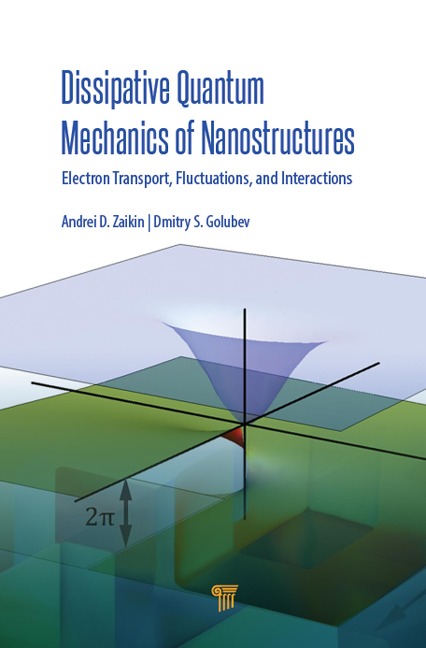
Continuing miniaturization of electronic devices, together with the quickly growing number of nanotechnological applications, demands a profound understanding of the underlying physics. Most of the fundamental problems of modern condensed matter physics involve various aspects of quantum transport and fluctuation phenomena at the nanoscale. In nanostructures, electrons are usually confined to a limited volume and interact with each other and lattice ions, simultaneously suffering multiple scattering events on impurities, barriers, surface imperfections, and other defects. Electron interaction with other degrees of freedom generally yields two major consequences, quantum dissipation and quantum decoherence. In other words, electrons can lose their energy and ability for quantum interference even at very low temperatures. These two different, but related, processes are at the heart of all quantum phenomena discussed in this book. This book presents copious details to facilitate the understanding of the basic physics behind a result and the learning to technically reproduce the result without delving into extra literature. The book subtly balances the description of theoretical methods and techniques and the display of the rich landscape of the physical phenomena that can be accessed by these methods. It is useful for a broad readership ranging from master's and PhD students to postdocs and senior researchers.
Andrei D. Zaikin is a principal investigator at the Institute of Nanotechnology, Karlsruhe Institute of Technology (KIT), Germany, and at I. E. Tamm Theory Department, P. N. Lebedev Physical Institute (LPI), Moscow, Russia. He is also a research professor at the National Research University Higher School of Economics, Moscow. He graduated from the Moscow Institute of Physics and Technology (MIPT) in 1979 and obtained his PhD in theoretical physics from LPI in 1983. He was an Alexander von Humboldt Fellow at the University of Karlsruhe, Germany, in 1995-1996. Professor Zaikin is a world-renowned expert in the theory of superconductivity, quantum nanotransport, quantum dissipation, and quantum decoherence. Dmitry S. Golubev is a senior research scientist at the Department of Applied Physics, Aalto University, Espoo, Finland. He obtained his PhD in 1995 from MIPT and since then he has been working in the field of condensed matter theory. He has been associated with LPI; Chalmers University of Technology, Gothenburg, Sweden; and KIT for extended periods. Dr. Golubev is an expert in the theory of charge and heat transport in various types of nanostructures, including superconducting and normal nanowires, metallic conductors in the Coulomb blockade regime, Josephson junctions, bolometers, and single-electron counting devices.
1. Quantum Mechanics with Dissipation: Influence Functional Theory 2. Dissipative Quantum Mechanics of Superconducting Junctions 3. Quantum Particle in a Dissipative Environment 4. Quantum Tunneling with Dissipation 5. Macroscopic Quantum Coherence and Dissipation 6. Quantum Dynamics of Phase and Charge in Josephson Junctions 7. Coulomb Effects in Metallic Tunnel Junctions 8. Quantum Particle in a Diffusive Electron Gas 9. Influence Functional for Interacting Electrons in Disordered Metals 10. Effective Action for Coherent Scatterers 11. Coulomb Effects in Short Coherent Conductors 12. Charging Effects in Metallic Quantum Dots 13. Coulomb Blockade in Quantum Dot Chains and Metallic Wires 14. Weak Localization and Electron Dephasing in Disordered Conductors I: Metallic Limit 15. Weak Localization and Electron Dephasing in Disordered Conductors II: Beyond Quasiclassics 16. Electron Transport, Fluctuations, and Coulomb Effects in Normal-Superconducting Hybrids 17. Superconducting Contacts beyond the Tunneling Limit 18. Effective Action and Superconducting Fluctuations 19. Thermal and Quantum Phase Slips in Superconducting Nanowires 20. Persistent Currents in Superconducting Nanorings
Dieses eBook wird im PDF-Format geliefert und ist mit einem Adobe Kopierschutz (DRM) versehen. Sie können dieses eBook mit allen Geräten lesen, die das PDF-Format und den Adobe Kopierschutz (DRM) unterstützen.
Zum Beispiel mit den folgenden Geräten:
• tolino Reader
Laden Sie das eBook direkt über den Reader-Shop auf dem tolino herunter oder übertragen Sie das eBook auf Ihren tolino mit einer kostenlosen Software wie beispielsweise Adobe Digital Editions.
• Sony Reader & andere eBook Reader
Laden Sie das eBook direkt über den Reader-Shop herunter oder übertragen Sie das eBook mit der kostenlosen Software Sony READER FOR PC/Mac oder Adobe Digital Editions auf ein Standard-Lesegeräte mit epub- und Adobe DRM-Unterstützung.
• Tablets & Smartphones
Möchten Sie dieses eBook auf Ihrem Smartphone oder Tablet lesen, finden Sie hier unsere kostenlose Lese-App für iPhone/iPad und Android Smartphone/Tablets.
• PC & Mac
Lesen Sie das eBook direkt nach dem Herunterladen mit einer kostenlosen Lesesoftware, beispielsweise Adobe Digital Editions, Sony READER FOR PC/Mac oder direkt über Ihre eBook-Bibliothek in Ihrem Konto unter „Meine eBooks“ - „online lesen“.
Schalten Sie das eBook mit Ihrer persönlichen Adobe ID auf bis zu sechs Geräten gleichzeitig frei.
Bitte beachten Sie, dass die Kindle-Geräte das Format nicht unterstützen und dieses eBook somit nicht auf Kindle-Geräten lesbar ist.