
Stöbern
genialokal zum Startbildschirm hinzufügen
Installieren Sie die genialokal App auf Ihrem Startbildschirm für einen schnellen Zugriff und eine komfortable Nutzung.
Installieren Sie die genialokal App auf Ihrem Startbildschirm für einen schnellen Zugriff und eine komfortable Nutzung.
Tippen Sie einfach auf Teilen:
 Und dann auf "Zum Home-Bildschirm [+]".
Bei genialokal.de kaufen Sie online bei Ihrer lokalen, inhabergeführten Buchhandlung!
Ihr gewünschter Artikel ist in 0 Buchhandlungen vorrätig - wählen Sie hier eine Buchhandlung in Ihrer Nähe aus:

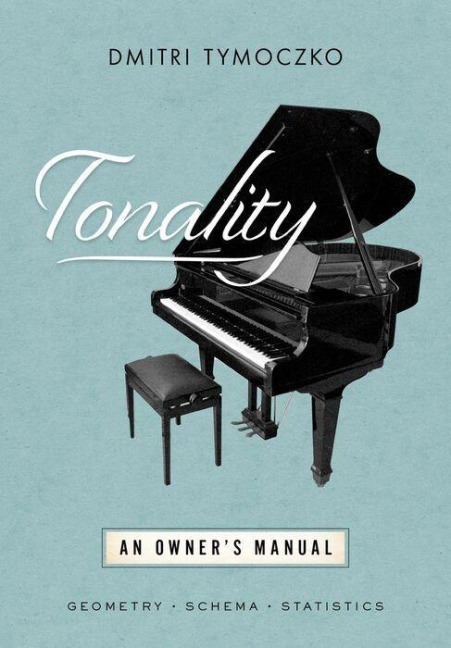
Wide-ranging in scope, and with almost 700 musical examples from the Middle Ages to the present day, Tonality: An Owner's Manual weaves philosophy, mathematics, statistics, and computational analysis into a new and truly twenty-first century theory of music. It proposes a sweeping reformulation of the basic concepts of Western music theory, revealing simple structures underlying a wide range of practices from the Renaissance to contemporary pop. Each of its central chapters re-examines a basic music-theoretical concept such as voice leading, repetition, nonharmonic tones, the origins of tonal harmony, the grammar of tonal harmony, modulation, and melody.
Dmitri Tymoczko is a composer and music theorist who teaches at Princeton University. Widely recognized as one of the world's leading music theorists, his music has been performed all over the world.
- Preface and Acknowledgements - 1. Implicit musical knowledge - 1. Gesualdo's trick - 2. The quadruple hierarchy - 3. Philosophy - 4. Statistics - 5. Schema - 6. Outline - Prelude: transposition along a collection - 2. Rock logic - 1. A melodic principle - 2. A harmonic principle - 3. A first chord-loop family - 4. Two more families - 5. Shepard-tone passacaglias - 6. Minor triads and other trichords - 7. A fourth family - 8. Other modalities - 9. Function and retrofunction - 10. Continuity or reinvention? - Prelude: the Tinctoris transform - 3. Line and configuration - 1. The imperfect system - 2. Voice exchanges - 3. Other intervals - 4. The circle of diatonic triads - 5. Voice exchanges and multiple chord types - 6. Four-voice triadic counterpoint - 7. Counterpoint within the chord - 8. Seventh chords - 9. Harmony and counterpoint - Prelude: sequence and function - 4. Repetition - 1. Repetition reimagined - 2. Repeating contrapuntal patterns - 3. The geometry of two-voice sequences - 4. Three voices and the circle of triads - 5. Three voices arranged 2+1 - 6. Four voices - 7. Contrary-motion sequences - 8. Melodic sequences and near sequences - 9. Near sequences - 10. Sequences as reductional targets - Prelude: three varieties of analytical reduction - 5. Nonharmonic tones - 1. The first practice and the SNAP system - 2. Schoenberg's critique - 3. Monteverdi's "Ohimè" - 4. The standardized second practice - 5. A loophole - 6. After nonharmonicity - Prelude: functional and scale-degree analysis - 6. The origins of functional harmony - 1. The logical structure of protofunctionality - 2. Similarities and differences - 3. Origin and meaning - 4. Harmony and polyphony - 5. The Pope Marcellus Kyrie - 6. A broader perspective - 7. "I Cannot Follow" - Prelude: could the Martians understand our music? - 7. Functional progressions - 1. A theory of harmonic cycles - 2. A more principled view - 3. Rameau and Bach - 4. Functional melody, functional harmony - 5. Fauxbourdon and linear idioms - 6. Sequences - 7. Bach the dualist - Prelude: chromatic or diatonic? - 8. Modulation - 1. Two models of key distance - 2. Enharmonicism and loops in scale space - 3. Minor keys - 4. Modulatory schemas - 5. Up and down the ladder - 6. Modal homogenization and scalar voice leading - 7. Generalized set theory - Prelude: hearing and hearing-as - 9. Melodic strategies - 1. Strategy and reduction - 2. Two models of the phrase - 3. Chopin and the Prime Directive - 4. An expanded vocabulary of melodic templates - 5. Simple harmonic hierarchy - 6. The four-part phrase - 7. Grouping, melody, harmony - 8. Beyond the phrase: hierarchy at the level of the piece - Prelude: why Beethoven? - 10. Beethoven theorist - 1. Meet the Ludwig - 2. From schema to flow - 3. The Tempest - 4. The Fifth Symphony - 5. The "Pastorale" sonata, op. 28 - 6. Schubert's Quartettsatz - 7. The prelude to Lohengrin - 11. Conclusion - 12. Appendix 1: Fundamentals - 13. Appendix 2: Deriving the spiral diagrams - 14. Appendix 3: From sequence to transformation - 15. Appendix 4: Music theory and corpus analysis - Terms and Abbreviations - Bibliography