Und dann auf "Zum Home-Bildschirm [+]".

Stöbern
genialokal zum Startbildschirm hinzufügen
Installieren Sie die genialokal App auf Ihrem Startbildschirm für einen schnellen Zugriff und eine komfortable Nutzung.
Installieren Sie die genialokal App auf Ihrem Startbildschirm für einen schnellen Zugriff und eine komfortable Nutzung.
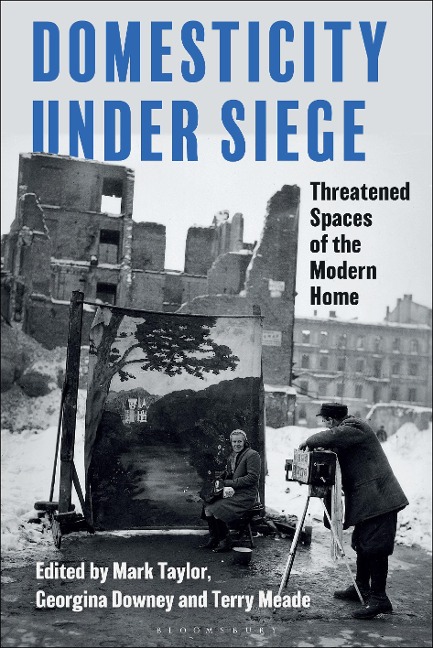
Theories of the domestic stemming from the 19th century have focused on the home as a refuge and place of repose for the family, a nurturing environment for children and a safe place for visitors. Under this conception, domestic space is positioned as nurturing and private, a refuge and place of retreat which gave rise to theories of 'home as haven'. While, arguably, some social conditions might suggest this is the case, Domesticity Under Siege exposes a different world, one in which the boundaries of nurturing domesticity collide with both outside and inside agents.
Whether these agents are external military forces, psychological trauma or familial violence, they re-position meta-narratives of domesticity, not through identity politics or specialized subgroup experience, but relative to the actions of the world around an inhabited domain. That is, when home is constituted as a private realm, a place where individuals or groups can reside in 'safety and comfort', it is argued as a place in which the individual exercises control or power. However, there are many occasions when forces act upon the home and threaten aspects of safety and comfort, often through such things as ruination, violence, mortality, and infestation.
Organised around four thematic sections, 'Microbes, Animals and Insects', 'Human Agents', Wars and Disasters as Agents' and 'Hauntings, Eeriness and the Uncanny', chapters provide a range of approaches to the home which challenge notions of 'haven' and reflect major causes that have played an important role in undermining the modern home. Examples and case studies explore the domestic screen, hoarding, hauntings, violence and imprisonment in the home, wartime interior art, the Hanover Merzbau and Wolfgang Staudte's 1946 film Die Mörder sind unter uns ('The Murderers are Among Us').
Mark Taylor is Professor of Architecture and Chair of Architectural and Industrial Design at Swinburne University, Australia.
Georgina Downey is Visiting Research Fellow in Art History at the University of Adelaide, Australia.
Terry Meade is Principal Lecturer of Architecture and Design at the University of Brighton, UK.
Introduction, Mark Taylor (Swinburne University, Australia), Georgina Downey (University of Adelaide, Australia) and Terry Meade (University of Brighton, UK)
SECTION ONE: Microbes, Animals and Insects
1. Miasmatical Fears, Annmarie Adams (McGill University, Canada)
2. Domesticity and Fear: Insects and Creepy Crawlies, Mark Taylor (Swinburne University of Technology, Australia)
SECTION TWO: Human Agents - Burrowing, Hoarding, Concealing, Undermining
3. The Domestic Screen, Terry Meade (University of Brighton, UK)
4. Hoarding Disorder, Schwitters' Merzbau and its Conflict with Domesticity, Judit Pusztaszeri (University of Brighton, UK)
SECTION THREE: Wars and Disasters as Agents
5. Under Siege: The Wartime Home in British Art of the London Blitz, Georgina Downey (University of Adelaide, Australia)
6. Searching for (a) Home in the Rubble: The Heimkehrer-Flâneur in Wolfgang Staudte's Die Mörder sind unter uns, Kai-Uwe Werbeck (University of North Carolina, USA)
SECTION FOUR: Hauntings, Eeriness and the Uncanny
7. I Have Ended up Like the House, Pretending to be Myself: Uncanny Heritage House Museums, Hannah Lewi (University of Melbourne, Australia)
8. Suburban Horror Story, James F. Kerestes (Ball State University, USA)
Dieses eBook wird im PDF-Format geliefert und ist mit einem Adobe Kopierschutz (DRM) versehen. Sie können dieses eBook mit allen Geräten lesen, die das PDF-Format und den Adobe Kopierschutz (DRM) unterstützen.
Zum Beispiel mit den folgenden Geräten:
• tolino Reader
Laden Sie das eBook direkt über den Reader-Shop auf dem tolino herunter oder übertragen Sie das eBook auf Ihren tolino mit einer kostenlosen Software wie beispielsweise Adobe Digital Editions.
• Sony Reader & andere eBook Reader
Laden Sie das eBook direkt über den Reader-Shop herunter oder übertragen Sie das eBook mit der kostenlosen Software Sony READER FOR PC/Mac oder Adobe Digital Editions auf ein Standard-Lesegeräte mit epub- und Adobe DRM-Unterstützung.
• Tablets & Smartphones
Möchten Sie dieses eBook auf Ihrem Smartphone oder Tablet lesen, finden Sie hier unsere kostenlose Lese-App für iPhone/iPad und Android Smartphone/Tablets.
• PC & Mac
Lesen Sie das eBook direkt nach dem Herunterladen mit einer kostenlosen Lesesoftware, beispielsweise Adobe Digital Editions, Sony READER FOR PC/Mac oder direkt über Ihre eBook-Bibliothek in Ihrem Konto unter „Meine eBooks“ - „online lesen“.
Schalten Sie das eBook mit Ihrer persönlichen Adobe ID auf bis zu sechs Geräten gleichzeitig frei.
Bitte beachten Sie, dass die Kindle-Geräte das Format nicht unterstützen und dieses eBook somit nicht auf Kindle-Geräten lesbar ist.