Und dann auf "Zum Home-Bildschirm [+]".

Stöbern
genialokal zum Startbildschirm hinzufügen
Installieren Sie die genialokal App auf Ihrem Startbildschirm für einen schnellen Zugriff und eine komfortable Nutzung.
Installieren Sie die genialokal App auf Ihrem Startbildschirm für einen schnellen Zugriff und eine komfortable Nutzung.
Ihr gewünschter Artikel ist in 0 Buchhandlungen vorrätig - wählen Sie hier eine Buchhandlung in Ihrer Nähe aus:

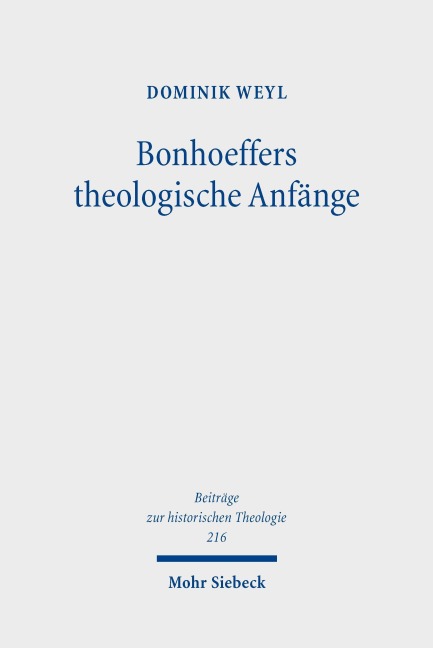
Dominik Weyl explores Dietrich Bonhoeffer's theological beginnings. In doing so, the author inquires into Bonhoeffer's earliest development and his first positionings between 1925 and 1929 and interprets selected texts from the period of his studies, his doctoral work, and his Barcelona vicariate. All of these writings exhibit a pronounced orientation toward ethics. Bonhoeffer's reflections are consistently directed toward the systematic-theological determination of the concordance of the human will with the divine will. Upon this rests his early responsible ethics of the moment, or situational ethics, which would later mature into his ethics of responsibility. At the same time, shadow problems emerge that Bonhoeffer only later perceives and corrects. The author shows how Bonhoeffer anchors his position in the voluntaristic Luther interpretation of Karl Holl and Reinhold Seeberg and brings it into conversation with the dialectical theology of Karl Barth. Already in his student papers, Bonhoeffer integrates faith and obedience as a unity and understands them as modes of resonance in response to God's efficacious grace. The moment of responsible decision-making, which occurs when encountering the demands of another human being, takes on decisive importance. In Sanctorum Communio , the demand of God's will appears in, with, and under these demands, whereby a distinction must be made between God's concrete ethical demand and the substantive demands of the other.
Born 1985; 2023 PhD, University of Zurich; Pastor of the Protestant Church in Hesse and Nassau in Groß-Rohrheim.
A Einleitung
1 Begründung des Forschungszeitraums
2 Bestimmung des Ziels und der Aufgaben
3 Begründung der Textauswahl
4 Forschungsüberblick
B Resonanzen: Bonhoeffers Studienarbeiten
1 Hinführung
2 Der Heilige Geist als heil- und heiligmachende (Willens-)Kraft
3 EXEGESE UND PREDIGT ÜBER JAKOBUS 1, 21-25: Gottgebundenheit als Glaube und Gehorsam
4 Ertrag
C Begegnungen: Bonhoeffers Dissertation SANCTORUM COMMUNIO
1 Hinführung
2 Der christlich-ethische Personbegriff
3 Ertrag
D Verschärfungen: Bonhoeffers Barcelonaer Predigten und Gemeindevorträge
1 Hinführung mit einer lebensgeschichtlichen Erfahrung Bonhoeffers
2 Predigt zu Römer 11, 6: Religions- und Ethikkritik als theologischer Grundton
3 Die Gemeindevorträge
4 Ertrag
E Kurze Rückschau
1 Systematisch-theologische Grundentscheidungen Bonhoeffers
2 Schattenproblematiken
Literaturverzeichnis
1 Dietrich Bonhoeffer Werke
2 Verwendete Literatur