Und dann auf "Zum Home-Bildschirm [+]".

Stöbern
genialokal zum Startbildschirm hinzufügen
Installieren Sie die genialokal App auf Ihrem Startbildschirm für einen schnellen Zugriff und eine komfortable Nutzung.
Installieren Sie die genialokal App auf Ihrem Startbildschirm für einen schnellen Zugriff und eine komfortable Nutzung.
Ihr gewünschter Artikel ist in 0 Buchhandlungen vorrätig - wählen Sie hier eine Buchhandlung in Ihrer Nähe aus:

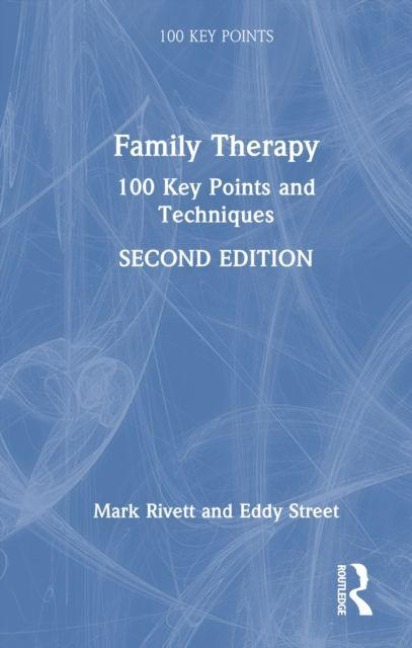
Family therapy: 100 Key Points and Techniques provides a concise and jargon-free guide to family therapy. Through a range of case examples, the authors describe how family therapists begin and progress their therapy. Each section of the book is constructed to lead both beginning and experienced clinicians into the acquisition of new skills. This new edition covers: - The use of formulation and hypotheses in family therapy practice - How relational patterns function and how to change negative ones - Initial skills and principles to help families change their patterns - Advanced family therapy interviewing - Evidence-based models of family therapy - Contemporary issues in family therapy practice Family Therapy: 100 Key Points and Techniques is an invaluable resource for psychotherapists and counsellors in training and in practice. As well as appealing to established family therapists, this new edition should also find an audience with other mental health professionals working with families and interested in learning more about family therapy techniques.
Mark Rivett, MSc, has practiced family therapy for forty years in a range of mental health settings. He has taught family therapy in three UK Universities and provided plenary speeches internationally. He has published on a range of subjects within family therapy including child mental health, domestic abuse and the use of 'gaming' in therapy. He is a previous editor of the Journal of Family Therapy. Eddy Street, PhD, worked as a clinical and counselling psychologist for over forty years in services focused on child mental health. He has written widely on family therapy and taught both in the UK and internationally. He is a previous editor of the Journal of Family Therapy.
Section One: The space between 1. Invisible webs of connection 2. Systems theory 3. Systems are not static 4. Taking a broader position on systems 5. Towards the 'systemic mind' Section Two: Family spaces 6. The multiverse of families 7. The family life cycle 8. Horizontal and vertical stressors 9. The family building 10. The lines of connection 11. Families and meaning 12. Families and emotions 13. Gender and the family 14. Race and the family 15. Culture and the family 16. The social GRRRAAACCEEESSS 17. Symptoms and functions Section Three: Controversies and debates about systems theory 18. Making people into 'cogs in the machine' 19. Systems theory as the 'normality police' 20. Systems theory as a 'grand narrative' 21. Decolonising systems theory Section Four: Foundational Principles 22. Collaboration 23. The therapeutic alliance 24. Safety and empowerment 25. Doing what works: evidence- based practice 26. Accountability to employers and clients 27. Reflective practice 28. The self of the therapist Section Five: Assessing Families 29. Assessment and family therapy 30. Assessment tools 31. Conversational systemic assessment: what do we need to know about the family? 32. How does the problem affect the family? 33. How does the family affect the problem? 34. Broadening the assessment: taking into account multiple levels of context 35. Assessing emotional upsets, pain and trauma 36. Hypothesizing and formulation 37. Assessing for change and building motivation Section Six: Beginning therapy: interactive interviewing 38. Interactive interviewing 39. Using a family tree (genogram) to stimulate interactive interviewing technique 40. Drawing feedback loops to highlight interactive cycles 41. Bringing interaction into the conversation 42. Evoking interaction curiosity by reflecting on patterns 43. Interactional goal setting Section Seven: Further into the therapy: interventive interviewing 44. What do we talk about? Bringing formulations and hypotheses to bear in family therapy 45. Intention, intervention and persistence 46. Circular questions 47. Using circular questions to connect family members to the identified problem 48. Using circular questions to interrupt patterns and invite new patterns 49. Using circular questions to deepen understanding 50. Using circular questions to clarify and expand time frames 51. Reframing in family therapy 52. Progressive reframing and Ockham's razor 53. Externalisation in family therapy 54. Enactment: an action method in family therapy 55. 'Sculpting' in family therapy practice Section Eight: Developing family therapy skills 56: Talking about talking 57: Integrating difference into the therapeutic conversation 58: The dual mind of the therapist 59: Working systemically with emotions 60: Working with blame and negativity 61: Taking the therapist's voice into everyday life 62: Bringing the therapeutic relationship into the conversation 63: Interrupting and guiding the process 64: More perspective taking techniques 65: Working with family scripts Section Nine: Common issues in family therapy 66: 'Resistance' in family therapy 67: Getting 'stuck' in family therapy 68: Distracting and alluring dramas in family therapy 69: Secrets in family therapy 70: Absent family members 71: The mantra of "I don't know" in family therapy 72: Meeting the needs of diverse family members 73: Endings in family therapy 74: Failure in family therapy Section Ten: Beyond technique 75: Embodying therapeutic presence 76: Excellence in family therapy 77: Walking into words: using language purposefully 78: When themes get blocked 79: Trusting the process 80: Transformational moments 81: Further journeys into self 82: On knowing not to know: letting go of systems theory Section Eleven: The schools of family therapy 83: The family therapy generations 84: The first generation: psychodynamic, structural , strategic and Milan 85: The second generation: Social Justice and Post-Milan 86: The third generation: the post-modern revolution in narrative and solution focused approaches 87: The fourth generation: collaborative and evidence-based approaches 88: The contemporary generation Section Twelve: Evidence based family therapies 89: The evidence-based family therapies 90: Adolescent eating disorders 91: Adolescent depression and suicidality 92: Disruptive adolescent behaviour 93: Family approaches in working with psychosis 94: Evidence-based couple therapy models 95: Multi-family group therapy Section Thirteen: Contemporary issues in family therapy 96: 'Family work' and its relationship to family therapy 97: Digital family therapy 98: Team work in family therapy 99: Becoming a family therapist 100: The family and its therapy Resources for family therapists