
Stöbern
genialokal zum Startbildschirm hinzufügen
Installieren Sie die genialokal App auf Ihrem Startbildschirm für einen schnellen Zugriff und eine komfortable Nutzung.
Installieren Sie die genialokal App auf Ihrem Startbildschirm für einen schnellen Zugriff und eine komfortable Nutzung.
Tippen Sie einfach auf Teilen:
 Und dann auf "Zum Home-Bildschirm [+]".
Bei genialokal.de kaufen Sie online bei Ihrer lokalen, inhabergeführten Buchhandlung!
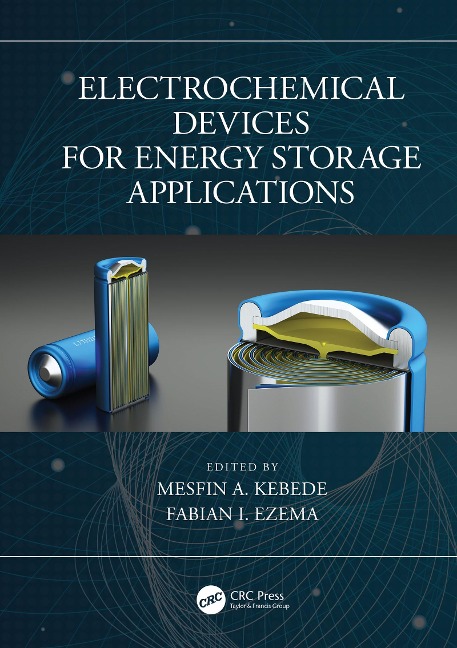
This book explores a wide range of energy storage devices, such as a lithium ion battery, sodium ion battery, magnesium ion battery and supercapacitors. Providing a comprehensive review of the current field, it also discusses the history of these technologies and introduces next-generation rechargeable batteries and supercapacitors. This book will serve as a valuable reference for researchers working with energy storage technologies across the fields of physics, chemistry, and engineering. Features: . Edited by established authorities in the field, with chapter contributions from subject area specialists . Provides a comprehensive review of field . Up to date with the latest developments and research
Mesfin Kebede completed his PhD in 2009 in Materials Science and Engineering from Inha University South Korea. He is currently a principal researcher at Energy Centre, CSIR in South Africa. He has been studying and researching nanostructured materials properties and applications as electrodes for lithium ion battery, gas sensors, luminescent and photoluminescence, photocatalysis for more than a decade. He has been supervising and mentoring MSc and PhD students' research projects. He has authored 2 book chapters and more than 46 papers in reputed journals with h-index of 12 and has been serving as reviewer for several high impact journals and he serves as editorial board member. Fabian Ezema is a Professor at the University of Nigeria, Nsukka. He obtained a PhD in Physics and Astronomy from University of Nigeria, Nsukka. His researches are on several areas of Materials Science; from synthesis and characterizations of particles and thin film materials through chemical routes with emphasis on energy applications. He was a CV Raman fellow at the Shivaji University Kolhapur India in 2011 and MIF fellow at Tokyo University of Science Japan in 2013. He is currently a visiting professor to NRS-EMT in Varennes, QC, MATECSS UNESCO chair in Canada and iThemba Labs and UNESCO UNISA South Africa under UNESCO UNISA Africa Chair in Nanosciences and Nanotechnology (U2ACN2). Due to his commitment to research and international visibility, he was appointment Acting Director International Office of the University of Nigeria by the University Senate. He is currently the coordinator Nano Research Group, UNN and has served as Coordinator, Natural Science Unit, School of General Studies, UNN. For the last 15 years, he has been working on the energy conversion and storage (cathodes, anodes, supercapacitors, solar cells, etc), including novel methods of synthesis, characterization and evaluation of the electrochemical and optical properties. He has published around 130 papers in various international journals and gave 30 talks at various conferences. His h-index is 18 with over 1000 citations.
Chapter 1- Cathodes for lithium ion battery. Chapter 2- Metal oxide based anodes for lithium ion battery. Chapter 3- Sodium-ion battery anode materials future prospects and challenges. Chapter 4- Sodium and sodium ion based energy storage batteries. Chapter 5- Magnesium battery. Chapter 6 - Graphene-Based Supercapacitor Applications. Chapter 7- Transition Metal Based Nanomaterials for High Energy and Power Density Supercapacitors. Chapter 8- The Role of Modeling and Simulation in the Achievement of Next-generation Electrochemical Capacitors. Chapter 9- Cerium Oxide: Synthesis, Structural, Morphology and Applications in Electrochemical Energy Storage- A Review. Chapter 10- Multifunctional Energy storage: Piezoelectric self-charging cell. Chapter 11- The Contributions of Electrolytes in Achieving the Performance index of Next generation Electrochemical Capacitors (ECs).
Dieses eBook wird im PDF-Format geliefert und ist mit einem Adobe Kopierschutz (DRM) versehen. Sie können dieses eBook mit allen Geräten lesen, die das PDF-Format und den Adobe Kopierschutz (DRM) unterstützen.
Zum Beispiel mit den folgenden Geräten:
• tolino Reader
Laden Sie das eBook direkt über den Reader-Shop auf dem tolino herunter oder übertragen Sie das eBook auf Ihren tolino mit einer kostenlosen Software wie beispielsweise Adobe Digital Editions.
• Sony Reader & andere eBook Reader
Laden Sie das eBook direkt über den Reader-Shop herunter oder übertragen Sie das eBook mit der kostenlosen Software Sony READER FOR PC/Mac oder Adobe Digital Editions auf ein Standard-Lesegeräte mit epub- und Adobe DRM-Unterstützung.
• Tablets & Smartphones
Möchten Sie dieses eBook auf Ihrem Smartphone oder Tablet lesen, finden Sie hier unsere kostenlose Lese-App für iPhone/iPad und Android Smartphone/Tablets.
• PC & Mac
Lesen Sie das eBook direkt nach dem Herunterladen mit einer kostenlosen Lesesoftware, beispielsweise Adobe Digital Editions, Sony READER FOR PC/Mac oder direkt über Ihre eBook-Bibliothek in Ihrem Konto unter „Meine eBooks“ - „online lesen“.
Schalten Sie das eBook mit Ihrer persönlichen Adobe ID auf bis zu sechs Geräten gleichzeitig frei.
Bitte beachten Sie, dass die Kindle-Geräte das Format nicht unterstützen und dieses eBook somit nicht auf Kindle-Geräten lesbar ist.