
Stöbern
genialokal zum Startbildschirm hinzufügen
Installieren Sie die genialokal App auf Ihrem Startbildschirm für einen schnellen Zugriff und eine komfortable Nutzung.
Installieren Sie die genialokal App auf Ihrem Startbildschirm für einen schnellen Zugriff und eine komfortable Nutzung.
Tippen Sie einfach auf Teilen:
 Und dann auf "Zum Home-Bildschirm [+]".
Bei genialokal.de kaufen Sie online bei Ihrer lokalen, inhabergeführten Buchhandlung!
Ihr gewünschter Artikel ist in 0 Buchhandlungen vorrätig - wählen Sie hier eine Buchhandlung in Ihrer Nähe aus:

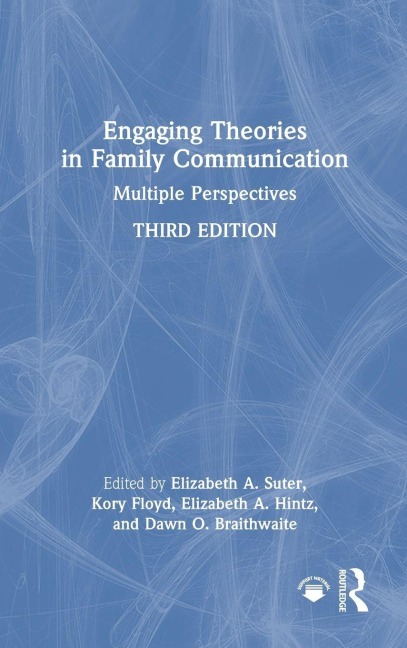
Bringing together the work of 60 contributors who represent both leading voices in family communication scholarship and an inspiring new generation of scholars shaping the field's future, this third edition is a comprehensive and accessible overview of the theories that form the foundation of the family communication field. The book begins with an overview chapter including an updated empirical analysis of family communication research from 1990 to 2024. Twenty-seven theory chapters follow. Each chapter is dedicated to a single theory and follows a consistent structure, allowing readers to engage deeply with individual theories and draw comparisons between multiple theories. The third edition offers two new sections. (Meta)Theoretical Perspectives includes critical feminism, discourse dependence, systems theory, social constructionism, and natural selection. Looking Ahead features a multi-authored chapter that addresses emerging developments in the study of Black families, Indigenous perspectives, the Global South, Latina/o/x perspectives, and quantitative criticalism. This third edition features ten theories new to this edition, six of which were developed within the discipline of communication studies. Ideal for advanced undergraduate and graduate students studying family communication, this text is also relevant for scholars and students of personal relationships, interpersonal communication, and family studies. Theories from the second edition that are not included in this third edition can be downloaded from the book's website: www.routledge.com/9781041013181.
Elizabeth A. Suter is professor and director of undergraduate studies in the department of communication studies at the University of Denver, USA. Kory Floyd is professor and chair of human development at Washington State University, USA. Elizabeth A. Hintz is assistant professor of communication at the University of Connecticut, USA. Dawn O. Braithwaite is Willa Cather Professor Emerita of communication at the University of Nebraska-Lincoln, USA.
1. Introduction: The Landscape of Paradigm and Theory in Family Communication Research Part 1: (Meta)Theoretical Perspectives in Family Communication Research 2. Critical Feminist Family Communication Theory: Gender, Critique, and Praxis 3. Discourse Dependent Theory: Constituting "Family" through Language 4. General Systems Theory: A Worldview Applied to Family Interactions 5. Social Construction Theory: Communication Co-Creating Families 6. Theory of Natural Selection: An Evolutionary Approach to Family Communication Part II: Theoretical Perspectives in Family Communication Research 7. Advocacy Communication Theory: Family Communication as an Early Site of Resistance 8. Affection Exchange Theory: A Bio-Evolutionary Look at Affectionate Communication 9. Attachment Theory in Families: The Role of Communication 10. Communicated Narrative Sense-Making Theory: Linking Storytelling and Well-Being 11. Communication Accommodation Theory and Communication Theory of Identity: Individual Identities and Family Relationships 12. Communication Privacy Management Theory: Understanding Families 13. Communication Theory of Resilience: Untangling Adaptive-Transformative Processes When Families Anticipate or Experience Loss and Disruption 14. Communicative Relational Distancing Theory: Navigating Distance in Personal Relationships 15. Confirmation Theory: Family Relational Climates and Child Development 16. Critical Communication and Race Theory: Embedding Family Processes Within Wider Systems of Race and Racism 17. Family Communication Patterns Theory: A Grand Theory of Family Communication 18. Intergroup Communication Theoretical Perspective: Understanding and Recognizing Identity and Difference in Family Relationships 19. Intersectionality theory: Moving the margins for (Black) family communication 20. Minority Stress Theory: Family as a Site of Both Support and Strain 21. Narrative Performance Theory: Making Stories, Doing Family 22. Queer Theory: Challenging Heteronormative Expectations of Family 23. Relational Dialectics Theory: Critically Examining Talk Within and About Family 24. Relational Turbulence Theory: Understanding Family Communication During Times of Change 25. Social Learning Theory: Modeling and Communication within the Family 26. Theory of Communicative (Dis)enfranchisement: Ramifications, Reification, and Resistance 27. Theory of Memorable Messages: Applications for Family Communication 28. Theory of Resilience and Relational Load: Understanding the Communication of Stress and Resilience in Families Part III: Looking Ahead 29. Emerging Conceptual and Theoretical Perspectives Black Families: Traditions, Practices, and Possibilities Global South Perspectives of Family Communication: Beyond Eurocentrism Indigenous Perspectives in Family Communication Studies: Alternative Understandings for Ways of Being and Communicating in Families Latina/o/x Perspectives: Historical Contexts and Future Directions Quantitative Criticalism: Using Statistical Methods to Expose Systemic Inequalities