Und dann auf "Zum Home-Bildschirm [+]".

Stöbern
genialokal zum Startbildschirm hinzufügen
Installieren Sie die genialokal App auf Ihrem Startbildschirm für einen schnellen Zugriff und eine komfortable Nutzung.
Installieren Sie die genialokal App auf Ihrem Startbildschirm für einen schnellen Zugriff und eine komfortable Nutzung.
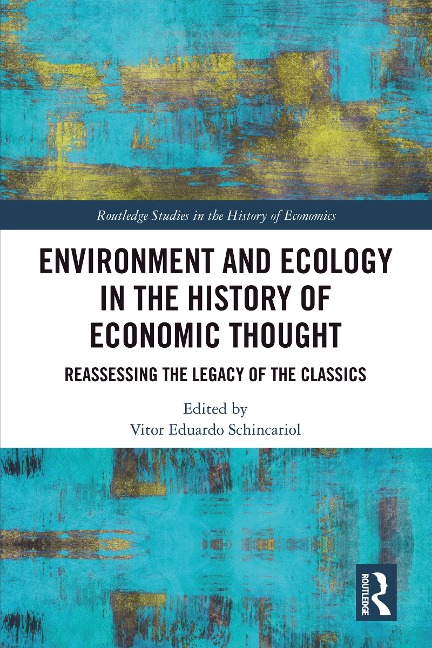
This volume proposes a reconsideration of ecological and environmental aspects of the work and ideas of various heterodox authors and traditions in the history of economic thought, including the field of economic development. Many of the contributors to this book focus on thinkers and works which are not typically considered as part of the ecological sphere, while others consider such economists in a new light or domain. Thus, the book elucidates a new and useful research field of reconsidering ecological dimensions in the traditional history of economic thought as well as helping to delineate alternative views for ongoing debates on ecological themes. Did Veblen, Keynes, Sraffa, C. Furtado and other key economists and schools of thought of our age have relevant and useful insights with respect to environmental issues? Which aspects of their intellectual legacies should eventually be discarded in the face of our new environmental challenges? On the contrary, what aspects of their economic theories can be updated and adapted to a better interpretation of our present ecological concerns? How do they differ, and why? The essays contained in this book will help to answer these questions, by means of recovering, analysing and updating the work of some of the most relevant heterodox economists and schools of thought of our time. This book will be of great interest for readers in the history of economic thought, ecological economics, environmental economics and economic development.
Vitor Eduardo Schincariol holds a PhD in economic history from the University of São Paulo and is Associate Professor of Economic History and Political Economy at the Federal University of ABC, São Paulo, Brazil.
PART I: Classical political economy and the surplus approach 1. Introduction 2. Adam Smith as ecological economist 3. On the accommodation of the ecological question in the Sraffian tradition PART II: Institutional and Post-Keynesian Economics 4. Environment and ecology in home economics 5. Nature, exploitation and institutions: on the political ecology of Thorstein Veblen and Karl Polanyi 6. Some Post-Keynesian principles for an environmental macroeconomics 7. Environment, development and equity in the work of Geoff Harcourt PART III: Economic development 8. Reflections on economic development and environment 9. Celso Furtado and environmental sustainability: economic development between myth and utopia Vitor Eduardo Schincariol 10. The evolution of the ecological perspective in Latin American Structuralism 11. Nicholas Georgescu-Roegen and the management of extractive resources
Dieses eBook wird im PDF-Format geliefert und ist mit einem Adobe Kopierschutz (DRM) versehen. Sie können dieses eBook mit allen Geräten lesen, die das PDF-Format und den Adobe Kopierschutz (DRM) unterstützen.
Zum Beispiel mit den folgenden Geräten:
• tolino Reader
Laden Sie das eBook direkt über den Reader-Shop auf dem tolino herunter oder übertragen Sie das eBook auf Ihren tolino mit einer kostenlosen Software wie beispielsweise Adobe Digital Editions.
• Sony Reader & andere eBook Reader
Laden Sie das eBook direkt über den Reader-Shop herunter oder übertragen Sie das eBook mit der kostenlosen Software Sony READER FOR PC/Mac oder Adobe Digital Editions auf ein Standard-Lesegeräte mit epub- und Adobe DRM-Unterstützung.
• Tablets & Smartphones
Möchten Sie dieses eBook auf Ihrem Smartphone oder Tablet lesen, finden Sie hier unsere kostenlose Lese-App für iPhone/iPad und Android Smartphone/Tablets.
• PC & Mac
Lesen Sie das eBook direkt nach dem Herunterladen mit einer kostenlosen Lesesoftware, beispielsweise Adobe Digital Editions, Sony READER FOR PC/Mac oder direkt über Ihre eBook-Bibliothek in Ihrem Konto unter „Meine eBooks“ - „online lesen“.
Schalten Sie das eBook mit Ihrer persönlichen Adobe ID auf bis zu sechs Geräten gleichzeitig frei.
Bitte beachten Sie, dass die Kindle-Geräte das Format nicht unterstützen und dieses eBook somit nicht auf Kindle-Geräten lesbar ist.