Und dann auf "Zum Home-Bildschirm [+]".

Stöbern
genialokal zum Startbildschirm hinzufügen
Installieren Sie die genialokal App auf Ihrem Startbildschirm für einen schnellen Zugriff und eine komfortable Nutzung.
Installieren Sie die genialokal App auf Ihrem Startbildschirm für einen schnellen Zugriff und eine komfortable Nutzung.
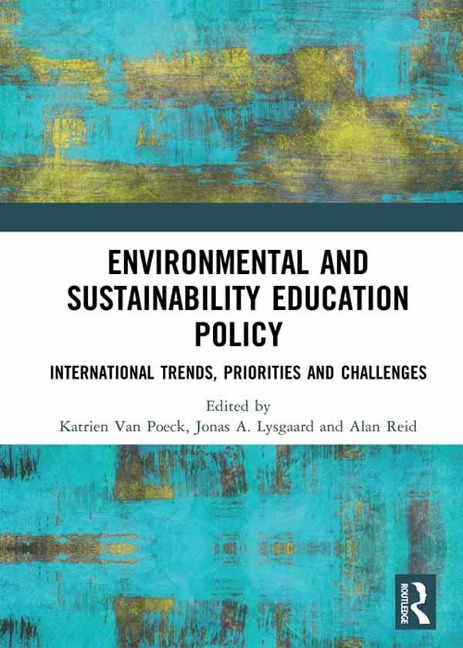
This timely collection surveys and critiques studies of environmental and sustainability education (ESE) policy since the mid-1990s. The volume draws on a wide range of policy studies and syntheses to provide readers with insights into the international genealogy and priorities of ESE policy. Editors and contributors call for renewed attention to the possibilities for future directions in light of previously published work and innovations in scholarship. They also offer critical commentary on the evolution of research trends, approaches and findings. Including a wide range of examples of ESE policy and policy research, the book draws on studies of educational initiatives and legislation, policy making processes and rhetoric, ideological orthodoxy and critique, curriculum making and educational theory, globalisation and neoliberalism, climate change and environmental worldviews, and much more. In addition, introductory commentary from the editors traces how ESE researchers have dealt with key trends, complexities and issues in the policy-practice-research nexus both conceptually and empirically. Throughout the collection, contributions illustrate how researchers might reimagine and reinvigorate policy research on ESE, including how working with other fields and diverse perspectives, ideas and expertise will aid the cross-fertilisation of a complex terrain of ideas, policy and practice. This book is based on a special issue of Environmental Education Research.
Katrien Van Poeck is a Postdoctoral Researcher at Ghent University's Centre for Sustainable Development. She conducts and supervises research projects on experiential learning in the context of urban sustainability transitions and on sustainability in higher education, and coordinates the international research networks SEDwise ('Sustainability Education - Teaching and learning in the face of wicked socio-ecological problems') and 'Public pedagogy and sustainability challenges'. Empirically and theoretically examining education's role in building a more sustainable world, she aims to contribute to progressing scholarship on the relation between educative and political spaces. Jonas A. Lysgaard is Associate Professor in the Danish School of Education at Aarhus University, Denmark. He conducts research on environmental and sustainability education that draws on theoretical perspectives inspired by Lacanian psychoanalysis and contemporary perspectives on materiality. His recent studies include work on educational ideals and philosophies of education, nature and realism as these apply to climate change, sustainable schools initiatives and health promotion. Alan Reid is Associate Professor in the Faculty of Education at Monash University, Australia. He is the editor of the research journal, Environmental Education Research. He conducts a range of studies focused on teachers' thinking and practice in environmental and sustainability education, and associated traditions, capacities and issues in theory, research and practice. He is particularly interested in the history and possible future of the field.
Preface Editorial Introduction 1. The roots and routes of environmental and sustainability education policy research 2. A Case Study of Dilemmas and Tensions: the writing and consultation process involved in developing a national guideline document for environmental education 3. Science: an unreliable friend to environmental education? 4. On the need to repoliticise environmental and sustainability education: rethinking the postpolitical consensus 5. Education policy mobility: reimagining sustainability in neoliberal times 6. The Quest for Holism in Education for Sustainable Development 7. Tensions and transitions in policy discourse: recontextualizing a decontextualized EE/ESD debate 8. Unsettling orthodoxies: education for the environment/for sustainability 9. Education for sustainable development (ESD): the turn away from 'environment' in environmental education? 10. Environmental Literacy: functional, cultural, critical. The case of the SCAA guidelines 11. Education for Sustainable Development, governmentality and Learning to Last 12. The action competence approach and the 'new' discourses of education for sustainable development, competence and quality criteria 13. Pluralism in practice - experiences from Swedish evaluation, school development and research 14. Environmental education policy research - challenges and ways research might cope with them 15. Taking stock of the UN Decade of education for sustainable development: the policy-making process in Flanders 16. Globalisation and education for sustainable development: exploring the global in motion 17. Environmental and sustainability education policy research: a systematic review of methodological and thematic trends
Dieses eBook wird im PDF-Format geliefert und ist mit einem Adobe Kopierschutz (DRM) versehen. Sie können dieses eBook mit allen Geräten lesen, die das PDF-Format und den Adobe Kopierschutz (DRM) unterstützen.
Zum Beispiel mit den folgenden Geräten:
• tolino Reader
Laden Sie das eBook direkt über den Reader-Shop auf dem tolino herunter oder übertragen Sie das eBook auf Ihren tolino mit einer kostenlosen Software wie beispielsweise Adobe Digital Editions.
• Sony Reader & andere eBook Reader
Laden Sie das eBook direkt über den Reader-Shop herunter oder übertragen Sie das eBook mit der kostenlosen Software Sony READER FOR PC/Mac oder Adobe Digital Editions auf ein Standard-Lesegeräte mit epub- und Adobe DRM-Unterstützung.
• Tablets & Smartphones
Möchten Sie dieses eBook auf Ihrem Smartphone oder Tablet lesen, finden Sie hier unsere kostenlose Lese-App für iPhone/iPad und Android Smartphone/Tablets.
• PC & Mac
Lesen Sie das eBook direkt nach dem Herunterladen mit einer kostenlosen Lesesoftware, beispielsweise Adobe Digital Editions, Sony READER FOR PC/Mac oder direkt über Ihre eBook-Bibliothek in Ihrem Konto unter „Meine eBooks“ - „online lesen“.
Schalten Sie das eBook mit Ihrer persönlichen Adobe ID auf bis zu sechs Geräten gleichzeitig frei.
Bitte beachten Sie, dass die Kindle-Geräte das Format nicht unterstützen und dieses eBook somit nicht auf Kindle-Geräten lesbar ist.