
Stöbern
genialokal zum Startbildschirm hinzufügen
Installieren Sie die genialokal App auf Ihrem Startbildschirm für einen schnellen Zugriff und eine komfortable Nutzung.
Installieren Sie die genialokal App auf Ihrem Startbildschirm für einen schnellen Zugriff und eine komfortable Nutzung.
Tippen Sie einfach auf Teilen:
 Und dann auf "Zum Home-Bildschirm [+]".
Bei genialokal.de kaufen Sie online bei Ihrer lokalen, inhabergeführten Buchhandlung!

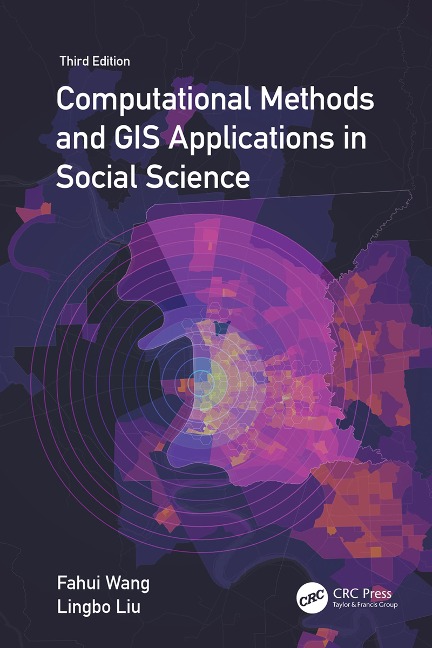
This textbook integrates GIS, spatial analysis, and computational methods for solving real-world problems in various policy-relevant social science applications. Thoroughly updated, the third edition showcases the best practices of computational spatial social science and includes numerous case studies with step-by-step instructions in ArcGIS Pro and open-source platform KNIME. Readers sharpen their GIS skills by applying GIS techniques in detecting crime hotspots, measuring accessibility of primary care physicians, forecasting the impact of hospital closures on local community, or siting the best locations for business. FEATURES - Fully updated using the latest version of ArcGIS Pro and open-source platform KNIME - Features two brand-new chapters on agent-based modeling and big data analytics - Provides newly automated tools for regionalization, functional region delineation, accessibility measures, planning for maximum equality in accessibility, and agent-based crime simulation - Includes many compelling examples and real-world case studies related to social science, urban planning, and public policy - Provides a website for downloading data and programs for implementing all case studies included in the book and the KNIME lab manual Intended for students taking upper-level undergraduate and graduate-level courses in quantitative geography, spatial analysis, and GIS applications, as well as researchers and professionals in fields such as geography, city and regional planning, crime analysis, public health, and public administration.
Fahui Wang is Associate Dean of the Pinkie Gordon Lane Graduate School and Cyril and Tutta Vetter Alumni Professor in the Department of Geography and Anthropology, Louisiana State University. He earned a BS in geography at Peking University, China, and an MA in economics and a PhD in city and regional planning at the Ohio State University. His research has revolved around the broad theme of spatially integrated computational social sciences, public policy, and planning in geographic information systems. He is among the top 1% most-cited researchers in geography in the world. Lingbo Liu is Postdoctoral Fellow at the Center for Geographic Analysis, Harvard University, leading the development of Geospatial Analytics Extension for KNIME. He was a lecturer at the Department of Urban Planning, School of Urban Design, Wuhan University, from 2005 to 2022, and earned a PhD in digital urban administration and planning at Wuhan University in 2018. His research uses multi-source data and quantitative models to capture the spatiotemporal features of urban systems and provides decision support for public policy, sustainable urban planning, and design.
Part I: GIS and Basic Spatial Analysis Tasks. 1. Getting Started with ArcGIS: Data Management and Basic Spatial Analysis Tools. 2. Measuring Distance and Travel Time and Analyzing Distance Decay Behavior. 3. Spatial Smoothing and Spatial Interpolation. Part II: Basic Computational Methods and Applications. 4. Delineating Functional Regions and Application in Health Geography. 5. GIS-Based Measures of Spatial Accessibility and Application in Examining Healthcare Disparity. 6. Function Fittings by Regressions and Application in Analyzing Urban Density Patterns. 7. Principal Components, Factor Analysis, and Cluster Analysis and Application in Social Area Analysis. 8. Spatial Statistics and Applications. 9. Regionalization Methods and Application in Analysis of Cancer Data. Part III: Advanced Computational Methods and Applications. 10. System of Linear Equations and Application of the Garin-Lowry Model in Simulating Urban Population and Employment Patterns. 11. Linear and Quadratic Programming and Applications in Examining Wasteful Commuting and Allocating Healthcare Providers. 12. Monte Carlo Method and Applications in Urban Population and Traffic Simulations. 13. Agent-Based Model and Application in Crime Simulation. 14. Spatiotemporal Big Data Analytics and Applications in Urban Studies.