Und dann auf "Zum Home-Bildschirm [+]".

Stöbern
genialokal zum Startbildschirm hinzufügen
Installieren Sie die genialokal App auf Ihrem Startbildschirm für einen schnellen Zugriff und eine komfortable Nutzung.
Installieren Sie die genialokal App auf Ihrem Startbildschirm für einen schnellen Zugriff und eine komfortable Nutzung.
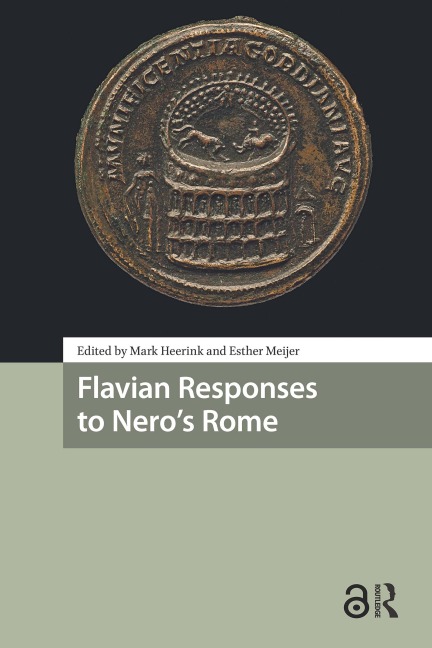
In this interdisciplinary volume, a team of classicists, historians, and archaeologists examines how the memory of the infamous emperor Nero was negotiated in different contexts and by different people during the ensuing Flavian age of imperial Rome. The contributions show different Flavian responses to Nero's complicated legacy: while some aspects of his memory were reinforced, others were erased. Emphasizing the constant and diverse nature of this negotiation, this book proposes a nuanced interpretation of both the Flavian age itself and its relation to Nero's Rome. By combining the study of these strategies with architectural approaches, archaeology, and memory studies, this volume offers a multifaceted picture of Roman civilization at a crucial turning point, and as such will have something to offer anyone interested in classics, (ancient) history, and archaeology.
Mark Heerink is Associate Professor of Latin literature at the University of Amsterdam. He is the author of Echoing Hylas: A Study in Hellenistic and Roman Metapoetics (University of Wisconsin Press, 2015) and co-editor of Brill's Companion to Valerius Flaccus (Brill, 2014). He is currently revising J.H. Mozley's 1934 edition and translation of Valerius Flaccus' Argonautica for the Loeb Classical Library. Esther Meijer is Teaching Fellow in Classics at Durham University. She recently obtained her doctoral degree with a dissertation entitled All Roads lead to Home: Navigating Self and Empire in Early Imperial Poetry (2021). Her research focuses on Neronian and Flavian literature, concentrating on the presence of philosophical currents and rhetoric of empire in poetry. Eric M. Moormann has held the chair of Classical Archaeology in Radboud University (Nijmegen) until his retirement in May 2021. His research concentrates on urban culture in Roman Italy (esp. Rome, Pompeii, Herculaneum) and interior design of Greco-Roman houses. He also works on reception history (esp. Pompeii) and the history of archaeology (esp. Winckelmann). Aurora Raimondi Cominesi is Project Curator at the Rijksmuseum van Oudheden in Leiden, where she prepared an exhibition on Domitian and co-edited the accompanying volume God on Earth: Emperor Domitian (2021). Her PhD dissertation is entitled The Past on the Wall: Anchoring Innovation in the Decoration and Architecture of the Imperial Residences on the Palatine (44 BCE-235 CE) (Radboud University, 2019) Anne Wolsfeld is a Classical archaeologist with research interests in Greek and Roman sculpture, with a focus on their iconography and semantics (Bildsprache). She received her PhD from the Albert-Ludwigs-Universität Freiburg i. Br. (Die Bildnisrepräsentation des Titus und Domitian, 2015). She currently works at the Landesmuseum für Vorgeschichte at Halle (Saale). Lisa Cordes is Assistant Professor for Latin Philology at the Humboldt_x0002_University, Berlin. She received her PhD from the Ludwig-Maximilians University, Munich (Kaiser und Tyrann. Die Kodierung und Umkodierung der Herrscherrepräsentation Neros und Domitians, 2017). Her research interests include Neronian and Flavian literature, panegyric rhetoric, ancient concepts of fiction and authorship, and gender studies in antiquity. Annemarie Ambühl is Associate Professor in Classics at the Johannes Gutenberg-Universität Mainz. Her main areas of research focus on Latin literature of the early imperial period (especially Lucan), on Hellenistic poetry and its reception, and on the role of gender issues in ruler representa_x0002_tion at Alexandria and Rome. Verena Schulz specializes in Roman imperial historiography and ancient rhetoric. Her most important publications are two monographs on Die Stimme in der antiken Rhetorik (2014) and Deconstructing Imperial Representation: Tacitus, Cassius Dio, and Suetonius on Nero and Domitian (2019). She co-edited an interdisciplinary volume on Nero und Domitian. Mediale Diskurse der Herrscherrepräsentation im Vergleich (2014). Ruurd Nauta was Professor of Latin at the University of Groningen until his early retirement in 2020. He has published widely on Flavian poetry and has recently proposed a new argument for the Neronian dating of Calpurnius Siculus: 'In Praise of Meliboeus: Calpurnius Siculus and Columella', Journal of Roman Studies, 111 (2021). Andrew B. Gallia is Associate Professor of History at the University of Minnesota. He is the author of Remembering the Roman Republic: Culture, Politics and History under the Principate (2012) and several articles on Roman history and culture. He is currently working on a study of rudeness in Roman society. Tim Stover is Associate Professor of Classics at Florida State University. He specializes in Latin literature, with a particular interest in epic poetry. In addition to articles on Lucretius, Virgil, Lucan, Valerius Flaccus, and Statius, he is the author of Epic and Empire in Vespasianic Rome (2012).
1. Introduction, 2. Nero's Divine Stepfather and the Flavian Regime, 3. The Flavians and their Women &-Re-writing Neronian Transgressions?, 4. Flavian Architecture on the Palatine: Continuity or Break?, 5. Some Observations on the Templum Pacis &-A Summa of Flavian Politics, 6. Civil War and Trauma in Valerius Flaccus' Argonautica, 7. Imitatio, aemulatio, and Ludic Allusion: Channeling Lucan in Statius' Thebaid, 8. Calpurnius Siculus in the Flavian Poets, 9. How to Portray the princeps: Visual Imperial Representation from Nero to Domitian, 10. Iuvenis infandi ingeni scelerum capaxque &-Flavian Responses to Nero's Youth, 11. Historiographical Responses to Flavian responses to Nero
Dieses eBook wird im PDF-Format geliefert und ist mit einem Adobe Kopierschutz (DRM) versehen. Sie können dieses eBook mit allen Geräten lesen, die das PDF-Format und den Adobe Kopierschutz (DRM) unterstützen.
Zum Beispiel mit den folgenden Geräten:
• tolino Reader
Laden Sie das eBook direkt über den Reader-Shop auf dem tolino herunter oder übertragen Sie das eBook auf Ihren tolino mit einer kostenlosen Software wie beispielsweise Adobe Digital Editions.
• Sony Reader & andere eBook Reader
Laden Sie das eBook direkt über den Reader-Shop herunter oder übertragen Sie das eBook mit der kostenlosen Software Sony READER FOR PC/Mac oder Adobe Digital Editions auf ein Standard-Lesegeräte mit epub- und Adobe DRM-Unterstützung.
• Tablets & Smartphones
Möchten Sie dieses eBook auf Ihrem Smartphone oder Tablet lesen, finden Sie hier unsere kostenlose Lese-App für iPhone/iPad und Android Smartphone/Tablets.
• PC & Mac
Lesen Sie das eBook direkt nach dem Herunterladen mit einer kostenlosen Lesesoftware, beispielsweise Adobe Digital Editions, Sony READER FOR PC/Mac oder direkt über Ihre eBook-Bibliothek in Ihrem Konto unter „Meine eBooks“ - „online lesen“.
Schalten Sie das eBook mit Ihrer persönlichen Adobe ID auf bis zu sechs Geräten gleichzeitig frei.
Bitte beachten Sie, dass die Kindle-Geräte das Format nicht unterstützen und dieses eBook somit nicht auf Kindle-Geräten lesbar ist.