
Stöbern
genialokal zum Startbildschirm hinzufügen
Installieren Sie die genialokal App auf Ihrem Startbildschirm für einen schnellen Zugriff und eine komfortable Nutzung.
Installieren Sie die genialokal App auf Ihrem Startbildschirm für einen schnellen Zugriff und eine komfortable Nutzung.
Tippen Sie einfach auf Teilen:
 Und dann auf "Zum Home-Bildschirm [+]".
Bei genialokal.de kaufen Sie online bei Ihrer lokalen, inhabergeführten Buchhandlung!

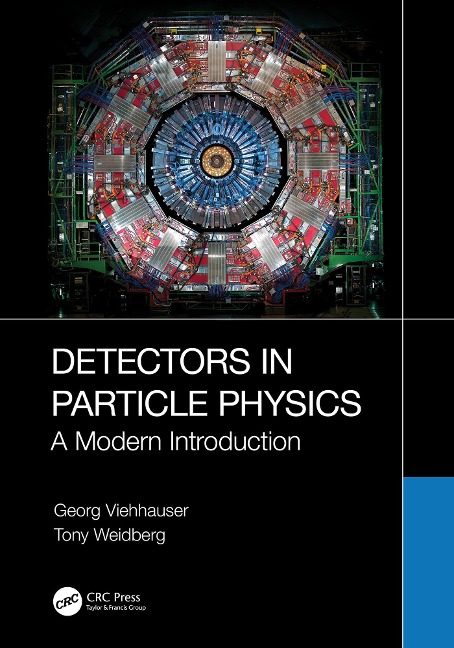
This textbook provides an accessible yet comprehensive introduction to detectors in particle physics. It emphasises the core physics principles, enabling a deeper understanding of the subject for further and more advanced studies. In addition to the discussion of the underlying detector physics, another aspiration of this book is to introduce the reader to practically important aspects of particle detectors, like electronics, alignment, calibration and simulation of particle detectors. Case studies of the various applications of detectors in particle physics are provided. The primary audience is graduate students in particle or nuclear physics, in addition to advanced undergraduate students in physics. Key Features: - Provides an accessible yet thorough discussion of the basic physics principles needed to understand how particle detectors work. - Presents applications of the basic physics concepts to examples of modern detectors. - Discusses practically important aspects like electronics, alignment, calibration and simulation of particle detectors. - Contains exercises for each chapter to further understanding. For more information and errata please see the authors companion webpage https://ppdetectors.web.ox.ac.uk/ This webpage also allows instructors to request a copy of the solutions manual. This eBook was published Open Access with funding support from the Sponsoring Consortium for Open Access Publishing in Particle Physics (SCOAP3).
Georg Viehhauser is a Lecturer in the Physics department at the University of Oxford, UK, and a supernumerary fellow at St. John's College, Oxford, UK. He has been working on a variety of different particle detector technologies, starting with the Forward Chamber A at the DELPHI experiment, the LKr calorimeter for NA48, the muon chambers for ATLAS, and the RICH for CLEO III. More recently, he has contributed to the construction of the ATLAS SCT and he is currently involved in the phase 2 upgrade of the ATLAS ITk, as well as the SVT for the ePIC experiment. He is one of the main organisers of the Forum on Tracking Detector Mechanics. Tony Weidberg is a Professor of Physics at Oxford University, UK and a tutorial fellow at St. John's College. He worked on CCD readout for a scintillating fibre detector at the CERN SPS collider. He played a major role in the founding of the ATLAS experiment and the design of the ATLAS SCT. He has a wide range of experience from detector R&D, assembly and integration of complex detector systems as well as evaluating their performance. He has extensive experience in radiation hardness studies, particularly for optoelectronics and applications of reliability theory. Both authors have a long experience in teaching undergraduate and graduate students at the University of Oxford.
Chapter 1: Introduction. Chapter 2: Interactions of Particles with Matter. Chapter 3: Electronic Signals and Noise. Chapter 4: Movement of Charges and Internal Amplification. Chapter 5: Response to Excitation. Chapter 6: Detection of Ionisation Without Charge Movement. Chapter 7: Gaseous Detectors. Chapter 8: Liquid Detectors. Chapter 9: Semiconductor Detectors. Chapter 10: Tracking. Chapter 11: Calorimetry. Chapter 12: Particle Identification. Chapter 13: Triggers. Chapter 14: Detector Systems and Applications. References. Index.