Und dann auf "Zum Home-Bildschirm [+]".

Stöbern
genialokal zum Startbildschirm hinzufügen
Installieren Sie die genialokal App auf Ihrem Startbildschirm für einen schnellen Zugriff und eine komfortable Nutzung.
Installieren Sie die genialokal App auf Ihrem Startbildschirm für einen schnellen Zugriff und eine komfortable Nutzung.
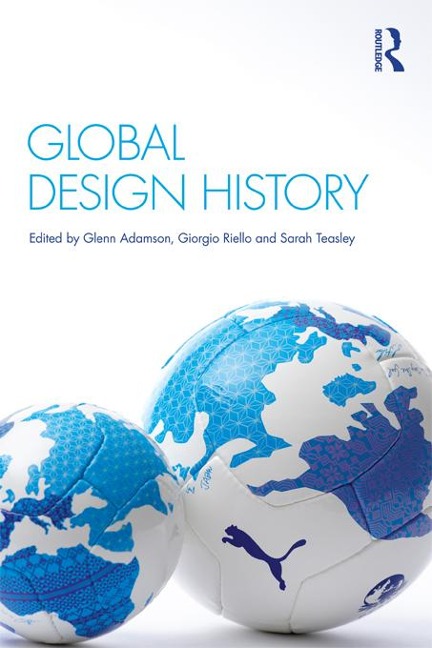
Globalism is often discussed using abstract terms, such as 'networks' or 'flows' and usually in relation to recent history. Global Design History moves us past this limited view of globalism, broadening our sense of this key term in history and theory. Individual chapters focus our attention on objects, and the stories they can tell us about cultural interactions on a global scale. They place these concrete things into contexts, such as trade, empire, mediation, and various forms of design practice. Among the varied topics included are: - the global underpinnings of Renaissance material culture - the trade of Indian cottons in the eighteenth-century - the Japanese tea ceremony as a case of 'import substitution' - German design in the context of empire - handcrafted modernist furniture in Turkey - Australian fashions employing 'ethnic' motifs - an experimental UK-Ghanaian design partnership - Chinese social networking websites - the international circulation of contemporary architects. Featuring work from leading design historians, each chapter is paired with a 'response', designed to expand the discussion and test the methodologies on offer. An extensive bibliography and resource guide will also aid further research, providing students with a user friendly model for approaches to global design. Global Design History will be useful for upper-level undergraduate and postgraduate students, academics and researchers in design history and art history, and related subjects such as anthropology, craft studies and cultural geography.
Glenn Adamson is Deputy Head of Research at the Victoria and Albert Museum, where he leads a graduate programme in the History of Design. He is co-editor of The Journal of Modern Craft, and author of Thinking Through Craft (2007) and The Craft Reader (2010). Giorgio Riello is Associate Professor in Global History and Culture at the University of Warwick, UK. He is the author of A Foot in the Past (2006) and has recently co-edited The Spinning World: A Global History of Cotton Textiles, 1200-1850 (2009) and The Fashion History Reader (2010). Sarah Teasley is Tutor in the History of Design and Liaison Tutor in Critical and Historical Studies at the Royal College of Art, UK. She is co-author of 20th Century Design History (2005), and a specialist in the history of design for mass production in modern Japan.
Selected Contents: Preface Introduction: Towards Global Design History Sarah Teasley, Giorgio Riello, and Glenn Adamson 1. The Global Renaissance: Cross-Cultural Material Culture and the Creation of a Community of Taste Marta Ajmar-Wollheim and Luca Molà Response by Dana Leibsohn 2. Global Design in Jingdezhen: Local Production and Global Connections Anne Gerritsen Response by Beverly Lemire 3. Indian Cottons and European Fashion, 1400-1800 John Styles Response by Prasannan Parthasarathi 4. Import Substitution, Innovation and the Tea Ceremony in Fifteenth and Sixteenth-Century Japan Christine M. E. Guth Response by Maxine Berg 5. The Globalization of the Fashion City Christopher Breward Response by Simona Segre Reinach 6. Performing White South African Identity through International and Empire Exhibitions Dipti Bhagat Response by Angus Lockyer 7. 'From the Far Corners': Telephones, Globalization, and the Production of Locality in the 1920s Michael J. Golec Response by Anne Balsamo 8. The Globalization of the Deutscher Werkbund: Design Reform, Industrial Policy, and German Foreign Policy, 1907-1914 John Maciuika Response by Paul Betts 9. Where in the World is Design?: The Case of India, 1900-1945 Victor Margolin Response by Christopher Pinney 10. 'Handmade Modernity': A Case Study on Postwar Turkish Modern Furniture Design Gyökan Karakus Response by Edward S. Cooke, Jr. 11. Old Empire and New Global Luxury: Fashioning Global Design Peter McNeil Response by Shehnaz Suterwalla 12. Analyzing Social Networking Websites: The Design of Happy Network in China Basile Zimmermann Response by Ngai-Ling Sum 13. From Nation-bound Histories to Global Narratives of Architecture Jilly Traganou Response by Lucia Allais 14. e-Artisans: Contemporary Design for the Global Market Tom Barker and Ashley Hall Response by Shannon May Bibliography Resource Guide
Dieses eBook wird im PDF-Format geliefert und ist mit einem Adobe Kopierschutz (DRM) versehen. Sie können dieses eBook mit allen Geräten lesen, die das PDF-Format und den Adobe Kopierschutz (DRM) unterstützen.
Zum Beispiel mit den folgenden Geräten:
• tolino Reader
Laden Sie das eBook direkt über den Reader-Shop auf dem tolino herunter oder übertragen Sie das eBook auf Ihren tolino mit einer kostenlosen Software wie beispielsweise Adobe Digital Editions.
• Sony Reader & andere eBook Reader
Laden Sie das eBook direkt über den Reader-Shop herunter oder übertragen Sie das eBook mit der kostenlosen Software Sony READER FOR PC/Mac oder Adobe Digital Editions auf ein Standard-Lesegeräte mit epub- und Adobe DRM-Unterstützung.
• Tablets & Smartphones
Möchten Sie dieses eBook auf Ihrem Smartphone oder Tablet lesen, finden Sie hier unsere kostenlose Lese-App für iPhone/iPad und Android Smartphone/Tablets.
• PC & Mac
Lesen Sie das eBook direkt nach dem Herunterladen mit einer kostenlosen Lesesoftware, beispielsweise Adobe Digital Editions, Sony READER FOR PC/Mac oder direkt über Ihre eBook-Bibliothek in Ihrem Konto unter „Meine eBooks“ - „online lesen“.
Schalten Sie das eBook mit Ihrer persönlichen Adobe ID auf bis zu sechs Geräten gleichzeitig frei.
Bitte beachten Sie, dass die Kindle-Geräte das Format nicht unterstützen und dieses eBook somit nicht auf Kindle-Geräten lesbar ist.