Und dann auf "Zum Home-Bildschirm [+]".

Stöbern
genialokal zum Startbildschirm hinzufügen
Installieren Sie die genialokal App auf Ihrem Startbildschirm für einen schnellen Zugriff und eine komfortable Nutzung.
Installieren Sie die genialokal App auf Ihrem Startbildschirm für einen schnellen Zugriff und eine komfortable Nutzung.
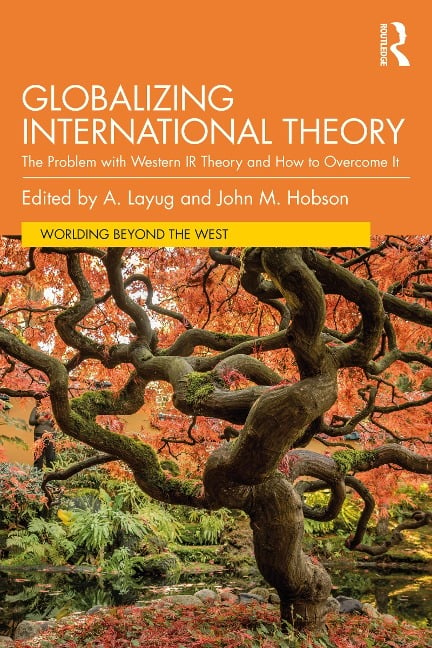
Globalizing International Theory adds to the literature on non-Western international relations (IR) theory by probing the question of what it means to globalize international theory. The book starts with the premise that international theory is unfinished, incomplete, and homogenous because it provides a limited conception of the international which, in turn, derives from its partiality that reflects its narrow Western-centric bias. The contributors argue that the IR vision of the world is projected through a polarizing Western-filtered lens. Rather than utilizing an objective set of explanatory tools for explaining world politics, the reality is that orthodox IR theory only tells us why 'the West is best' and why 'the Rest should become like the West'. This means that international theory is not truly international. In provincializing Western international theory, this volume navigates beyond the Eurocentric and imperial frontier of the prevailing limited conception of the international to explore the hidden contributions to international theory which can be found in the non-Western world. Bringing in excluded, non-Western conceptions of international theory highlights a broader conception of the international. The book provides a framework for theorizing globally, exploring the fundamental problems with Western IR theory, and how to overcome them. This book will be used by advanced undergraduate and postgraduate students, scholars, researchers, and IR theorists worldwide who are interested in non-Western IR theory. It will help navigate the problem of internationalness in the face of the grand theoretical problem of our time: the use and misuse of international theory in making sense of, and responding to, the complex global realities of the twenty-first century.
A. Layug is a PhD Candidate in the School of Political Science and International Studies at the University of Queensland, Australia; research associate at the Fairbank Center for Chinese Studies at Harvard University, USA; and an associate at the Center for Global Knowledge Studies at the University of Cambridge, UK. His research interests include international theory, international security, global strategic thought/culture, global political theory, global intellectual history, theories of world order, international relations of the Global South, US and China's Grand Strategies, Islam, the Association of Southeast Asian Nations (ASEAN), and Philippine politics and foreign/security relations. John M. Hobson is Professor of Politics and International Relations at the University of Sheffield, UK, and is a Fellow of the British Academy. His research interests comprise the critique of Eurocentrism in international relations/international political economy with an emphasis on connected global historical sociologies.
Preface: Thickening International Theory or Shrinking the Shagreen Skin? Acknowledgments 1. On the Road Toward a Globalized International Theory Part 1. Racist/Eurocentric Foundations of IR, c.1850-2020: Why IR's Conception of the International is Provincial and Thin 2. Beyond a 'More International' International Relations 3. Un-veiling the Racist Foundations of Modern Realist and Liberal IR Theory Part 2. Problematizing International Theory: How and Why 'Bringing the Non-Western World In' Overcomes the Thin Eurocentric Conception of the International 4. Challenging the Illusion of Theoretical 'Internationalness' 5. Being International and/or Global? 6. On the Logic of Non-Western Theoretical Argument 7. Identity, Knowledge, Dialogue and the International Part 3. Globalizing International Theory: Constructing a Non-Eurocentric Thick Conception of the International 8. Ethno-Culturalism in World History: Race, Identity and 'the Global' 9. Pluriversality in Islamic Political Thought 10. International or Not, Being Human is Being 'Global'! 11. Indigenous Disruptions: How Indigenous Self-Determination Practices Can Deepen and Expand International Theory 12. International Theory and Critique in Unusual Places: From Lusotropicalism to Anticolonial Poetics Part 4. Conclusion: Reflections on Globalizing International Theory 13. Thick/Thin as Multifaceted Metaphor
Dieses eBook wird im PDF-Format geliefert und ist mit einem Adobe Kopierschutz (DRM) versehen. Sie können dieses eBook mit allen Geräten lesen, die das PDF-Format und den Adobe Kopierschutz (DRM) unterstützen.
Zum Beispiel mit den folgenden Geräten:
• tolino Reader
Laden Sie das eBook direkt über den Reader-Shop auf dem tolino herunter oder übertragen Sie das eBook auf Ihren tolino mit einer kostenlosen Software wie beispielsweise Adobe Digital Editions.
• Sony Reader & andere eBook Reader
Laden Sie das eBook direkt über den Reader-Shop herunter oder übertragen Sie das eBook mit der kostenlosen Software Sony READER FOR PC/Mac oder Adobe Digital Editions auf ein Standard-Lesegeräte mit epub- und Adobe DRM-Unterstützung.
• Tablets & Smartphones
Möchten Sie dieses eBook auf Ihrem Smartphone oder Tablet lesen, finden Sie hier unsere kostenlose Lese-App für iPhone/iPad und Android Smartphone/Tablets.
• PC & Mac
Lesen Sie das eBook direkt nach dem Herunterladen mit einer kostenlosen Lesesoftware, beispielsweise Adobe Digital Editions, Sony READER FOR PC/Mac oder direkt über Ihre eBook-Bibliothek in Ihrem Konto unter „Meine eBooks“ - „online lesen“.
Schalten Sie das eBook mit Ihrer persönlichen Adobe ID auf bis zu sechs Geräten gleichzeitig frei.
Bitte beachten Sie, dass die Kindle-Geräte das Format nicht unterstützen und dieses eBook somit nicht auf Kindle-Geräten lesbar ist.