Und dann auf "Zum Home-Bildschirm [+]".

Stöbern
genialokal zum Startbildschirm hinzufügen
Installieren Sie die genialokal App auf Ihrem Startbildschirm für einen schnellen Zugriff und eine komfortable Nutzung.
Installieren Sie die genialokal App auf Ihrem Startbildschirm für einen schnellen Zugriff und eine komfortable Nutzung.
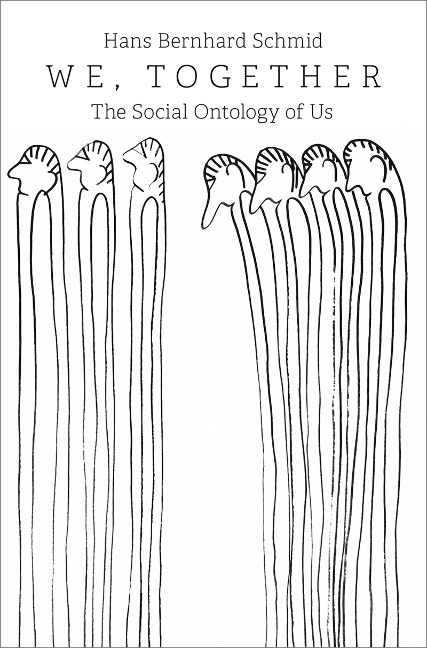
Who are we and what do we do as agents living together? In We, Together, Hans Bernhard Schmid argues, first, that our living together is a joint activity. Joint activities involve shared intentions, and shared intentions have plural intentional subjects. We are, thus, the plural subjects of our shared intentions in the same way as we are the singular subjects of our individual intentions: through pre-reflective self-awareness. Just as there is no substantive, singular "self," "I," or ego, there is no substantive "we." In order to understand who we are, together, it is important to see that intentional subjects are a feature of intentionality. Schmid continues with the assertion that the social worlds of roles and statuses, norms and structures, institutions and artifacts are our ways of living together. As such, the social worlds are determined neither by Nature nor Gods, but by us. What can be harmful, Schmid writes, is our frequent and systematic failure to understand our own place as both creatures and creators of social worlds. This brings We, Together back to our existence as plural intentional subjects. How we live together is up to us, together. The book suggests that understanding this might enable us to do better--to live well, better, together.
Hans Bernhard Schmid is Professor of Political and Social Philosophy at the University of Vienna. He received training in Sociology, Philosophy, and the History of the Middle Ages at the University of Basel, where he was also an SNRF Research Professor of Philosophy (2006-2011). Previous positions include Visiting Researcher with the Graduate Faculty at the New School for Social Research and Lecturer at the universities of St. Gallen, Basel, and Freiburg. Schmid is a co-founder of the International Social Ontology Society (ISOS) and the Editor-in-Chief of the Journal of Social Ontology.
Contents Preface: We who? Introduction: Fundamental Social Ontology I. Acting Together 1) Living Together 2) What's Shared in Shared Intention? 3) The Content of Shared Intention 4) The Subject of Shared Intention 5) The Mode of Shared Intention 6) So Who's "the We"? II. We as Plural Subjects 7) What is an Intentional Subject? 8) The Case for Singularism 9) Why Pluralism? 10) Plural Self-Identification 11) We who? Kita! 12) Plural Self-Validation 13) Plural Self-Commitment 14) Plural Self-Authorization 15) Plural Intentional Subjects III. Conceiving of Ourselves 16) Socialization: Joining in 17) Community: Being Together 18) Social Norms: Doing it Our Way 19) Society: Playing our Roles 20) Politics: Achieving Autonomy 21) Ethics: Owning up to Ourselves Postscript: Philosophizing Together References
Dieses eBook wird im PDF-Format geliefert und ist mit einem Adobe Kopierschutz (DRM) versehen. Sie können dieses eBook mit allen Geräten lesen, die das PDF-Format und den Adobe Kopierschutz (DRM) unterstützen.
Zum Beispiel mit den folgenden Geräten:
• tolino Reader
Laden Sie das eBook direkt über den Reader-Shop auf dem tolino herunter oder übertragen Sie das eBook auf Ihren tolino mit einer kostenlosen Software wie beispielsweise Adobe Digital Editions.
• Sony Reader & andere eBook Reader
Laden Sie das eBook direkt über den Reader-Shop herunter oder übertragen Sie das eBook mit der kostenlosen Software Sony READER FOR PC/Mac oder Adobe Digital Editions auf ein Standard-Lesegeräte mit epub- und Adobe DRM-Unterstützung.
• Tablets & Smartphones
Möchten Sie dieses eBook auf Ihrem Smartphone oder Tablet lesen, finden Sie hier unsere kostenlose Lese-App für iPhone/iPad und Android Smartphone/Tablets.
• PC & Mac
Lesen Sie das eBook direkt nach dem Herunterladen mit einer kostenlosen Lesesoftware, beispielsweise Adobe Digital Editions, Sony READER FOR PC/Mac oder direkt über Ihre eBook-Bibliothek in Ihrem Konto unter „Meine eBooks“ - „online lesen“.
Schalten Sie das eBook mit Ihrer persönlichen Adobe ID auf bis zu sechs Geräten gleichzeitig frei.
Bitte beachten Sie, dass die Kindle-Geräte das Format nicht unterstützen und dieses eBook somit nicht auf Kindle-Geräten lesbar ist.