Und dann auf "Zum Home-Bildschirm [+]".

Stöbern
genialokal zum Startbildschirm hinzufügen
Installieren Sie die genialokal App auf Ihrem Startbildschirm für einen schnellen Zugriff und eine komfortable Nutzung.
Installieren Sie die genialokal App auf Ihrem Startbildschirm für einen schnellen Zugriff und eine komfortable Nutzung.
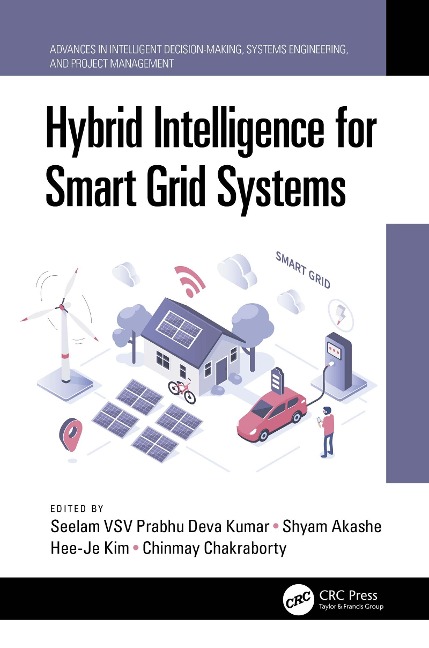
This book provides an overview of distributed control and distributed optimization theory, followed by specific details on industrial applications to smart grid systems. It discusses the fundamental analysis and design schemes for developing actual working smart grids and covers all aspects concerning the conventional and nonconventional methods of their use. Hybrid Intelligence for Smart Grid Systems provides an overview of a smart grid, along with its needs, benefits, challenges, and existing structure and describes the inverter topologies adopted for integrating renewable power, and provides an overview of its needs, benefits, challenges, and possible future technologies. This pioneering book is a must-read for researchers, engineering professionals, and students, giving them the tools needed to move from the concept of a smart grid to its actual design and implementation. Moreover, it will enable regulators, policymakers, and energy executives to understand the future of energy delivery systems towards safe, economical, high-quality power delivery in a dynamic and demanding environment.
Seelam VSV Prabhu Deva Kumar is an Assistant Researcher (R&D) in JoongAng Control Co., Ltd. South Korea. He graduated Masters in Electrical Engineering, Pusan National University, South Korea, and Bachelors in Electronics and Communication Engineering, ITM University, M.P. India. He is also a certified Chartered Engineer (C.Eng) and member of IET (UK), IEI (India), SESI (India). His research area focuses on DC-DC Converters and On/Off-Grid Inverters. Shyam Akashe got PhD from Electronics and Communication Engineering, Thapar University, Panjab, India. At present he is professor of Department of Electronics and Communication Engineering in ITM University, Gwalior, India. He is a Board Member of VLSI Circuits and Systems Letter, IEEE African Journal of Computing & ICTS, IE, IETE, ISTE, ISOI, VSI. Biography published in Marquis's Who's Who in Engineering Field, USA awarded by Marquis, 2015 Our research area mainly in Designing of low power CMOS circuits, Modelling, FinFET based memory design, Implementation of control algorithms and digital design in FPGA boards, IoT application, Low voltage DC-DC converters. Hee-Je Kim got PhD of Energy Conversion, Kyushu University, Japan. At present he is professor of Department of Electrical Engineering in Pusan National University, South Korea. He is a Board Member of Journal [Energies], Korea Institute of Electrical Engineers and Renewable Energy. Our research area mainly in Fabrication and commercialization of next-generation solar cells such as dye synthesized, perovskite solar cells etc... Improving efficiency of existing solar and wind hybrid systems using different techniques. High energy and power density flexible super-capacitor for hybrid-energy storage system. Converter, MPPT, PV Inverter, Remote-control by smart-phone with novel algorithm for Power conditioning system. Chinmay Chakraborty is an Assistant Professor (Sr.) in the Department of Electronics and Communication Engineering, BIT Mesra, India. His primary areas of research include Wireless body area network, Internet of Medical Things, point-of-care diagnosis, Smart City, Green Technology, m-Health/e-health, and Medical imaging. He has published more than 15 edited books, and co-editing 10 books on Smart IoMT, Healthcare Technology, and Sensor Data Analytics with CRC Press, IET, Pan Stanford, and Springer. He received a Young Research Excellence Award, Global Peer Review Award, Young Faculty Award, and Outstanding Researcher Award.
1. Performance Comparison of Various FACTS Devices in Combined LFC and AVR of Multi-Area System for Simultaneous Frequency and Coltage Stabilization. 2. Reliable Energy Storage System for the Grid Integration. 3. Implementation of Solar, UC/Battery-Based Hybrid Electric Vehicle with an Efficient Controller. 4. Recreation and Control of Multi Rotor Wind Power Generating Scheme for Pumping Applications. 5. Analytical Study of DC-to-DC Power Converter. 6. Controller for a Remotely Located PV/Wind Hybrid Energy System Implemented via Internet of Things. 7. Facile Hydrothermal Synthesis of CuS/MnS Composite Material Improved Improved the Power Conversion Efficiency of Quantum-Dot Sensitized Solar Cells. 8. Performance Investigation of LG-SDM-FSO Transmission Link under Snow Weather Conditions. 9. Optimization of Energy Consumption in the Wireless Sensor Network (WSN) Using IoT-Based Cross-Layer Model. 10. Study and Analysis of Average Throughput Based on the Performance of Broadcast Scheme in Wireless Ad-hoc Networks. 11. Advanced Metering in Smart Distributions Grid.
Dieses eBook wird im PDF-Format geliefert und ist mit einem Adobe Kopierschutz (DRM) versehen. Sie können dieses eBook mit allen Geräten lesen, die das PDF-Format und den Adobe Kopierschutz (DRM) unterstützen.
Zum Beispiel mit den folgenden Geräten:
• tolino Reader
Laden Sie das eBook direkt über den Reader-Shop auf dem tolino herunter oder übertragen Sie das eBook auf Ihren tolino mit einer kostenlosen Software wie beispielsweise Adobe Digital Editions.
• Sony Reader & andere eBook Reader
Laden Sie das eBook direkt über den Reader-Shop herunter oder übertragen Sie das eBook mit der kostenlosen Software Sony READER FOR PC/Mac oder Adobe Digital Editions auf ein Standard-Lesegeräte mit epub- und Adobe DRM-Unterstützung.
• Tablets & Smartphones
Möchten Sie dieses eBook auf Ihrem Smartphone oder Tablet lesen, finden Sie hier unsere kostenlose Lese-App für iPhone/iPad und Android Smartphone/Tablets.
• PC & Mac
Lesen Sie das eBook direkt nach dem Herunterladen mit einer kostenlosen Lesesoftware, beispielsweise Adobe Digital Editions, Sony READER FOR PC/Mac oder direkt über Ihre eBook-Bibliothek in Ihrem Konto unter „Meine eBooks“ - „online lesen“.
Schalten Sie das eBook mit Ihrer persönlichen Adobe ID auf bis zu sechs Geräten gleichzeitig frei.
Bitte beachten Sie, dass die Kindle-Geräte das Format nicht unterstützen und dieses eBook somit nicht auf Kindle-Geräten lesbar ist.