Und dann auf "Zum Home-Bildschirm [+]".

Stöbern
genialokal zum Startbildschirm hinzufügen
Installieren Sie die genialokal App auf Ihrem Startbildschirm für einen schnellen Zugriff und eine komfortable Nutzung.
Installieren Sie die genialokal App auf Ihrem Startbildschirm für einen schnellen Zugriff und eine komfortable Nutzung.
Ihr gewünschter Artikel ist in 0 Buchhandlungen vorrätig - wählen Sie hier eine Buchhandlung in Ihrer Nähe aus:

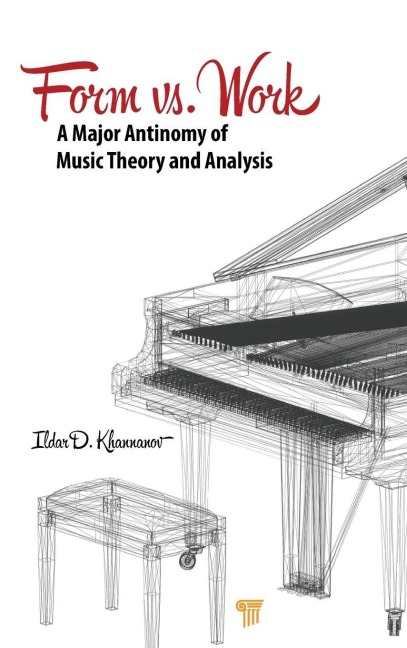
This book covers the events related to the binary opposition of form vs. work, that is, the interaction of formalists and integralists. It also presents the history and evolution of the Soviet music theory viewed from the standpoint of an insider.
Ildar D. Khannanov is associate professor of music theory at Peabody Institute, Johns Hopkins University. He is a student of Yuri Kholopov (Moscow Conservatory), Pieter C. Van den Toorn (University of California, Santa Barbara), and Jacques Derrida (University of California, Irvine) and is a member of the Scientific Committee of EuroMAC. His scholarly interests range from music theory and analysis to philosophy, Soviet music theory, musical semiotics, ethnomusicology, and film music. Dr Khannanov has authored books and articles in English and Russian languages, including The Nonverbal Specificity of Music: Music Beyond Logos (2019), Music of Sergei Rachmaninoff: Seven Musical-Theoretical Etudes (2011), translation of Boleslav Yavorsky's treatise The Design of Musical Speech (2022), chapters in Sounding the Virtual: Gilles Deleuze and the Theory and Philosophy of Music (2011), L'Analyse aujourd'hui (2015), and The Routledge Companion on Music and Space (2023). He actively participates in international conferences globally and took part in organizing the 10th European Music Analysis Conference (EuroMAC-10).
Introduction 1. The Antinomy of Musical Form vs. Work: Integralism vs. Formalism 2. Early Stages of Integralism in Russia: Eleventh through Seventeenth Centuries 3. Encounters with Western Formalism: Seventeenth-Twentieth Centuries 4. Reemergence of Integralism in the Nineteenth and Twentieth Centuries 5. Late Soviet and Post-Soviet Developments of the Opposition Form vs. Work 6. Sample Analyses: Formalist, Integralist and Mixed 7. In Lieu of Conclusion: Contemplation on the Categories of the Whole, Logos and Theory