Und dann auf "Zum Home-Bildschirm [+]".

Stöbern
genialokal zum Startbildschirm hinzufügen
Installieren Sie die genialokal App auf Ihrem Startbildschirm für einen schnellen Zugriff und eine komfortable Nutzung.
Installieren Sie die genialokal App auf Ihrem Startbildschirm für einen schnellen Zugriff und eine komfortable Nutzung.
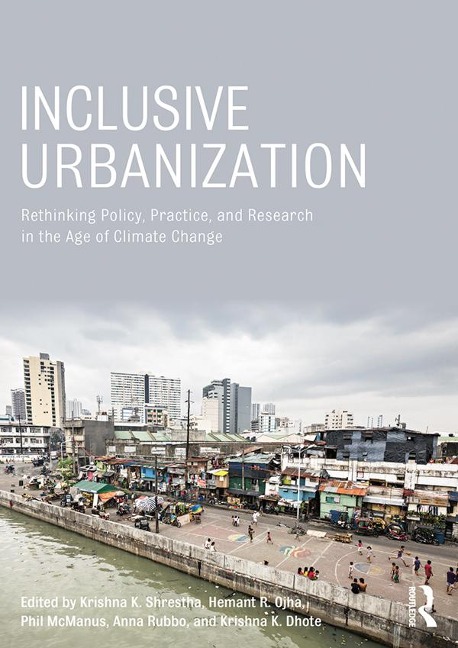
How do we include and represent all people in cities? As the world rapidly urbanizes, and climate change creates global winners and losers, understanding how to design cities that provide for all their citizens is of the utmost importance. Inclusive Urbanization attempts to not only provide meaningful, practical guidance to urban designers, managers, and local actors, but also create a definition of inclusion that incorporates strategies bigger than the welfare state, and tactics that bring local actors and the state into meaningful dialogue. Written by a team of experienced academics, designers, and NGO professionals, Inclusive Urbanization shows how urbanization policy and management can be used to make more inclusive, climate resilient cities, through a series of 18 case studies in South Asia. By creating a model of urban life and processes that takes into account social, spatial, cultural, regulatory and economic dimensions, the book finds a way to make both the processes and outcomes of urban design representative of all of the city's inhabitants.
Krishna K. Shrestha is Senior Lecturer in Development Studies at the School of Social Sciences, University of New South Wales, Australia. Hemant R. Ojha is Research Fellow with the School of Social Sciences at the University of New South Wales, Australia, and also the Chair of Southasia Institute of Advanced Studies (SIAS), Nepal. Phil McManus is Professor of Urban and Environmental Geography at the University of Sydney, Australia. Anna Rubbo, formerly Associate Professor in Architecture at the University of Sydney, Australia, is a senior scholar in the Centre for Sustainable Urban Development in the Earth Institute at Columbia University, New York, USA. Krishna K. Dhote is Professor of Architecture at Maulana Azad National Institute of Technology (MANIT), Bhopal, India.
Urbanization, social inclusion and climate change: An introduction KRISHNA K. SHRESTHA, HEMANT R. OJHA AND PHIL MCMANUS Part A: CROSS-CUTTING ARENAS OF INCLUSION Climate change mitigation and adaptation: Towards sustainable and equitable cities PHIL MCMANUS Community participation for inclusive urbanization: Moving from tokenism to genuine participation RENU KHOSLA Socially engaged architecture in the age of climate change: A historical review FARHAN S. KARIM Politics of social marginalization and inclusion: The challenge of adaptation to climate change ANDREA NIGHTINGLAE AND KATHARINE N. RANKIN PART B: SERVICE ARENAS OF INCLUSION Politics of sanitation: Informality and the constitution of urban metabolic life in Mumbai COLIN MCFARLANE Community approach to health services: Learning from the Bhopal disaster STEPHEN ZAVESTOSKI Transporting people: Implementation of the BRTS in Ahmedabad MEGHYAL ARYA Affordable housing: Rethinking affordability in economic and environmental terms in India ANUPAMA KUNDOO Pro-poor microfinance: Rethinking policies and practices in urban India AMELIA MAXWELL AND KRISHNA K. SHRESTHA Inclusive service delivery: Insights from urban governance in two Indian cities MADHUSHREE SEKHER Re-engaging indigenous communities: Insights from heritage conservation in Kathmandu, Nepal NEELAM PRADHANANGA AND KRISHNA K. SHRESTHA PART C: OPPORTUNITIES FOR INCLUSIVE URBANIZATION Community driven solutions for inclusive urbanization: The experience of grassroots organizational alliances in India SHEELA PATEL Pro-poor professionalism in urbanization: The role of women architects in Indian slum renewal CHRIS JOHNSON Rethinking education for inclusive urbanization: Insights from Global Studio in Bhopal KRISHNA K. DHOTE AND PREETI O. SINGH PART D: CONCLUSIONS Inclusive urbanization in the age of climate change: Key conclusions and way forward HEMANT R. OJHA, KRISHNA K. SHRESTHA AND PHIL MCMANUS
Dieses eBook wird im PDF-Format geliefert und ist mit einem Adobe Kopierschutz (DRM) versehen. Sie können dieses eBook mit allen Geräten lesen, die das PDF-Format und den Adobe Kopierschutz (DRM) unterstützen.
Zum Beispiel mit den folgenden Geräten:
• tolino Reader
Laden Sie das eBook direkt über den Reader-Shop auf dem tolino herunter oder übertragen Sie das eBook auf Ihren tolino mit einer kostenlosen Software wie beispielsweise Adobe Digital Editions.
• Sony Reader & andere eBook Reader
Laden Sie das eBook direkt über den Reader-Shop herunter oder übertragen Sie das eBook mit der kostenlosen Software Sony READER FOR PC/Mac oder Adobe Digital Editions auf ein Standard-Lesegeräte mit epub- und Adobe DRM-Unterstützung.
• Tablets & Smartphones
Möchten Sie dieses eBook auf Ihrem Smartphone oder Tablet lesen, finden Sie hier unsere kostenlose Lese-App für iPhone/iPad und Android Smartphone/Tablets.
• PC & Mac
Lesen Sie das eBook direkt nach dem Herunterladen mit einer kostenlosen Lesesoftware, beispielsweise Adobe Digital Editions, Sony READER FOR PC/Mac oder direkt über Ihre eBook-Bibliothek in Ihrem Konto unter „Meine eBooks“ - „online lesen“.
Schalten Sie das eBook mit Ihrer persönlichen Adobe ID auf bis zu sechs Geräten gleichzeitig frei.
Bitte beachten Sie, dass die Kindle-Geräte das Format nicht unterstützen und dieses eBook somit nicht auf Kindle-Geräten lesbar ist.