
Stöbern
genialokal zum Startbildschirm hinzufügen
Installieren Sie die genialokal App auf Ihrem Startbildschirm für einen schnellen Zugriff und eine komfortable Nutzung.
Installieren Sie die genialokal App auf Ihrem Startbildschirm für einen schnellen Zugriff und eine komfortable Nutzung.
Tippen Sie einfach auf Teilen:
 Und dann auf "Zum Home-Bildschirm [+]".
Bei genialokal.de kaufen Sie online bei Ihrer lokalen, inhabergeführten Buchhandlung!
Ihr gewünschter Artikel ist in 0 Buchhandlungen vorrätig - wählen Sie hier eine Buchhandlung in Ihrer Nähe aus:

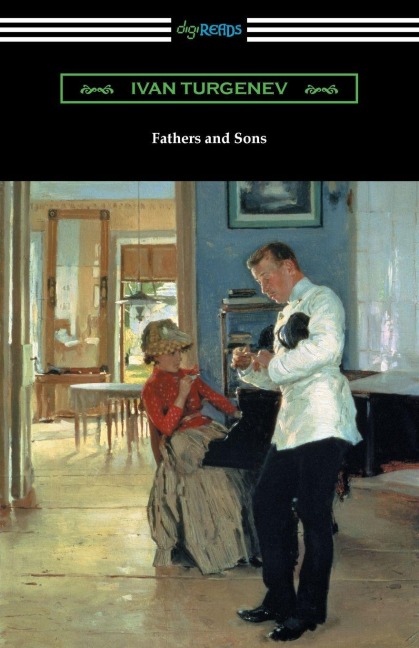
First published in 1862, Ivan Turgenev's "Fathers and Sons" is widely considered to be the author's greatest literary achievement. It is a novel about the clash of ideologies of two generations. The older generation, the fathers, represents an upper class whose power and influence is fading and giving way to the younger generation, the sons, who represent an increasing objection to the status quo. This conflict is embodied in the characters of Arkady Nikolaevich Kirsanov and Yevgeny Vasilevich Bazarov, two friends who have meet as students at St. Petersburg University. Arkady has recently graduated and has returned home to his father's small estate in an outlying province of Russia bringing his friend Yevgeny with him. What follows is uneasiness amongst the family when Arkady and Yevgeny's nihilistic views begin to emerge and are shown in conflict with the older generations more traditional views. "Fathers and Sons" is a brilliant work that captures the tension that existed among generations and class in the years leading up to the revolution in Russia. This edition is printed on premium acid-free paper and follows the translation of Constance Garnett.
Ivan Turgenev was born on 9th November 1818 to noble and wealthy parents in Oryol, Russia. His father a Colonel in the Russian Cavalry and his mother came from the nobel Lutovinov house of the Oryol Governorate. Turgenev spent the majority of his younger life in Moscow with his two younger brothers, where he was brought up having a proper education. Turgenev started out university life at the university of Moscow in 1833, before moving to the University of St Petersburg to study Classic Russian Literature and philology between 1834 to 1837, it was during this time Turgenev started to write poetry. Whilst he was studying there he would lose his father to kidney stoney disease and his youngest brother to epilepsy.From 1838 to 1841, Turgenev studied philosophy and history at the university of Berlin before finishing his master in St Petersburg. Unable to get a professorship at St Petersburg University, Turgenev ventured into the world of politics and government where he spent two years between 1843 and 1845 at the Russian Ministry of Interior. Here he would continue to write poetry before venturing into play writing with 'The Rash Thing To Do', in 1843. Though he never married, Turgenev did have a love with the well renowned Spanish singer Pauline Viardot. Though this relationship would only be a platonic one, the two would become close friends exchanging letters with Viardot helping Turgenev later on in life. Turgenev was known to have many love affairs with his family servants, with one of these love affairs in 1842 leading to the birth of his illegitimate daughter Paulinette. Turgenev would later entrust his dear friend Viardot to bring-up his daughter Paulinette. Turgenev's writing career began in the 1840's, writing long poems before transitioning into plays, novels and short stories. Unlike a lot of writers of the time Turgenev's works shied away from the religious influences of the time and preferred to revolve his work around the political and social issues of Russia during the 1800's. This would come and haunt him when he wrote his greatest novel 'Father and Sons' in 1862, where it was given a hostile reaction by the Russian audience leading him to go into self-exile. This self-exile first sent Turgenev to Germany but at the outbreak of the Franco-German war in 1870, he moved to London and then Paris, where he would settle. Turgenev's final piece of word was a short story called 'The Mysterious tales' in 1883, later that year he would die at the age of 64 on the 3rd September 1883 in Bougival, France. His body was then transported back to St Petersburg where he was buried in Volkovo Cemetery.