Stöbern
genialokal zum Startbildschirm hinzufügen
Installieren Sie die genialokal App auf Ihrem Startbildschirm für einen schnellen Zugriff und eine komfortable Nutzung.
Installieren Sie die genialokal App auf Ihrem Startbildschirm für einen schnellen Zugriff und eine komfortable Nutzung.
Tippen Sie einfach auf Teilen:
 Und dann auf "Zum Home-Bildschirm [+]".

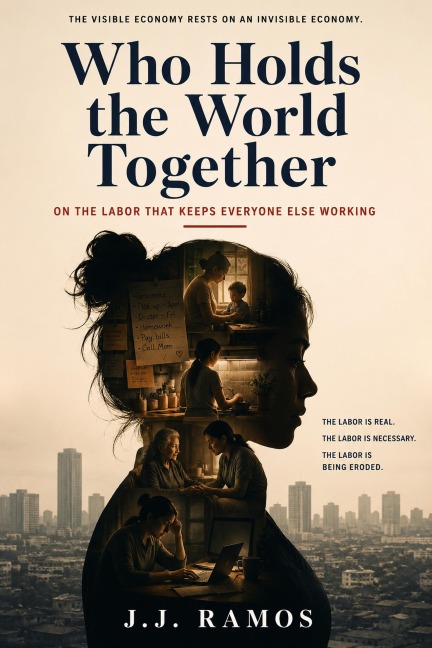

There is a labor that does not appear in the productivity statistics. It begins before the visible workday begins. It includes the dressing of children, the calling of an aging parent's doctor, the texting of the sibling whose marriage is wobbling, the cognitive list of what the household needs, the emotional repair after a conflict, the network maintenance that keeps a family or a community from quietly dissolving. It is performed disproportionately by women. It is structurally necessary for everything else. And in 2026, it is being eroded faster than anything is replacing it. In Who Holds the World Together, J.J. Ramos refuses both the sentimental register (women are naturally suited to this work) and the resentful register (women have been tricked into doing this work and should refuse it). She describes the labor honestly: what it is, who does it, what it costs the bodies that perform it, and what would have to change for the work to be sustainable. The book is in four parts. Part I unpacks what care actually is, traces why GDP and the national-income accounts have systematically failed to measure it (Simon Kuznets's 1934 exclusions, Marilyn Waring's 1988 intervention), and maps the gender, race, and immigration patterns of who performs the labor globally. Part II is a field guide to four kinds of maintenance work: child care, elder care, the mental load, and the relational repair work that holds family and friend networks together. Part III names the costs: the documented health, career, and retirement scars on long-term caregivers; the present-tense care-worker shortage and childcare-cost crisis; what happens to families, workplaces, and communities when the labor finally stops being absorbed; and an honest diagnosis of why both pure markets and pure state-provision approaches have failed. Part IV proposes the constructive program: measurement reform (household satellite accounts), financing (paid family leave, universal childcare on the Quebec/French model, eldercare infrastructure, care-worker organizing), and the household-level renegotiation that the Swedish father-quota reforms have shown is possible at scale. Drawing on Marilyn Waring, Arlie Hochschild, Joan Tronto, Nancy Folbre, Ai-jen Poo, Eve Rodsky, Allison Daminger, and the documented care-economy literature, Ramos gives the reader a vocabulary for what she is already doing, walks through what the research shows about its costs, and connects the personal experience to the political program.
J.J. Ramos is a writer whose work examines feminism, technology, and the structures that shape modern life. She writes about power, identity, labor, and social change, with a particular interest in how emerging technologies are transforming longstanding questions about equality and human freedom. Her work bridges intellectual inquiry and everyday experience, exploring how broad cultural and technological shifts are felt in homes, workplaces, institutions, and relationships. Through clear and accessible prose, she seeks to make complex ideas visible and to illuminate the forces that often operate unnoticed beneath contemporary life.