
Stöbern
genialokal zum Startbildschirm hinzufügen
Installieren Sie die genialokal App auf Ihrem Startbildschirm für einen schnellen Zugriff und eine komfortable Nutzung.
Installieren Sie die genialokal App auf Ihrem Startbildschirm für einen schnellen Zugriff und eine komfortable Nutzung.
Tippen Sie einfach auf Teilen:
 Und dann auf "Zum Home-Bildschirm [+]".
Bei genialokal.de kaufen Sie online bei Ihrer lokalen, inhabergeführten Buchhandlung!
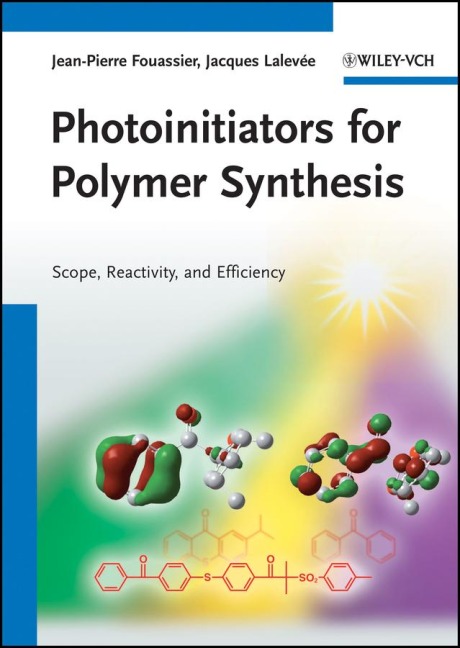
Photoinitiating systems for polymerization reactions are largely encountered in a variety of traditional and high-tech sectors, such as radiation curing, (laser) imaging, (micro)electronics, optics, and medicine. This book extensively covers radical and nonradical photoinitiating systems and is divided into four parts: * Basic principles in photopolymerization reactions * Radical photoinitiating systems * Nonradical photoinitiating systems * Reactivity of the photoinitiating system The four parts present the basic concepts of photopolymerization reactions, review all of the available photoinitiating systems and deliver a thorough description of the encountered mechanisms. A large amount of experimental and theoretical data has been collected herein. This book allows the reader to gain a clear understanding by providing a general discussion of the photochemistry and chemistry involved. The most recent and exciting developments, as well as the promising prospects for new applications, are outlined.
Jean-Pierre Fouassier was a Professor of Physical Chemistry at the University of Haute Alsace, Mulhouse until October 2011. He was Head of a University/CNRS Laboratory, a Member of the Organizing Committees of many International Conferences, a Director of the Ecole Nationale Supérieure de Chimie de Mulhouse and a Member of the French National University Council. His research interests focused both on the excited-state processes in photoinitiatiors and photosensitizers and their application to photopolymerization reactions in various areas. He has published a total of around 600 research articles, book chapters, review papers, technical papers, proceedings, and patents, as well as authoring one book, one technical report and editing 6 books (14 volumes).
Jacques Lalevée is a Professor of Physical Chemistry at the University of Haute Alsace, Mulhouse. His research interests are focused on free-radical chemistry and the design of efficient systems for photopolymerization processes. He has published a total of around 160 research articles, technical papers, proceedings, patents, review papers, and book chapters. He is also a Member of the Institut Universitaire de France (Paris).
INTRODUCTION PART I: Basic Principles and Applications of Photopolymerization Reactions PHOTOPOLYMERIZATION AND PHOTO-CROSS-LINKING LIGHT SOURCES Electromagnetic Radiation Characteristics of a Light Source Conventional and Unconventional Light Sources EXPERIMENTAL DEVICES AND EXAMPLES OF APPLICATIONS UV Curing Area: Coatings, Inks, Varnishes, Paints, and Adhesives Conventional Printing Plates Manufacture of Objects and Composites Stereolithography Applications in Microelectronics Laser Direct Imaging Computer-to-Plate Technology Holography Optics Medical Applications Fabrication of Nano-Objects through a Two-Photon Absorption Polymerization Photopolymerization Using Near-Field Optical Techniques Search for New Properties and New End Uses Photopolymerization and Nanotechnology Search for a Green Chemistry PHOTOPOLYMERIZATION REACTIONS Encountered Reactions, Media, and Experimental Conditions Typical Characteristics of Selected Photopolymerization Reactions Two-Photon Absorption-Induced Polymerization Remote Curing: Photopolymerization without Light Photoactivated Hydrosilylation Reactions PHOTOSENSITIVE SYSTEMS General Properties Absorption of Light by a Molecule Jablonski's Diagram Kinetics of the Excited State Processes Photoinitiator and Photosensitizer Absorption of a Photosensitive System Initiation Step of a Photoinduced Polymerization Reactivity of a Photosensitive System APPROACH OF THE PHOTOCHEMICAL AND CHEMICAL REACTIVITY Analysis of the Excited-State Processes Quantum Mechanical Calculations Cleavage Process Hydrogen Transfer Processes Energy Transfer Reactivity of Radicals EFFICIENCY OF A PHOTOPOLYMERIZATION REACTION Kinetic Laws Monitoring the Photopolymerization Reaction Efficiency versus Reactivity Absorption of Light by a Pigment Oxygen Inhibition Absorption of Light Stabilizers Role of the Environment PART II: Radical Photoinitiating Systems ONE-COMPONENT PHOTOINITIATING SYSTEMS Benzoyl-Chromophore-Based Photoinitiators Substituted Benzoyl-Chromophore-Based Photoinitiators Hydroxy Alkyl Heterocyclic Ketones Hydroxy Alkyl Conjugated Ketones Benzophenone- and Thioxanthone-Moiety-Based Cleavable Systems Benzoyl Phosphine Oxide Derivatives Phosphine Oxide Derivatives Trichloromethyl Triazines Biradical-Generating Ketones Peroxides Diketones Azides and Aromatic Bis-Azides Azo Derivatives Disulfide Derivatives Disilane Derivatives Diselenide and Diphenylditelluride Derivatives Digermane and Distannane Derivatives Carbon - Germanium Cleavable-Bond-Based Derivatives Carbon - Silicon and Germanium 'Silicon Cleavable' Bond-Based Derivatives Silicon Chemistry and Conventional Cleavable Photoinitiators Sulfur - Carbon Cleavable-Bond-Based Derivatives Sulfur - Silicon Cleavable-Bond-Based Derivatives Peresters Barton's Ester Derivatives Hydroxamic and Thiohydroxamic Acids and Esters Organoborates Organometallic Compounds Metal Salts and Metallic Salt Complexes Metal-Releasing Compound Cleavable Photoinitiators in Living Polymerization Oxyamines Cleavable Photoinitiators for Two-Photon Absorption Nanoparticle-Formation-Mediated Cleavable Photoinitiators Miscellaneous Systems Tentatively Explored UV-Light-Cleavable Bonds TWO-COMPONENT PHOTOINITIATING SYSTEMS Ketone-/Hydrogen-Donor-Based Systems Dye-Based Systems Other Type II Photoinitiating Systems MULTICOMPONENT PHOTOINITIATING SYSTEMS Generally Encountered Mechanism Other Mechanisms Type II Photoinitiator/Silane: Search for New Properties Miscellaneous Multicomponent Systems OTHER PHOTOINITIATING SYSTEMS Photoinitiator-Free Systems or Self-Initiating Monomers Semiconductor Nanoparticles Self-Assembled Photoinitiator Monolayers PART III: Nonradical Photoinitiating Systems CATIONIC PHOTOINITIATING SYSTEMS Diazonium Salts Onium Salts Organometallic Derivatives Onium Salt/Photosensitizer Systems Free-Radical-Promoted Cationic Photopolymerization Miscellaneous Systems Photosensitive Systems for Living Cationic Polymerization Photosensitive Systems for Hybrid Cure ANIONIC PHOTOINITIATORS Inorganic Complexes Organometallic Complexes Cyano Derivative/Amine System Photosensitive Systems for Living Anionic Polymerization PHOTOACID GENERATORS (PAG) SYSTEMS Iminosulfonates and Oximesulfonates Naphthalimides Photoacids and Chemical Amplification PHOTOBASE GENERATORS (PBG) SYSTEMS Oxime Esters Carbamates Ammonium Tetraorganyl Borate Salts N-Benzylated-Structure-Based Photobases Other Miscellaneous Systems Photobases and Base Proliferation Processes PART IV: Reactivity of the Photoinitiating System ROLE OF THE EXPERIMENTAL CONDITIONS IN THE PERFORMANCE OF A RADICAL PHOTOINITIATOR Role of Viscosity Role of the Surrounding Atmosphere Role of the Light Intensity REACTIVITY AND EFFICIENCY OF RADICAL PHOTOINITIATORS Relative Efficiency of Photoinitiators Role of the Excited-State Reactivity Role of the Medium on the Photoinitiator Reactivity Structure/Property Relationships in Photoinitiating Systems REACTIVITY OF RADICALS TOWARD OXYGEN, HYDROGEN DONORS, MONOMERS, AND ADDITIVES: UNDERSTANDING AND DISCUSSION Alkyl and Related Carbon-Centered Radicals Aryl Radicals Benzoyl Radicals Acrylate and Methacrylate Radicals Aminoalkyl Radicals Phosphorus-Centered Radicals Thiyl Radicals Sulfonyl and Sulfonyloxy Radicals Silyl Radicals Oxyl Radicals Peroxyl Radicals Aminyl Radicals Germyl and Stannyl Radicals Boryl Radicals Lophyl Radicals Iminyl Radicals Metal-Centered Radicals Propagating Radicals Radicals in Controlled Photopolymerization Reactions Radicals in Hydrosilylation Reactions REACTIVITY OF RADICALS: TOWARDS THE OXIDATION PROCESS Reactivity of Radicals toward Metal Salts Radical/Onium Salt Reactivity in Free-Radical-Promoted Cationic Photopolymerization INDEX
Dieses eBook wird im PDF-Format geliefert und ist mit einem Adobe Kopierschutz (DRM) versehen. Sie können dieses eBook mit allen Geräten lesen, die das PDF-Format und den Adobe Kopierschutz (DRM) unterstützen.
Zum Beispiel mit den folgenden Geräten:
• tolino Reader
Laden Sie das eBook direkt über den Reader-Shop auf dem tolino herunter oder übertragen Sie das eBook auf Ihren tolino mit einer kostenlosen Software wie beispielsweise Adobe Digital Editions.
• Sony Reader & andere eBook Reader
Laden Sie das eBook direkt über den Reader-Shop herunter oder übertragen Sie das eBook mit der kostenlosen Software Sony READER FOR PC/Mac oder Adobe Digital Editions auf ein Standard-Lesegeräte mit epub- und Adobe DRM-Unterstützung.
• Tablets & Smartphones
Möchten Sie dieses eBook auf Ihrem Smartphone oder Tablet lesen, finden Sie hier unsere kostenlose Lese-App für iPhone/iPad und Android Smartphone/Tablets.
• PC & Mac
Lesen Sie das eBook direkt nach dem Herunterladen mit einer kostenlosen Lesesoftware, beispielsweise Adobe Digital Editions, Sony READER FOR PC/Mac oder direkt über Ihre eBook-Bibliothek in Ihrem Konto unter „Meine eBooks“ - „online lesen“.
Schalten Sie das eBook mit Ihrer persönlichen Adobe ID auf bis zu sechs Geräten gleichzeitig frei.
Bitte beachten Sie, dass die Kindle-Geräte das Format nicht unterstützen und dieses eBook somit nicht auf Kindle-Geräten lesbar ist.