Und dann auf "Zum Home-Bildschirm [+]".

Stöbern
genialokal zum Startbildschirm hinzufügen
Installieren Sie die genialokal App auf Ihrem Startbildschirm für einen schnellen Zugriff und eine komfortable Nutzung.
Installieren Sie die genialokal App auf Ihrem Startbildschirm für einen schnellen Zugriff und eine komfortable Nutzung.
Ihr gewünschter Artikel ist in 0 Buchhandlungen vorrätig - wählen Sie hier eine Buchhandlung in Ihrer Nähe aus:

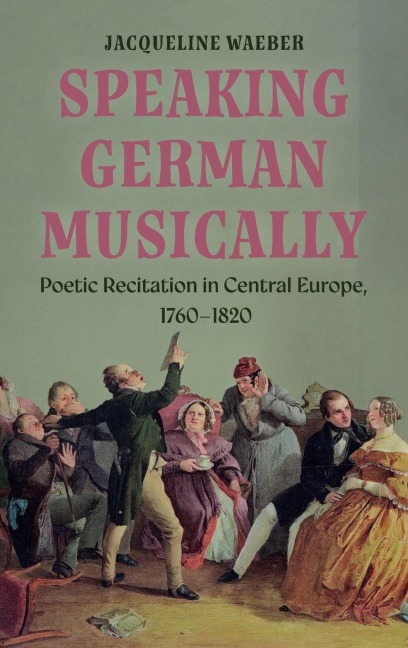
Shows how poetic recitation and the interweaving of music and poetry contributed to the advent of a German identity in late eighteenth- and early nineteenth-century Europe.
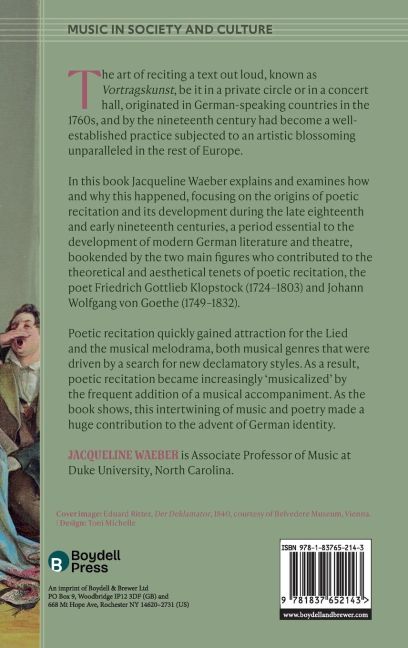
The art of reciting a text out loud, known as Vortragskunst, be it in a private circle or in a concert hall, originated in German-speaking countries in the 1760s, and by the nineteenth century had become a well-established practice subjected to an artistic blossoming unparalleled in the rest of Europe.
In this book Jacqueline Waeber explains and examines how and why this happened, focusing on the origins of poetic recitation and its development during the late eighteenth and early nineteenth centuries, a period essential to the development of modern German literature and theatre, bookended by the two main figures who contributed to the theoretical and aesthetical tenets of poetic recitation, the poet Friedrich Gottlieb Klopstock (1724-1803) and Johann Wolfgang von Goethe (1749-1832).
Poetic recitation quickly gained attraction for the Lied and the musical melodrama, both musical genres that were driven by a search for new declamatory styles. As a result, poetic recitation became increasingly 'musicalized' by the frequent addition of a musical accompaniment. As the book shows, this intertwining of music and poetry made a huge contribution to the advent of German identity through the reappraisal of its language.
JACQUELINE WAEBER is Associate Professor of Music at Duke University, North Carolina.
Introduction PART I 1. Re-evaluating German from Lessing to Klopstock 2. 'Germany's greatest bard' 3. On Wohlklang PART II 4. Italian poetic improvisation and the German tradition of occasional poetry 5. Pygmalion: Before and after 6. German versus French melodrama 7. Goethe's Proserpina PART III 8. From poetic recitation to Lied: The declamatorium as a missing link 9. Zumsteeg, Schubart, and the ballad: Poetic recitation and the demands of Sangbarkeit 10. J. F. Reichardt's Deklamationsstücke PART IV 11. Theorising declamation c. 1800 12. Unearthing Sprachmelodie 13. Epilogue: Reconciling Ton and Rhythmus Bibliography Index