
Stöbern
genialokal zum Startbildschirm hinzufügen
Installieren Sie die genialokal App auf Ihrem Startbildschirm für einen schnellen Zugriff und eine komfortable Nutzung.
Installieren Sie die genialokal App auf Ihrem Startbildschirm für einen schnellen Zugriff und eine komfortable Nutzung.
Tippen Sie einfach auf Teilen:
 Und dann auf "Zum Home-Bildschirm [+]".
Bei genialokal.de kaufen Sie online bei Ihrer lokalen, inhabergeführten Buchhandlung!
Ihr gewünschter Artikel ist in 0 Buchhandlungen vorrätig - wählen Sie hier eine Buchhandlung in Ihrer Nähe aus:

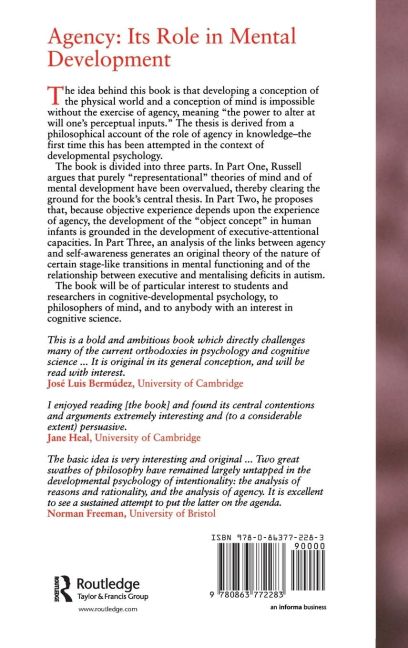
The idea behind this book is that developing a conception of the physical world and a conception of mind is impossible without the exercise of agency, meaning "the power to alter at will one's perceptual inputs". The thesis is derived from a philosophical account of the role of agency in knowledge - the first time this has been attempted in the context of developmental psychology. The book is divided into three parts. In Part One, Russell argues that purely "representational" theories of mind and of mental development have been overvalued, thereby clearing the ground for the book's central thesis. In Part Two, he proposes that, because objective experience depends upon the experience of agency, the development of the "object concept" in human infants is grounded in the development of executive-attentional capacities. In Part Three, an analysis of the links between agency and self-awareness generates an original theory of the nature of certain stage-like transitions in mental functioning and of the relationship between executive and mentalising deficits in autism. The book will be of particular interest to students and researchers in cognitive-developmental psychology, to philosophers of mind, and to anybody with an interest in cognitive science.
James Russell
Part 1 Symbols, Models and Connections. Symbol-Processing and "the language of thought". Mental Models. Connectionism. Why Connectionism is the Representational Theory Best Places to Model Action. "Working from the Outside in". Part 2 Knowledge of Objects Self-world Dualism and the Waterdown Piaget. The Four Features and the Experience of Agency. What the Four Features Give Us. Self-locating Thought and "Externatlity". Search, Dishabituation and "Representation Permanance" in Infancy. Answering Some Objections. Some Empirical Issues. Computational Modelling of Object Permanence. Part 3 Action and Our Knowledge of Minds. Mental Unity. Bodily- awareness, Selfhood and Ownership. Agency and the Acquisition of a "Theory of Mind". "Executive" Versus "Theory-theory" Accounts of Developmental Transitions - the 6-7 transition and the 3-4 Tranistion. Autism, Executive Dysfunctions and "Mind Blindness".