Und dann auf "Zum Home-Bildschirm [+]".

Stöbern
genialokal zum Startbildschirm hinzufügen
Installieren Sie die genialokal App auf Ihrem Startbildschirm für einen schnellen Zugriff und eine komfortable Nutzung.
Installieren Sie die genialokal App auf Ihrem Startbildschirm für einen schnellen Zugriff und eine komfortable Nutzung.

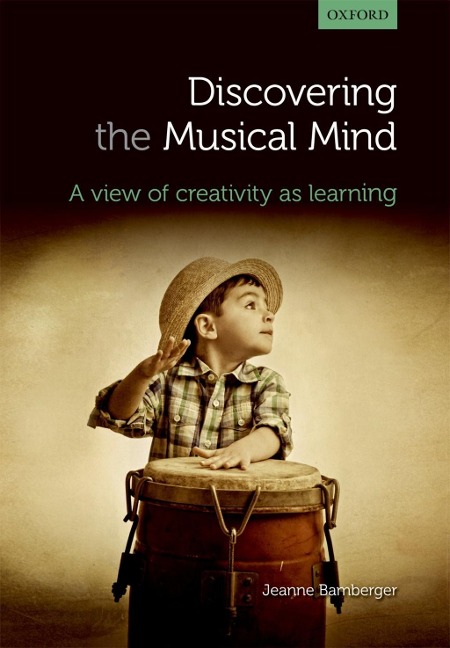
Following her distinguished earlier career as a concert pianist and later as a music theorist, Jeanne Bamberger conducted countless case studies analysing musical development and creativity the results of which were published in important scientific journals. Discovering musical mind draws together in one source these classic studies, offering the chance to revisit and reconsider some of her conclusions. Reviewing the data in light of current theories of cognitive development, she discusses how some of the conclusions she drew stand up to scrutiny, whilst in other cases, anomalies turn out to have greater significance than expected. The book is a collection of Bamberger's papers from 1975 to 2011. It includes her first study of Beethoven's original fingerings, her beginning work with children's invented notations, close observations and analysis of children in the Laboratory for Making Things, studies of musically gifted children, and the emergent musical development of students in elementary-secondary school and university undergraduate and graduate studies. The observations and research lead to the development of an interactive, computer-based music environment that uses her pragmatic theory of musical development as the basis for a project-oriented program for teaching and learning. Unlike other collections, the book is both interdisciplinary and strongly practical. It brings together and integrates Bamberger's background in music theory, research in music perception and music education, performance, cognitive development, artificial intelligence, and procedural music composition. Her multi-faceted approach to music theory and music pedagogy is guided throughout by her commitment to an understanding and respect for an individual's natural, creative musical intelligence. This natural competence becomes the formative ground on which to help people of all ages build an ever growing understanding and engagement with the evolving structures of the world's music. Bringing together a body of research currently scattered across a range of journals, or simply no longer available, the book will make fascinating reading for those in the fields of musical developmental and educational psychology.
Jeanne Bamberger is Emerita Professor of Music and Urban Education at the Massachusetts Institute of Technology, where she taught music theory and music cognition. She is currently Visiting Scholar in the Music Department at UC=Berkeley. Bamberger's research focuses on cognitive aspects of music perception, learning, and development. Her interdisciplinary stance leads her to investigations of learning in other related domains (e.g., cognitive psychology, computer science)and to an interest in young children and their teachers. She was a student of Artur Schnabel and Roger Sessions and has performed in the US and Europe as piano soloist and in chamber music ensembles. She attended the University of Minnesota, Columbia University and the University of California at Berkeley receiving degrees in philosophy and music theory.
- Part I: Beginnings - 1: Introduction: Where do our questions come from? Where do our answers go? - 2: The first invented notations: Designing the Class Piece - 3: Children's drawings of simple rhythms: A typology of children's invented notations - 4: The typology revisited - Part II: Developing the musical mind - 5: Introduction: What develops in music development? - 6: Restructuring conceptual intuitions through invented notations: From path-making to map-making - 7: Changing musical perception through reflective conversation - 8: Cognitive issues in the development of musically gifted children - 9: Developing musical structures: Going beyond the Simples - Part III: Designing educational environments - 10: Introduction: Designing educational environments - 11: Developing a musical ear: A new experiment - 12: Action knowledge and symbolic knowledge: The computer as mediator - 13: The collaborative invention of meaning: A short history of evolving ideas - 14: Noting Time: The Math, Music, and Drumming Project - Part IV Computer as Sandbox - 15: Turning music theory on its ear: Do we hear what we see; do we see what we say? - 16: The development of intuitive musical understanding: A natural experiment - 17: Music as embodied mathematics: A study of a mutually informing affinity - Part V: Summing Up - 18: Engaging complexity: Three hearings of a Beethoven Sonata movement - 19: Recapitulation and coda