Und dann auf "Zum Home-Bildschirm [+]".

Stöbern
genialokal zum Startbildschirm hinzufügen
Installieren Sie die genialokal App auf Ihrem Startbildschirm für einen schnellen Zugriff und eine komfortable Nutzung.
Installieren Sie die genialokal App auf Ihrem Startbildschirm für einen schnellen Zugriff und eine komfortable Nutzung.
Ihr gewünschter Artikel ist in 0 Buchhandlungen vorrätig - wählen Sie hier eine Buchhandlung in Ihrer Nähe aus:

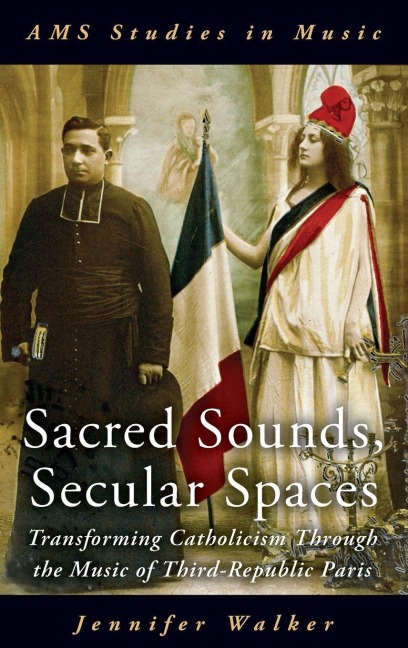
Military defeat, political and civil turmoil, and a growing unrest between Catholic traditionalists and increasingly secular Republicans formed the basis of a deep-seated identity crisis in Third Republic France. Beginning in the early 1880s, Republican politicians introduced increasinglysecularizing legislation to the parliamentary floor that included, but was not limited to, the secularization of the French educational system. As the divide between Church and State widened on the political stage, more and more composers began writing religious--even liturgical--music forperformance in decidedly secular venues, including popular cabaret theaters, prestigious opera houses, and international exhibitions. This trend coincided with Pope Leo XIII's Ralliement politics that encouraged conservative Catholics to rally with the Republican government. But the idea of amusical Ralliement has largely gone unquestioned by historians and musicologists alike. Sacred Sounds, Secular Spaces provides the first fundamental reconsideration of music's role in the relationship between the French state and the Catholic Church in the Third Republic. In doing so, the book dismantles the somewhat simplistic epistemological position that emphasizes a sharp divisionbetween the Church and the secular Republic during this period. Drawing on extensive archival research, critical reception studies, and musical analysis, author Jennifer Walker reveals how composers and critics from often opposing ideological factions undermined the secular/sacred binary throughcomposition and musical performance in an effort to craft a brand of Frenchness that was built on the dual foundations of secular Republicanism and the heritage of the French Catholic Church.
Jennifer Walker is Assistant Professor of Musicology in the School of Music at West Virginia University. Her research focuses on the relationship between sacred music and secular societies, and she is the author of several articles and essays that examine this subject in the context of nineteenth-century France. Her research has been funded by the American Council of Learned Societies and the American Musicological Society.
Introduction
Chapter 1: The Catholic Church in Republican Musical Aesthetics
Chapter 2: Pious Puppets and the Limits of Symbolism
Chapter 3: Sincerity and the Limits of Symbolism
Chapter 4: Saint-Eustache: The Republic's Sacred Cathedral
Chapter 5: The Trocadéro: The Republic's Secular Cathedral
Chapter 6: The Republic's Righteous Woman at the Opéra-Comique: Jules Massenet's Grisélidis
Conclusion
Appendix A: "Les grands oratorios à l'église Saint-Eustache": Programs
Appendix B: Jules Massenet's La Terre promise: Biblical References
Appendix C: Programs of the Ten concerts officiels at the 1900 Exposition Universelle
Bibliography
Index