Und dann auf "Zum Home-Bildschirm [+]".

Stöbern
genialokal zum Startbildschirm hinzufügen
Installieren Sie die genialokal App auf Ihrem Startbildschirm für einen schnellen Zugriff und eine komfortable Nutzung.
Installieren Sie die genialokal App auf Ihrem Startbildschirm für einen schnellen Zugriff und eine komfortable Nutzung.
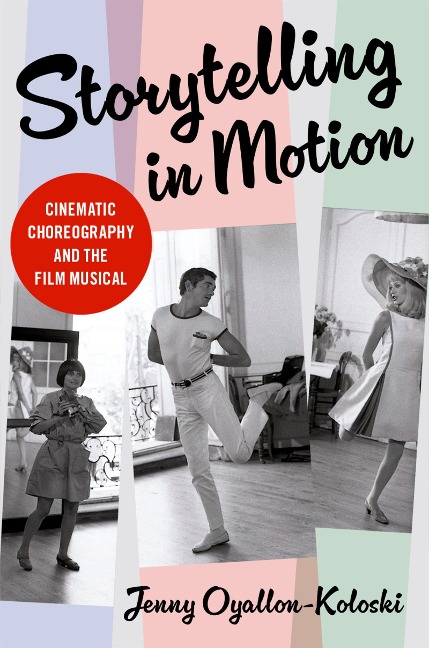
How do filmmakers guide viewer attention through the frame using the movement of bodies on screen? What do they seek to communicate with their cinematic choreography, and how were those choices shaped by the industrial conditions available to them? Storytelling in motion: Cinematic Choreography and the Film Musical demonstrates how figure movement can serve as a versatile strategy of meaning-making, particularly when filmmakers attend to the relationship between choreographed movement and film style. Using Franco-American film musicals as case studies, this book analyses the narrative and stylistic impact of figure movement in cinema and the subtle power of cinematic choreography, those moments when filmmakers deliberately combine the strengths of film style and organized figure movement to convey narrative meaning through motion. Cinematic choreography emphasizes musical conventions in Singin' in the Rain (Stanley Donen and Gene Kelly, 1952), prejudiced conflict in West Side Story (Jerome Robbins and Robert Wise, 1961), aesthetic play in Les Demoiselles de Rochefort (Jacques Demy, 1967), generic discomfort in Trois places pour le 26 (Jacques Demy, 1988), the politics of illness in Jeanne et le garçon formidable (Olivier Ducastel and Jacques Martineau, 1998), and decision-making in La La Land (Damien Chazelle, 2016). Integrating vocabularies and analytical systems from Laban/Bartenieff Movement Studies, film studies, and related fields to parse cinematic figure movement on multiple formal levels, this book uses performative research methods from videographic criticism to show the poetic and oblique connections between films through videographic as well as written chapters. Storytelling in Motion centers the crucial material conditions needed to make figure movement a significant component of narrative filmmaking: time, money, rehearsal space, industrial support, and performers and crew with the necessary embodied and institutional knowledge. The films discussed tell a clear story of how cinematic choreography was used by French and American filmmakers to innovate storytelling through figure movement, inspired by their predecessors' aesthetics while working within differing industrial conditions.
Jenny Oyallon-Koloski is an assistant professor of media and cinema studies at the University of Illinois Urbana-Champaign and a Certified Movement Analyst through the Laban/Bartenieff Institute of Movement Studies.
Dedication Acknowledgements Introduction Part I | Musical foundations Chapter 1 | Formal conventions and musical practices: Singin' in the Rain (1952) Chapter 2 | Seeing movement in cinema: An introduction to Laban Movement Analysis Chapter 3 | Agency, control, and space: West Side Story (1961) Part II | Musical eclecticism Chapter 4 | Minimalism and excess: Les Demoiselles de Rochefort (1967) Chapter 5 | Musical unease: Trois places pour le 26 (1988) Chapter 6 | Endless conversations: Reflexive musical clusters Part III | Musical realism Chapter 7 | Diegetic flutters: Views from the bridge Chapter 8 | Imperfect bodies: Jeanne et le garçon formidable (1998) Chapter 9 | Rhythmic realism: La La Land (2016) Appendix 1: Laban Movement Analysis cheat sheet Appendix 2: Analytical data References
Dieses eBook wird im PDF-Format geliefert und ist mit einem Adobe Kopierschutz (DRM) versehen. Sie können dieses eBook mit allen Geräten lesen, die das PDF-Format und den Adobe Kopierschutz (DRM) unterstützen.
Zum Beispiel mit den folgenden Geräten:
• tolino Reader
Laden Sie das eBook direkt über den Reader-Shop auf dem tolino herunter oder übertragen Sie das eBook auf Ihren tolino mit einer kostenlosen Software wie beispielsweise Adobe Digital Editions.
• Sony Reader & andere eBook Reader
Laden Sie das eBook direkt über den Reader-Shop herunter oder übertragen Sie das eBook mit der kostenlosen Software Sony READER FOR PC/Mac oder Adobe Digital Editions auf ein Standard-Lesegeräte mit epub- und Adobe DRM-Unterstützung.
• Tablets & Smartphones
Möchten Sie dieses eBook auf Ihrem Smartphone oder Tablet lesen, finden Sie hier unsere kostenlose Lese-App für iPhone/iPad und Android Smartphone/Tablets.
• PC & Mac
Lesen Sie das eBook direkt nach dem Herunterladen mit einer kostenlosen Lesesoftware, beispielsweise Adobe Digital Editions, Sony READER FOR PC/Mac oder direkt über Ihre eBook-Bibliothek in Ihrem Konto unter „Meine eBooks“ - „online lesen“.
Schalten Sie das eBook mit Ihrer persönlichen Adobe ID auf bis zu sechs Geräten gleichzeitig frei.
Bitte beachten Sie, dass die Kindle-Geräte das Format nicht unterstützen und dieses eBook somit nicht auf Kindle-Geräten lesbar ist.